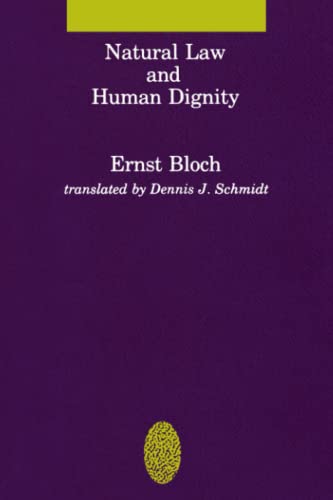

Natural law and human dignity / Ernst Bloch ; translated by Dennis J. Schmidt.
Idioma: engger Descripción: xxx, 323 pages ; 24 cmTipo de contenido:- text
- unmediated
- volume
- 9780262521291
- 171/.2 19
- K 460 .B5613 1986
| Imagen de cubierta | Tipo de ítem | Biblioteca actual | Biblioteca de origen | Colección | Ubicación en estantería | Signatura topográfica | Materiales especificados | Info Vol | URL | Copia número | Estado | Notas | Fecha de vencimiento | Código de barras | Reserva de ítems | Prioridad de la cola de reserva de ejemplar | Reservas para cursos | |
|---|---|---|---|---|---|---|---|---|---|---|---|---|---|---|---|---|---|---|
| Libro BET | Biblioteca Escuela de Teología Colección General BET | K 460 .B5613 1986 (Navegar estantería(Abre debajo)) | Disponible | 41000000006727 |
Descripciones mejoradas de Syndetics:
Ernst Bloch (1885-1977), one of the most original and influential of contemporary European thinkers and a founder of the Frankfurt School, has left his mark on a range of fields from philosophy and social theory to aesthetics and theology. Natural Law and Human Dignity, the first of his major works to appear in English is unique in its attempt to get beyond the usual oppositions between the natural law and social utopian traditions, providing basic insights on the question of human rights in a socialist society. Natural Law and Human Dignity is a sweeping yet synthetic work that critically reviews the great legal philosophies, from Plato to the present, in order to uncover and clarify the normative features of true socialism. Along the way it offers thoughtful reflections on topics as diverse as the abolition of poverty and degradation, the nature of the state, and the installation of freedom and dignity.Taking the idea of natural law as his guiding thread, Bloch argues that revolution and right, rather than being antagonistic, are fundamentally interconnected. With their emphasis on human dignity, the traditions of natural law have an irreplaceable contribution to make to the socialist vision of a more humane society. In his effort to wed the demands of law and right to the agenda of social revolution, Bloch offers a radical restructuring of our understanding of the social world. This rethinking of the fundamental principles of political philosophy is the product of a long personal and philosophical odyssey. Bloch lived as a writer in Munich, Bern, and Berlin until he was forced to emigrate to Czechoslovakia and then to the United States during World War 11. After the war he returned to East Germany, where he held a chair in philosophy at the University of Leipzig. He emigrated to the west as the Berlin Wall was being built (carrying the manuscript of this book under his arm), and he taught at the University of T#65533;bingen until his death. Natural Law and Human Dignity is included in the series Studies in Contemporary German Social Thought, edited by Thomas McCarthy.
Translation of: Naturrecht und menschliche Würde.
Includes index.
Overly Used -- It Is a Third Who Decides -- The First Opponents of Institutions -- On the Natural Law of Epicurus and the Stoics -- Stoic Doctrines and Roman Law -- The Relative Natural law of Thomas Aquinas and of Reformation -- The Ideal According to Relative Natural Law: Justice form Above -- Althaus, Hobbes, Grotius: Rationalized Natural Law and the New Edifice of the Law -- Once Again: Rationalist Natural law, Its Relation to Mathematical Construction and to Natural Religion -- Rousseau's Social Contract, the American Declaration of Independence, Human Rights -- Kant's and Fichte's Natural Law, Its Relation to Mathematical Construction and to Natural Religion -- On the Passion of Law within Positive Law (Kohlhaus and the Seriousness of Minos) -- Anselm Feuerbach, Savigny; The Fate of Rational Law in Schelling's Darker Nature -- Bachofen, Gaea-Themis, and Natural Law -- Confrontation: Gaea-Themis and Its Survival in the Collective Schools of Natural Law -- The Oath on the Styx, the Ambiguous Cosmos in Hegel's Philosophy of Right -- The Death and the Semblance of Life of a Late-Bourgeois Natural Law -- Aporias and the Heritage of the Tricolor: Liberty, Equality, Fraternity -- The Marxist Distance to Right and Even to Natural Right; the Problem of a Classless Quintessence of "The Upright Path" in Natural Right -- Subjective, Objective Right (Facultas, Agendi, Norma Agendi) in Their Bourgeois Opposition and in Their Classless Solution -- Right and Morality in Their Separation (Morality Instead of Natural Law), Classified According to Their Value -- Penal Law, Tragedy, and the Real Negation of Crime -- The Origin of the State, Public Law, Arcana Dominationis, and Its Opposite -- The Nationalized God and the Right to Community
Reseñas proporcionadas por Syndetics
Library Journal Review
An unconventional Marxist philosopher who left East Germany when the Berlin Wall was built, Bloch is perhaps closest to the Bernstein revisionist tradition which affirms a neo-Kantian ethic as the basis for Marxism. In a style influenced by Hegel, Bloch surveys the concepts of law and right from Plato to the present, rejecting positive law theorists and defending natural law. Since Bloch excludes any transcendent validation for natural law, he finds for it the practical rationale that it is essential to preserve the concept of human dignity which, in turn, is essential to the realization through socialism of a humane society. For academic collections on Marxism, German philosophy, and philosophy of law. Brent A. Nelson, Univ. of Arkansas, Technology Campus Lib., Little Rock (c) Copyright 2010. Library Journals LLC, a wholly owned subsidiary of Media Source, Inc. No redistribution permitted.CHOICE Review
For scholars who regard Ernst Bloch as a significant thinker, the publication of what the publisher calls the first of Bloch's major works to appear in English is a noteworthy event. The views of natural law theorists and social utopians are often thought to be in conflict. Bloch's book attempts (in a very roundabout way) to synthesize the two traditions, arguing that a true socialism needs to include a number of concepts found in natural law theory. Although reading Bloch is an acquired taste, his effort undoubtedly deserves study. As is typical of books of this sort, no bibliography is needed. The index is inadequate. This book does not appear to be a work that will be appreciated by many contemporary undergraduates. It is a more appropriate acquisition for libraries that support graduate courses in political and social theory.-R.H. Nash, Western Kentucky UniversityNotas de autor provistas por Syndetics
Ernst Bloch ranks as a major German Marxist philosopher. Beginning his career as author and teacher during World War I, he moved in the orbit of Marxist thought during the 1920s. In 1933 he left Germany and eventually found his way to the United States, where he created his major work The Principle of Hope. After World War II, he settled in East Germany, where from 1948 to 1957 he was professor at the University of Leipzig. His work eventually aroused the hostility of the authorities, and in 1961 he was granted political asylum in West Germany.Bloch departed from orthodox Marxism by attending to the problem of intellectual culture and refraining from treating it merely as superstructure determined by the materialist elements of political economy. Emphasizing the role of hope-as an inner drive, or hunger, in human beings-for a possible ideal future order, Bloch's thought may be described as utopian, involving the realization of a religious community akin to the kingdom of God, where people are no longer exploited but are free. Bloch's style echoes recent expressionism and is also rich in mystical overtones of biblical origin.
Bloch died in 1977.
(Bowker Author Biography)