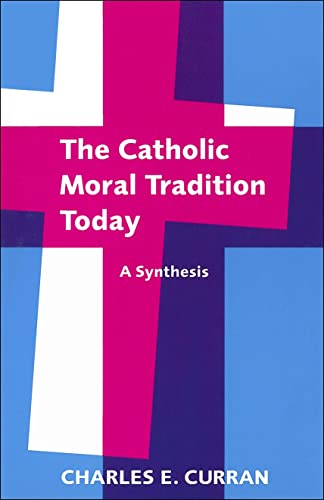

The Catholic moral tradition today : a synthesis / Charles E. Curran.
Descripción: xiii, 255 pages ; 23 cmTipo de contenido:- text
- unmediated
- volume
- 0878407170 (pbk. : alk. paper)
- 0878407162 (cloth : alk. paper)
- 241/.042 21 C9761 1999
- BJ 1249 .C79 1999
| Imagen de cubierta | Tipo de ítem | Biblioteca actual | Biblioteca de origen | Colección | Ubicación en estantería | Signatura topográfica | Materiales especificados | Info Vol | URL | Copia número | Estado | Notas | Fecha de vencimiento | Código de barras | Reserva de ítems | Prioridad de la cola de reserva de ejemplar | Reservas para cursos | |
|---|---|---|---|---|---|---|---|---|---|---|---|---|---|---|---|---|---|---|
| Libro BET | Biblioteca Escuela de Teología Colección General BET | 241.042 C9761 1999 (Navegar estantería(Abre debajo)) | Disponible | 41000000006289 |
Descripciones mejoradas de Syndetics:
The Catholic tradition has always tried to explain its theology in a coherent and systematic way, but the great changes and tensions existing within Catholic moral theology today have made it difficult to develop systematic approaches to what was once called fundamental moral theology. Now a leading scholar active in this field for forty years offers a synthesis of Catholic moral theology set in the context of the broader Catholic tradition and the significant developments that have occurred since the Second Vatican Council.
Charles E. Curran's succinct, coherent account of his wide-ranging work in Catholic moral theology points out agreements, disagreements, and changes in significant aspects of the Catholic moral tradition. His systematic approach explores major topics in a logical development: the ecclesiological foundation and stance of moral theology; the person as moral subject and agent; virtues, principles and norms; conscience and decision making; and the role of the church as a teacher of morality.
Curran's work condenses and organizes a large amount of material to show that the Catholic theological tradition is in dialogue with contemporary life and thought while remaining conscious of its rich history. Of great interest to theologians for its broad synthetic scope, this book is also a thorough introduction to the Catholic moral tradition for students and interested readers, including non-Catholics.
Includes bibliographical references and index.
Ecclesial Context -- Stance -- Model -- Person -- Virtues --Principles --Conscience -- Church Teaching
Tabla de contenidos provista por Syndetics
- Preface(p. ix)
- 1 Ecclesial Context(p. 1)
- What is the Church?(p. 2)
- Catholicity of the Church(p. 4)
- Mediation and Hierarchical Structure(p. 10)
- Catholic Practice(p. 14)
- Dangers in the Catholic Approach(p. 15)
- Contemporary Challenges to the Catholic Approach(p. 18)
- Notes(p. 25)
- 2 Stance(p. 30)
- Meaning of Stance(p. 30)
- Stance Based on the Fivefold Christian Mysteries(p. 33)
- The Stance and the Catholic Tradition(p. 34)
- Stance and Other Approaches(p. 45)
- Sources of Moral Theology(p. 47)
- Notes(p. 56)
- 3 Model(p. 60)
- The Deontological Model(p. 61)
- The Teleological Model(p. 66)
- Relationality-Responsibility Model(p. 73)
- The Relationality-Responsibility Model and Catholic Moral Theology Today(p. 77)
- Notes(p. 83)
- 4 Person(p. 87)
- Preliminary Considerations(p. 87)
- Discipleship(p. 89)
- Contemporary Theology and the Person(p. 91)
- Contemporary Spirituality and the Person(p. 93)
- Contemporary Moral Theology and the Person(p. 95)
- Social and Institutional Involvements of the Person(p. 98)
- Notes(p. 106)
- 5 Virtues(p. 110)
- Virtue in the Catholic Tradition(p. 111)
- General Virtues(p. 113)
- Particular Virtues(p. 118)
- Power(p. 130)
- Notes(p. 133)
- 6 Principles(p. 137)
- The Approach of the Hierarchical Magisterium(p. 138)
- Criticisms of the Hierarchical Approach(p. 144)
- Role of Principles and Norms(p. 160)
- Absolute Norms(p. 165)
- Notes(p. 166)
- 7 Conscience(p. 172)
- Preliminary Considerations(p. 172)
- The Catholic Moral Tradition(p. 174)
- Other Ways of Decision Making(p. 177)
- A Constructive Theory of Conscience and Decision Making(p. 181)
- Meaning of Sin(p. 190)
- The "Law of Growth"(p. 192)
- Notes(p. 194)
- 8 Church Teaching(p. 197)
- Total Church as Teacher(p. 197)
- The Hierarchical Teaching Office(p. 199)
- Justification of Dissent(p. 215)
- Present Situation(p. 221)
- Conclusion(p. 226)
- Notes(p. 228)
- Afterword(p. 235)
- Notes(p. 240)
- Index(p. 241)
Notas de autor provistas por Syndetics
Charles E. Curran is the Elizabeth Scurlock University Professor of Human Values at Southern Methodist University. He has served as president of three national societies: the American Theological Society, the Catholic Theological Society of America, and the Society of Christian Ethics. Curran has written or edited more than forty books, including T he Origins of Moral Theology in the United States (Georgetown University Press, 1997).