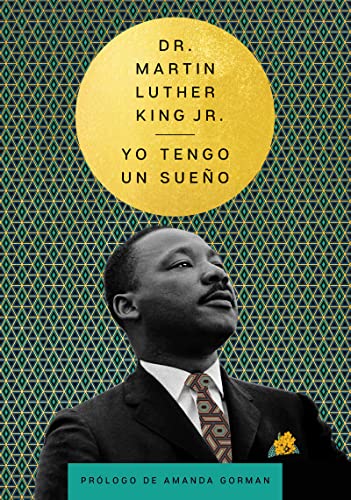

Yo tengo un sueño
HarperCollins Publishers 2022Tipo de contenido:- 9780063246881
| Imagen de cubierta | Tipo de ítem | Biblioteca actual | Biblioteca de origen | Colección | Ubicación en estantería | Signatura topográfica | Materiales especificados | Info Vol | URL | Copia número | Estado | Notas | Fecha de vencimiento | Código de barras | Reserva de ítems | Prioridad de la cola de reserva de ejemplar | Reservas para cursos | |
|---|---|---|---|---|---|---|---|---|---|---|---|---|---|---|---|---|---|---|
| Book (Oversize) bea | Biblioteca Mons. Iñaki Mallona (Arecibo) | Ej. | Disponible |
Descripciones mejoradas de Syndetics:
Presentamos la biblioteca Martin Luther King Jr.
Con un nuevo prólogo de Amanda Gorman.
Una hermosa edición coleccionable del legendario discurso del Dr. Martin Luther King Jr en la Marcha en Washington, parte de los archivos del Dr. King publicados exclusivamente por HarperCollins. El 28 de agosto de 1963, el Dr. Martin Luther King Jr. se presentó ante miles de estadounidenses que se habían reunido en el Lincoln Memorial en Washington, D.C. en nombre de los derechos civiles. Incluyendo las palabras inmortales, "Tengo un sueño", el discurso de apertura del Dr. King dinamizaría un movimiento y cambiaría el curso de la historia.
Con referencias al Discurso de Gettysburg, la Proclamación de Emancipación, la Declaración de Independencia, la Constitución de los Estados Unidos, Shakespeare y la Biblia, el discurso de la Marcha en Washington del Dr. King ha sido aclamado durante mucho tiempo como uno de los mejores escritos y oraciones de la historia.
Profundo y profundamente conmovedor, es tan relevante hoy como lo fue casi sesenta años antes.
Esta edición de tapa dura bellamente diseñada presenta el discurso del Dr. King en su totalidad, rindiendo homenaje a este líder extraordinario y su inconmensurable contribución, e inspirando a una nueva generación de activistas dedicados a continuar la lucha por la justicia y la igualdad.
Introducing the Martin Luther King Jr Library
With a New Foreword by Amanda Gorman
A beautiful collectible edition of Dr. Martin Luther King Jr's legendary speech at the March on Washington, laid out to follow the cadence of his oration--part of Dr. King's archives published exclusively by HarperCollins.
On August 28, 1963, Dr. Martin Luther King Jr. stood before thousands of Americans who had gathered at the Lincoln Memorial in Washington, D.C. in the name of civil rights. Including the immortal words, "I have a dream," Dr. King's keynote speech would energize a movement and change the course of history.
With references to the Gettysburg Address, the Emancipation Proclamation, the Declaration of Independence, the U.S. Constitution, Shakespeare, and the Bible, Dr. King's March on Washington address has long been hailed as one of the greatest pieces of writing and oration in history. Profound and deeply moving, it is as relevant today as it was nearly sixty years earlier.
This beautifully designed hardcover edition presents Dr. King's speech in its entirety, paying tribute to this extraordinary leader and his immeasurable contribution, and inspiring a new generation of activists dedicated to carrying on the fight for justice and equality.
Notas de autor provistas por Syndetics
Martin Luther King, Jr. was born on January 15, 1929 into a middle-class black family in Atlanta, Georgia. He received a degree from Morehouse College. While there his early concerns for social justice for African Americans were deepened by reading Henry David Thoreau's essay "Civil Disobedience." He enrolled in Crozer Theological Seminary and there became acquainted with the Social Gospel movement and the works of its chief spokesman, Walter Rauschenbusch. Mohandas Gandhi's practice of nonviolent resistance (ahimsaahimsa) later became a tactic for transforming love into social change.After seminary, he postponed his ministry vocation by first earning a doctorate at Boston University School of Theology. There he discovered the works of Reinhold Niebuhr and was especially struck by Niebuhr's insistence that the powerless must somehow gain power if they are to achieve what is theirs by right. In the Montgomery bus boycott, it was by economic clout that African Americans broke down the walls separating the races, for without African American riders, the city's transportation system nearly collapsed.
The bus boycott took place in 1954, the year King and his bride, Coretta Scott, went to Montgomery, where he had been called to serve as pastor of the Dexter Avenue Baptist Church. Following the boycott, he founded the Southern Christian Leadership Conference (SCLC) to coordinate civil rights organizations. Working through African American churches, activists led demonstrations all over the South and drew attention, through television and newspaper reports, to the fact that nonviolent demonstrations by blacks were being suppressed violently by white police and state troopers. The federal government was finally forced to intervene and pass legislation protecting the right of African Americans to vote and desegregating public accommodations. For his nonviolent activism, King received the Nobel Peace Prize in 1964.
While organizing a "poor people's campaign" to persuade Congress to take action against poverty, King accepted an invitation to visit Memphis, Tennessee, where sanitation workers were on strike. There, on April 4, 1968, he was gunned down while standing on the balcony of his hotel.
(Bowker Author Biography)