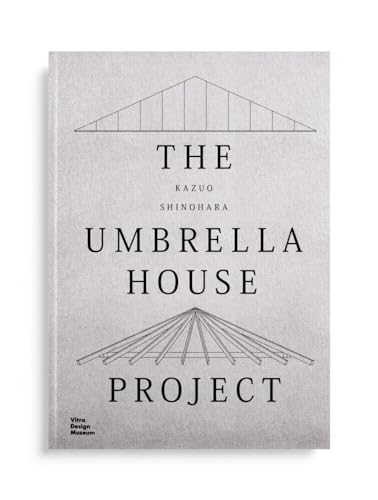

Kazuo Shinohara : the umbrella house project / edited by Christian Dehli, Andrea Grolimund. txt
Editor: Weil am Rhein : Vitra Design Museum, 2022Edición: First editionDescripción: 111 p. ; 9 unnumbered pages : ill. ; photo. col. ; 25 cmTipo de contenido:- text
- unmediated
- volume
- 9783945852552
- NA1559.S55 U43 2022
| Imagen de cubierta | Tipo de ítem | Biblioteca actual | Biblioteca de origen | Colección | Ubicación en estantería | Signatura topográfica | Materiales especificados | Info Vol | URL | Copia número | Estado | Notas | Fecha de vencimiento | Código de barras | Reserva de ítems | Prioridad de la cola de reserva de ejemplar | Reservas para cursos | |
|---|---|---|---|---|---|---|---|---|---|---|---|---|---|---|---|---|---|---|
| Libro Col. General CARIBET | CARIBET Biblioteca Arquitectura Colección General CARIBET | General NA1559.S55 U43 2022 (Navegar estantería(Abre debajo)) | 1 | Disponible | 91000000069955 |
Descripciones mejoradas de Syndetics:
The Umbrella House is the smallest residential home by Japanese architect and mathematician Kazuo Shinohara (1925-2006). This book tells the story of his unique masterpiece, which was first built in Tokyo in 1961. More than sixty years later, a stroke of good fortune made it possible to save the Umbrella House from demolition and move it to a new location, where it now stands on the Vitra Campus in Weil am Rhein (Germany). The wooden house's post-and-beam construction references traditional Japanese domestic and temple architecture. Experts from Japan and Europe supervised the dismantling of the house in Tokyo and its reassembly in Weil am Rhein.
The book traces the long journey of the Umbrella House in lavish illustrations including impressions from 1960s Japan, architectural designs and plans, and photographs that document its dismantling and reassembly or show the house in its new location. Texts by Ryue Nishizawa (SANAA), Shin-ichi Okuyama, and David B. Stewart discuss the Umbrella House against the background of Japanese architectural discourse between 1960 and the present.
"The strength of my conviction that A House is a Work of Art was born of the struggle with this small house. I wished to express the force of space contained in the doma [earthen-floor room] of an old Japanese farmhouse, this time by means of the geometric structural design of a karakasa [oiled-paper Japanese umbrella]." Kazuo Shinohara in a text on the Umbrella House published in October 1962 in the Japanese architecture journal Shinkenchiku (vol. 37, no. 10; first published in English in February 1963 in The Japan Architect, vol. 38, no. 2).
13 Introduction --
15 Umbrella House and the struggles of Kazuo Shinohara / Ryue Nishizawa --
31 Umbrella House / Kazuo Shinohara --
51 Plans --
57 Construction and reconstruction / Christian Dehli, Andrea Grolimund --
96 An architect's DNA revealed in a single work / Shin-ichi Okuyama, David B. Stewart --
109 Biography, Kazuo Shinohara, contributors --
110 Building facts --
111 Chronology Acknowledgements --
"Built in Tokyo in 1961, the Umbrella House is the smallest residential home created by Japanese architect and mathematician Kazuo Shinohara. More than 60 years later, a stroke of good fortune made it possible to save the Umbrella House from demolition and move it to a new location, where it now stands on the Vitra Campus in Weil am Rhein, Germany. The wooden house's post-and-beam construction references traditional Japanese domestic and temple architecture. Experts from Japan and Europe supervised the dismantling of the house in Tokyo and its reassembly in Weil am Rhein.This concise volume traces the long journey of the Umbrella House, in lavish illustrations including impressions from 1960s Japan, architectural designs and plans, and photographs documenting its dismantling and reassembly at its new location. Texts by Ryue Nishizawa (SANAA), Shin-ichi Okuyama and David B. Stewart discuss the Umbrella House against the background of Japanese architectural discourse between 1960 and the present.Kazuo Shinohara (1925-2006) was one of the greatest and most influential architects of Japan's postwar generation, forming what is now widely known as the Shinohara School alongside Toyo Ito, Kazunari Sakamoto and Itsuko Hasegawa. He was awarded the Architectural Institute of Japan's (AIJ) grand prize in 2005. In 2010 the Venice Biennale awarded a special commemorative Golden Lion in memory of Shinohara."--Amazon.com
Tabla de contenidos provista por Syndetics
- Introduction(13)
- Umbrella House And The Struggles Of Kazuo Shinohara(15)
- Umbrella House(31)
- Plans(51)
- Construction And Reconstruction(57)
- An Architect's Dna Revealed In A Single Work(96)
- Biography Kazuo Shinohara, Contributors(109)
- Building Facts(110)
- Chronology Acknowledgments(111)