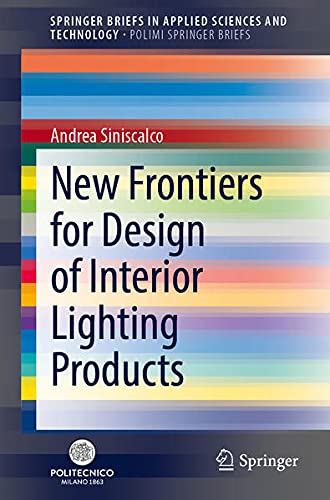
Imagen de portada de Amazon
Imagen de Amazon.com
Imagen de cubierta Syndetics
Portada de Syndetics
Imagen de OpenLibrary

New frontiers for design of interior lighting products / Andrea Siniscalco.

Por: Series SpringerBriefs in applied sciences and technology. PoliMI SpringerBriefs.Detalles de publicación: Cham, Switzerland : Springer, 2021.Descripción: 1 online resourceTipo de contenido:
  • text
Tipo de medio:
  • computer
Tipo de soporte:
  • online resource
ISBN:
  • 9783030757823
  • 303075782X
  • 9783030757830
  • 3030757838
Tema(s): Género/Forma: Formatos físicos adicionales: Print version:: Sin títuloClasificación CDD:
  • 621.32/2 23
Clasificación LoC:
  • TH7703
Recursos en línea:
Contenidos:
Intro -- Foreword -- Preface -- Intended Readership -- Book Content -- Acknowledgements -- Contents -- 1 Classification of Lighting Fixtures and Main Related Standards -- 1.1 Introduction -- 1.2 Classification by Photometric Distribution -- 1.3 CIE System -- 1.4 Classification by Type of Cut-off -- 1.5 Classification by Application -- 1.6 Classification by Installation Method -- 1.7 Classification According to Standards Requirements -- 1.7.1 Classification by Electrical Insulation -- 1.7.2 Ingress Protection Classification -- 1.7.3 LED Product Performance Standard
1.7.4 Blue Light Hazard and Photobiological Safety -- 1.8 The Standardisation Bodies -- 1.8.1 IEC: International Electrotechnical Commission -- 1.8.2 CENELEC: Comit�e Europ�een de Normalization en �Electronique et en �Electrotechnique -- 1.9 CE Marking: Directives for Lighting Fixtures in the European Community -- 1.9.1 The Restriction of the Use of Certain Hazardous Substances in Electrical and Electronic Equipment (Directive 2011/65/EU) -- 1.9.2 Ecodesign Requirements for Energy-Related Products (Directive 2009/125/EC)
1.9.3 Electrical Equipment Designed for Use Within Certain Voltage Limits (Directive 2006/95/EC and Directive 2014/35/EU) -- 1.9.4 Electromagnetic Compatibility (Directive 2004/108/EC and Directive 2014/30/EU) -- 1.9.5 Energy Labelling (Directive 2010/30/EU) -- References -- 2 Light Sources -- 2.1 Introduction -- 2.2 Basic Notions -- 2.3 LED -- 2.3.1 Principle of Operation -- 2.3.2 Semiconductors -- 2.3.3 The P-N Junction -- 2.3.4 The Substrate -- 2.3.5 White Light with LEDs -- 2.3.6 The Binning -- 2.3.7 Classification of LEDs for Lighting -- 2.4 Future Scenarios -- 2.4.1 Quantum Dot Technology
2.4.2 Miniaturization -- 2.4.3 OLED -- References -- 3 Power Supply -- 3.1 Introduction -- 3.2 Parameters to Consider to Power the LEDs -- 3.2.1 Voltage (V) and Current (I) -- 3.2.2 Reverse Biasing -- 3.2.3 Junction Temperature -- 3.2.4 Footprint and Layout -- 3.3 LED Driving -- 3.3.1 Discrete Components -- 3.3.2 Linear Regulators -- 3.3.3 Switching Mode Drivers -- References -- 4 Thermal Dissipation -- 4.1 Introduction -- 4.2 Basic Notions -- 4.2.1 LED Life -- 4.2.2 Heat Transfer -- 4.3 LED Dissipation -- 4.3.1 Calculation Example -- 4.4 Components to Consider in the Cooling Process
4.4.1 Printed Circuit Board (PCB) -- 4.4.2 Thermal Interface Material (TIM) -- 4.4.3 Housing -- 4.4.4 Heatsinks -- 4.5 Computational Fluid Dynamics Software -- References -- 5 An Overview on Controls -- 5.1 Introduction: Products for Well-Being -- 5.2 Classic Communication Systems for Light Control -- 5.3 Sensors for Control -- 5.4 IPS and IoT in the Interior Design -- 5.5 IPS Open Source -- 5.6 Smart Lighting Controls -- 5.7 Research on Light Control Strategies -- 5.8 Commercial Control Systems -- 5.9 DIY and Smart Lighting -- References -- 6 Optical Systems -- 6.1 Introduction
Resumen: This book explores the single components that commonly constitute luminaires for interiors, describing their operating principles, families, strengths and weaknesses. It opens with the product classification and main standard requirements. The following chapters describe the different components: light sources, power supplies, thermal dissipation techniques, control technologies, optical systems. The description focuses on the most recent technologies to allow the reader to consider a product design capable of confronting future lighting scenarios. The book provides a simple path addressed to all those who want to try their hand at designing luminaires for interiors, even without a specific engineering background.
Valoración
    Valoración media: 0.0 (0 votos)
No hay ítems correspondientes a este registro

This book explores the single components that commonly constitute luminaires for interiors, describing their operating principles, families, strengths and weaknesses. It opens with the product classification and main standard requirements. The following chapters describe the different components: light sources, power supplies, thermal dissipation techniques, control technologies, optical systems. The description focuses on the most recent technologies to allow the reader to consider a product design capable of confronting future lighting scenarios. The book provides a simple path addressed to all those who want to try their hand at designing luminaires for interiors, even without a specific engineering background.

Includes bibliographical references.

Online resource; title from PDF title page (SpringerLink, viewed June 4, 2021).

Intro -- Foreword -- Preface -- Intended Readership -- Book Content -- Acknowledgements -- Contents -- 1 Classification of Lighting Fixtures and Main Related Standards -- 1.1 Introduction -- 1.2 Classification by Photometric Distribution -- 1.3 CIE System -- 1.4 Classification by Type of Cut-off -- 1.5 Classification by Application -- 1.6 Classification by Installation Method -- 1.7 Classification According to Standards Requirements -- 1.7.1 Classification by Electrical Insulation -- 1.7.2 Ingress Protection Classification -- 1.7.3 LED Product Performance Standard

1.7.4 Blue Light Hazard and Photobiological Safety -- 1.8 The Standardisation Bodies -- 1.8.1 IEC: International Electrotechnical Commission -- 1.8.2 CENELEC: Comit�e Europ�een de Normalization en �Electronique et en �Electrotechnique -- 1.9 CE Marking: Directives for Lighting Fixtures in the European Community -- 1.9.1 The Restriction of the Use of Certain Hazardous Substances in Electrical and Electronic Equipment (Directive 2011/65/EU) -- 1.9.2 Ecodesign Requirements for Energy-Related Products (Directive 2009/125/EC)

1.9.3 Electrical Equipment Designed for Use Within Certain Voltage Limits (Directive 2006/95/EC and Directive 2014/35/EU) -- 1.9.4 Electromagnetic Compatibility (Directive 2004/108/EC and Directive 2014/30/EU) -- 1.9.5 Energy Labelling (Directive 2010/30/EU) -- References -- 2 Light Sources -- 2.1 Introduction -- 2.2 Basic Notions -- 2.3 LED -- 2.3.1 Principle of Operation -- 2.3.2 Semiconductors -- 2.3.3 The P-N Junction -- 2.3.4 The Substrate -- 2.3.5 White Light with LEDs -- 2.3.6 The Binning -- 2.3.7 Classification of LEDs for Lighting -- 2.4 Future Scenarios -- 2.4.1 Quantum Dot Technology

2.4.2 Miniaturization -- 2.4.3 OLED -- References -- 3 Power Supply -- 3.1 Introduction -- 3.2 Parameters to Consider to Power the LEDs -- 3.2.1 Voltage (V) and Current (I) -- 3.2.2 Reverse Biasing -- 3.2.3 Junction Temperature -- 3.2.4 Footprint and Layout -- 3.3 LED Driving -- 3.3.1 Discrete Components -- 3.3.2 Linear Regulators -- 3.3.3 Switching Mode Drivers -- References -- 4 Thermal Dissipation -- 4.1 Introduction -- 4.2 Basic Notions -- 4.2.1 LED Life -- 4.2.2 Heat Transfer -- 4.3 LED Dissipation -- 4.3.1 Calculation Example -- 4.4 Components to Consider in the Cooling Process

4.4.1 Printed Circuit Board (PCB) -- 4.4.2 Thermal Interface Material (TIM) -- 4.4.3 Housing -- 4.4.4 Heatsinks -- 4.5 Computational Fluid Dynamics Software -- References -- 5 An Overview on Controls -- 5.1 Introduction: Products for Well-Being -- 5.2 Classic Communication Systems for Light Control -- 5.3 Sensors for Control -- 5.4 IPS and IoT in the Interior Design -- 5.5 IPS Open Source -- 5.6 Smart Lighting Controls -- 5.7 Research on Light Control Strategies -- 5.8 Commercial Control Systems -- 5.9 DIY and Smart Lighting -- References -- 6 Optical Systems -- 6.1 Introduction

Added to collection customer.56279.3

Compartir
logopucpr-y-vive

Contáctanos

¡Queremos saber de ti!

Tel. 787.841.2000 Ext. 1801

bibliotecavaldes@pucpr.edu

⁣Búscanos en las redes

© 2026 Desarrollado por Ignite Online • All Rights Reserved • Powered by Koha.