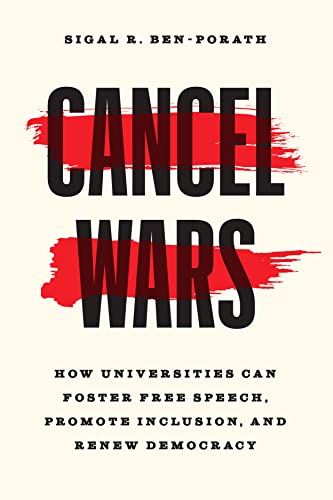
Imagen de portada de Amazon
Imagen de Amazon.com
Imagen de cubierta Syndetics
Portada de Syndetics
Imagen de OpenLibrary

Cancel wars : how universities can foster free speech, promote inclusion, and renew democracy / Sigal R. Ben-Porath.

Por: Editor: Chicago, Illinois : University of Chicago Press, 2023Descripción: 198 pagesTipo de contenido:
  • text
Tipo de medio:
  • unmediated
Tipo de soporte:
  • volume
ISBN:
  • 9780226823782
  • 9780226823805
Tema(s): Clasificación CDD:
  • 378.1/2130973 23/eng/20220608
Clasificación LoC:
  • LC72.2 .B464 2023
Otra clasificación:
  • EDU040000 | POL042020
Contenidos:
Polarized democracy -- Scientific truth, partisan facts, and knowledge we can share -- Do I belong here? Inclusion and harm -- Freedom of speech and habits of democracy in K-12 schools -- Campus speech and democratic renewal.
Resumen: "An even-handed exploration of the polarized state of campus politics that suggests ways for schools and universities to encourage discourse across difference. College campuses have become flashpoints of the current culture war and, consequently, much ink has been spilled over the relationship between universities and the cultivation or coddling of young American minds. Philosopher Sigal R. Ben-Porath takes head-on arguments that infantilize students who speak out against violent and racist discourse on campus or rehash interpretations of the First Amendment. Ben-Porath sets out to demonstrate the role of the university in American society and, specifically, how it can model free speech in ways that promote democratic ideals. In Cancel Wars, she argues that the escalating struggles over "cancel culture," "safe spaces," and free speech on campus are a manifestation of broader democratic erosion in the United States. At the same time, she takes a nuanced approach to the legitimate claims of harm put forward by those who are targeted by hate speech. Ben-Porath's focus on the boundaries of acceptable speech (and on the disproportional impact that hate speech has on marginalized groups) sheds light on the responsibility of institutions to respond to extreme speech in ways that proactively establish conversations across difference. Establishing these conversations has profound implications for political discourse beyond the boundaries of collegiate institutions. If we can draw on the truth, expertise, and reliable sources of information that are within the work of academic institutions, we might harness the shared construction of knowledge that takes place at schools, colleges, and universities against truth decay. Of interest to teachers and school leaders, this book shows that by expanding and disseminating knowledge, universities can help rekindle the civic trust that is necessary for revitalizing democracy."-- Provided by publisher.
Valoración
    Valoración media: 0.0 (0 votos)
Existencias
Imagen de cubierta Tipo de ítem Biblioteca actual Biblioteca de origen Colección Ubicación en estantería Signatura topográfica Materiales especificados Info Vol URL Copia número Estado Notas Fecha de vencimiento Código de barras Reserva de ítems Prioridad de la cola de reserva de ejemplar Reservas para cursos
Libro Biblioteca Encarnación Valdés Colección General bev 378.1213 B4564c (Navegar estantería(Abre debajo)) Disponible 80000002656109
Total de reservas: 0

Descripciones mejoradas de Syndetics:

An even-handed exploration of the polarized state of campus politics that suggests ways for schools and universities to encourage discourse across difference.


College campuses have become flashpoints of the current culture war and, consequently, much ink has been spilled over the relationship between universities and the cultivation or coddling of young American minds. Philosopher Sigal R. Ben-Porath takes head-on arguments that infantilize students who speak out against violent and racist discourse on campus or rehash interpretations of the First Amendment. Ben-Porath sets out to demonstrate the role of the university in American society and, specifically, how it can model free speech in ways that promote democratic ideals.


In Cancel Wars , she argues that the escalating struggles over "cancel culture," "safe spaces," and free speech on campus are a manifestation of broader democratic erosion in the United States. At the same time, she takes a nuanced approach to the legitimate claims of harm put forward by those who are targeted by hate speech. Ben-Porath's focus on the boundaries of acceptable speech (and on the disproportional impact that hate speech has on marginalized groups) sheds light on the responsibility of institutions to respond to extreme speech in ways that proactively establish conversations across difference. Establishing these conversations has profound implications for political discourse beyond the boundaries of collegiate institutions. If we can draw on the truth, expertise, and reliable sources of information that are within the work of academic institutions, we might harness the shared construction of knowledge that takes place at schools, colleges, and universities against truth decay. Of interest to teachers and school leaders, this book shows that by expanding and disseminating knowledge, universities can help rekindle the civic trust that is necessary for revitalizing democracy.

Includes bibliographical references and index.

Polarized democracy -- Scientific truth, partisan facts, and knowledge we can share -- Do I belong here? Inclusion and harm -- Freedom of speech and habits of democracy in K-12 schools -- Campus speech and democratic renewal.

"An even-handed exploration of the polarized state of campus politics that suggests ways for schools and universities to encourage discourse across difference. College campuses have become flashpoints of the current culture war and, consequently, much ink has been spilled over the relationship between universities and the cultivation or coddling of young American minds. Philosopher Sigal R. Ben-Porath takes head-on arguments that infantilize students who speak out against violent and racist discourse on campus or rehash interpretations of the First Amendment. Ben-Porath sets out to demonstrate the role of the university in American society and, specifically, how it can model free speech in ways that promote democratic ideals. In Cancel Wars, she argues that the escalating struggles over "cancel culture," "safe spaces," and free speech on campus are a manifestation of broader democratic erosion in the United States. At the same time, she takes a nuanced approach to the legitimate claims of harm put forward by those who are targeted by hate speech. Ben-Porath's focus on the boundaries of acceptable speech (and on the disproportional impact that hate speech has on marginalized groups) sheds light on the responsibility of institutions to respond to extreme speech in ways that proactively establish conversations across difference. Establishing these conversations has profound implications for political discourse beyond the boundaries of collegiate institutions. If we can draw on the truth, expertise, and reliable sources of information that are within the work of academic institutions, we might harness the shared construction of knowledge that takes place at schools, colleges, and universities against truth decay. Of interest to teachers and school leaders, this book shows that by expanding and disseminating knowledge, universities can help rekindle the civic trust that is necessary for revitalizing democracy."-- Provided by publisher.

Extracto provisto por Syndetics

Can colleges and universities help heal a backsliding democracy? Some see these institutions as culprits in the demise of democracy and point to students' sensitivities or professors' ideologies as reasons to lose faith in their contributions. I suggest instead that higher education in all its variety, from the Ivy League to community colleges, is well situated and ready to take on the challenges democracy currently faces. This book considers the struggles over the boundaries of speech in order to make the case for the active role that institutions of higher education can take in bridging political divides and helping reverse the process of democratic decline. Colleges are laboratories in which democracy is learned, practiced, and enhanced. As students, instructors, and leaders in higher education pursue and disseminate knowledge - and work to create inclusive and engaged learning communities-- they seed democratic habits and practices. It is necessary to focus on the boundaries of speech on campus because of both the nature of work in higher education, where so much of the work involves speech, and the current state of democracy.  We can understand and begin to address some of the most pressing challenges to democracy by paying careful attention to struggles over truth and to disagreements over belonging and inclusion. These controversies have taken center stage at many college campuses in recent years, especially in debates over the regulation and protection of speech on campus. I argue that the challenges of campus speech are the result of contestations over broader societal fractures concerning truth and inclusion and that campuses need to, in most cases, address these challenges through efforts to engage across differences rather than as breaches to be corrected through regulation or punishment.  The boundaries of acceptable expression on a campus should be set by the mission of the institution, by the call to search for truth through shared work, and through the inclusion of diverse perspectives and voices in the process of inquiry.1 If a form of expression excludes some people on campus, it is the institution's responsibility to correct the outcomes of that speech. In the vast majority of cases, this does not mean censorship, firing, or "canceling" but rather other types of action taken by the institution to ensure that equity and continued dialogue are both preserved. In this way, speech remains robust while inclusion is reaffirmed and sustained. This is a modified version of the "more speech" response encouraged by Justice Louis Brandeis: it seeks to not simply encourage more speech but also to place the burden of expressing, supporting, and sometimes sponsoring more and better speech on the institution as part of its educational and democratic role.  College campuses have become flashpoints in the current culture war. In this book, I argue that the escalating struggles over "cancel culture," "safe spaces," and free speech on campus are a manifestation of broader democratic erosion in the United States. I take a closer look at how these tensions play out to illuminate a path toward revitalizing American democracy. In what follows, I consider the gray areas of permissible speech, taking a close look at their sources and offering solutions to the tensions they create. I situate open expression on campus within the broader polarization occurring in the political sphere to show that the fight over the future of democracy takes place in two battlegrounds: one revolving around truth, how to identify it, and how it is distorted; and the other around inclusion, exclusion, and "cancellation" from the public sphere. Taken together, tensions around truth and inclusion reshape the civic culture of contemporary democracies. Colleges and universities, along with K- 12 schools, are among the main arenas where these battles are fought, and they hold a key to surmounting the current democratic impasse.  Excerpted from Cancel Wars: How Universities Can Foster Free Speech, Promote Inclusion, and Renew Democracy by Sigal R. Ben-Porath All rights reserved by the original copyright owners. Excerpts are provided for display purposes only and may not be reproduced, reprinted or distributed without the written permission of the publisher.

Reseñas proporcionadas por Syndetics

CHOICE Review

This extended essay provides a way for quieting, or at least calming, the polarization that characterizes so much free speech and inquiry today. The idea is to offer, through a focus on civic education, respect for the value of exchanging ideas as an antidote to the hostility and tension that are now widespread features of public discourse: shouting down speakers, defending untruths and anti-science, and "cancelling" those whom some do not wish to hear. There is little doubt that "polarization, mistrust, and democratic erosion" beset the US (p. 115), and education is the route to a more civil polity. To reassert the value of civil discourse, Ben-Porath (Univ. of Pennsylvania) makes "trust" and "no harm" touchstones for judging the value of exchanges of ideas and political positions. Beyond what K--12 schooling can do, the responsibility rests in universities to instill in students, faculty, and staff a firmer support for the principles of free speech and inquiry. Though the author is on the side of the angels, the argument needs some case studies; it is very general from start to finish. It is not easy reading. Summing Up: Recommended. Graduate students, faculty, and professionals. --Joel T. Rosenthal, emeritus, SUNY at Stony Brook

Notas de autor provistas por Syndetics

Sigal R. Ben-Porath is professor of education, philosophy, and political science at the University of Pennsylvania and coauthor of Making Up Our Mind: What School Choice Is Really About published by the University of Chicago Press.

Compartir
logopucpr-y-vive

Contáctanos

¡Queremos saber de ti!

Tel. 787.841.2000 Ext. 1801

bibliotecavaldes@pucpr.edu

⁣Búscanos en las redes

© 2026 Desarrollado por Ignite Online • All Rights Reserved • Powered by Koha.