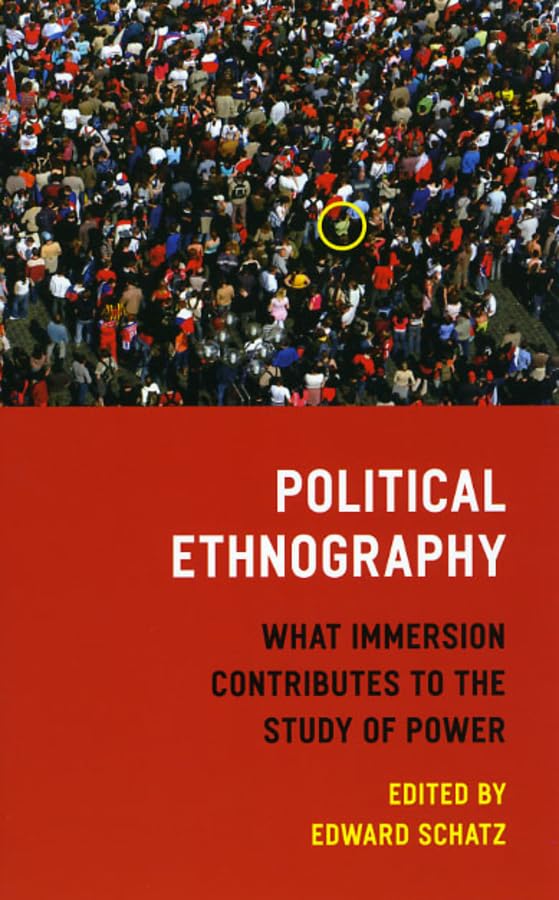

Political ethnography : what immersion contributes to the study of power / edited by Edward Schatz ; foreword by Myron J. Aronoff.
Detalles de publicación: Chicago ; London : The University of Chicago Press, 2009.Descripción: xiv, 361 p. ; 23 cmISBN:- 9780226736761 (cloth : alk. paper)
- 0226736768 (cloth : alk. paper)
- 9780226736778 (pbk. : alk. paper)
- 0226736776 (pbk. : alk. paper)
- 306.2 22
- GN492 .P655 2009
| Imagen de cubierta | Tipo de ítem | Biblioteca actual | Biblioteca de origen | Colección | Ubicación en estantería | Signatura topográfica | Materiales especificados | Info Vol | URL | Copia número | Estado | Notas | Fecha de vencimiento | Código de barras | Reserva de ítems | Prioridad de la cola de reserva de ejemplar | Reservas para cursos | |
|---|---|---|---|---|---|---|---|---|---|---|---|---|---|---|---|---|---|---|
| Libro | Biblioteca Encarnación Valdés Colección General bev | 306.2 S312p (Navegar estantería(Abre debajo)) | Lost and Paid For | 80000002496142 |
Descripciones mejoradas de Syndetics:
Scholars of politics have sought in recent years to make the discipline more hospitable to qualitative methods of research. Lauding the results of this effort and highlighting its potential for the future, Political Ethnography makes a compelling case for one such method in particular. Ethnography, the contributors amply demonstrate in a wide range of original essays, is uniquely suited for illuminating the study of politics.
Situating these pieces within the context of developments in political science, Edward Schatz provides an overarching introduction and substantive prefaces to each of the volume's four sections. The first of these parts addresses the central ontological and epistemological issues raised by ethnographic work, while the second grapples with the reality that all research is conducted from a first-person perspective. The third section goes on to explore how ethnographic research can provide fresh perspectives on such perennial topics as opinion, causality, and power. Concluding that political ethnography can and should play a central role in the field as a whole, the final chapters illuminate the many ways in which ethnographic approaches can enhance, improve, and, in some areas, transform the study of politics.
Includes bibliographical references and index.
Introduction: Ethnographic immersion and the study of politics / Edward Schatz -- Two traditions of political ethnography -- Ethnography of politics: foundations, applications, prospects / Jan Kubik -- How to tell an axe murderer: an essay on ethnography, truth, and lies / Jessica Allina-Pisano -- Ethnography as interpretive enterprise : first-person research / Lisa Wedeen -- When nationalists are not separatists: discarding and recovering academic theories while doing fieldwork in the Basque region of Spain / Cyrus Ernesto Zirakzadeh -- Ethnographic research in the shadow of civil war / Elisabeth Jean Wood -- The political in political ethnography: dispatches from the kill floor / Timothy Pachirat -- Ethnography's varied contributions -- Scholars as citizens: studying public opinion through ethnography / Katherine Cramer Walsh -- Ethnography and causality: sorcery and popular culture in the Congo / Michael G. Schatzberg -- The ethnographic sensibility: overlooked authoritarian dynamics and islamic ambivalences in west Africa / Cedric Jourde -- Participant-observation, politics, and power relations: Nicaraguan mothers and U.S casino waitresses / Lorraine Bayard de Volo -- Placing ethnography in the discipline -- Ethnography and the study of Latin American politics: an agenda for research / Enrique Desmond Arias -- When you can see the sky through your roof: policy analysis from the bottom up / Corey Shdaimah, Roland Stahl, and Sanford F. Schram -- Dear author, dear reader: the third hermeneutic in writing and reviewing ethnography / Dvora Yanow -- Conclusion / What kind(s) of ethnography does political science need? / Edward Schatz.
Tabla de contenidos provista por Syndetics
- Foreword
- Acknowledgments
- Introduction / Ethnographic Immersion and the Study of Politics
- Part I Two Traditions of Political Ethnography
- 1 Ethnography of Politics: Foundations, Applications, Prospects
- 2 How to Tell an Axe Murderer: An Essay on Ethnography, Truth, and Lies
- 3 Ethnography as Interpretive Enterprise
- Part II First-Person Research
- 4 When Nationalists Are Not Separatists: Discarding and Recovering Academic Theories While Doing Fieldwork in the Basque Region of Spain
- 5 Ethnographic Research in the Shadow of Civil War
- 6 The Political in Political Ethnography: Dispatches from the Kill Floor
- Part III Ethnography's Varied Contributions
- 7 Scholars as Citizens: Studying Public Opinion through Ethnography
- 8 Ethnography and Causality: Sorcery and Popular Culture in the Congo
- 9 The Ethnographic Sensibility: Overlooked Authoritarian Dynamics and Islamic Ambivalences in West Africa
- 10 Participant-Observation, Politics, and Power Relations: Nicaraguan Mothers and U.S. Casino Waitresses
- Part IV Placing Ethnography in the Discipline
- Enrique Desmond Arias
- 11 Ethnography and the Study of Latin American Politics: An Agenda for Research
- 12 When You Can See the Sky through Your Roof: Policy Analysis from the Bottom Up
- 13 Dear Author, Dear Reader: The Third Hermeneutic in Writing and Reviewing Ethnography
- Conclusion: What Kind(s) of Ethnography Does Political Science Need?
- Works Cited
- List of Contributors
- Index