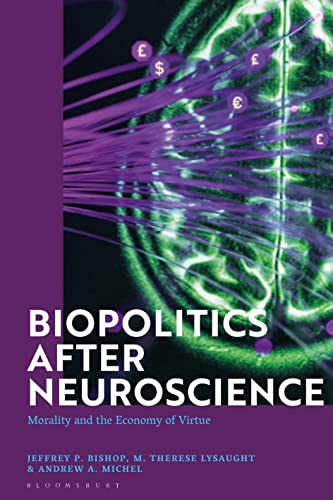

Biopolitics after neuroscience : morality and the economy of virtue / Jeffrey P. Bishop, M. Therese Lysaught and Andrew A. Michel.
Idioma: Inglés Editor: London ; New York : Bloomsbury Academic, 2022Descripción: 288 pagesTipo de contenido:- text
- unmediated
- volume
- 9781350288447
- 9781350288485
- 170 23
- BJ45.5 .B57 2022
| Imagen de cubierta | Tipo de ítem | Biblioteca actual | Biblioteca de origen | Colección | Ubicación en estantería | Signatura topográfica | Materiales especificados | Info Vol | URL | Copia número | Estado | Notas | Fecha de vencimiento | Código de barras | Reserva de ítems | Prioridad de la cola de reserva de ejemplar | Reservas para cursos | |
|---|---|---|---|---|---|---|---|---|---|---|---|---|---|---|---|---|---|---|
| Libro | Biblioteca Encarnación Valdés Colección General bev | 170 B6221b (Navegar estantería(Abre debajo)) | Disponible | 80000002495862 |
Descripciones mejoradas de Syndetics:
This book offers a provocative analysis of the neuroscience of morality. Written by three leading scholars of science, medicine, and bioethics, it critiques contemporary neuroscientific claims about individual morality and notions of good and evil. Winner of a 2021 prize from the Expanded Reason Institute, it connects moral philosophy to neoliberal economics and successfully challenges the idea that we can locate morality in the brain.
Instead of discovering the source of morality in the brain as they claim to do, the popularizers of contemporary neuroscience are shown to participate in an understanding of human behavior that serves the vested interests of contemporary political economy. Providing evidence that the history of claims about morality and brain function reach back 400 years, the authors locate its genesis in the beginnings of modern philosophy, science, and economics. They further map this trajectory through the economic and moral theories of Francis Bacon, David Hume, Jeremy Bentham, John Stuart Mill, and the Chicago School of Economics to uncover a pervasive colonial anthropology at play in the neuroscience of morality today.
The book concludes with a call for a humbler and more constrained neuroscience, informed by a more robust human anthropology that embraces the nobility, beauty, frailties, and flaws in being human.
Includes bibliographical references and index.
"This book offers a provocative analysis of the neuroscience of morality. Written by three leading scholars of science, medicine, and bioethics, it critiques contemporary neuroscientific claims about individual morality and notions of good and evil. Winner of a 2021 prize from the Expanded Reason Institute, it connects moral philosophy to neoliberal economics and successfully challenges the idea that we can locate morality in the brain. Instead of discovering the source of morality in the brain as they claim to do, the popularizers of contemporary neuroscience are shown to participate in an understanding of human behavior that serves the vested interests of contemporary political economy. Providing evidence that the history of claims about morality and brain function reach back 400 years, the authors locate its genesis in the beginnings of modern philosophy, science, and economics. They further map this trajectory through the economic and moral theories of Francis Bacon, David Hume, Jeremy Bentham, John Stuart Mill, and the Chicago School of Economics to uncover a pervasive colonial anthropology at play in the neuroscience of morality today. The book concludes with a call for a humbler and more constrained neuroscience, informed by a more robust human anthropology that embraces the nobility, beauty, frailties, and flaws in being human"--
Reseñas proporcionadas por Syndetics
CHOICE Review
Physician and theologian Bishop (Saint Louis Univ.), theological ethicist Lysaught (Loyola Univ. Chicago), and psychiatrist Michel (Belmont Univ.) collaborated on this exploration of how the views of human nature advocated by the 18th-century philosopher David Hume have influenced neoliberal economics, especially the work of Milton Friedman, and now dominate the social imaginary of contemporary neuroscience. Through a careful reading of both historical and contemporary sources, they show how some early modern philosophers pathologized the poor, hoping that poverty-induced hunger would force poor individuals to work. The authors' exploration of contemporary neuroscience literature shows that many studies have sought to establish that growing up in poverty leads to a lack of self-control and self-regulation. They note that many current neuroscientific studies evacuate rich conceptions of ethics to reduce human decisions to the avoidance of pleasure, or to make virtue out of the self-control necessary to flourish in a free market society. Finally, they call for richer conceptions of ethics to inform contemporary neuroscientific studies, including studies on how virtue can be cultivated. Despite traversing multiple fields of study, this text is clear and convincing, a provocative and illuminating read for advanced students of neuroscience as well as philosophy. Summing Up: Recommended. Upper-division undergraduates. Graduate students and professionals. --Aaron Wesley Klink, Duke UniversityNotas de autor provistas por Syndetics
Jeffrey P. Bishop is Professor of Philosophy and Professor of Theological Studies at Saint Louis University, USA, where he also holds the Tenet Endowed Chair in Bioethics.
M. Therese Lysaught is Professor at the Neiswanger Institute for Bioethics and Healthcare Leadership at Loyola University Chicago, Stritch School of Medicine, USA.
Andrew A. Michel is Associate Professor of Psychiatry at the Thomas F. Frist, Jr. College of Medicine at Belmont University, USA.