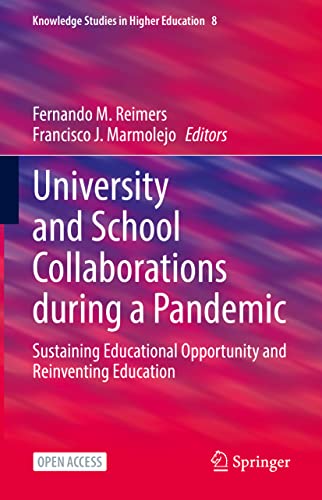

University and school collaborations during a pandemic: sustaining educational opportunity and reinventing education / Fernando M. Reimers and Francisco J. Marmolejo.
Idioma: Inglés Series Knowledge studies in higher education 8Springer, 2022 Cambridge, MA :Descripción: vii, 357 pages : illustrations (some color) ; 24 cmTipo de contenido:- text
- unmediated
- volume
- 9783030821586
- 23 378.1
| Imagen de cubierta | Tipo de ítem | Biblioteca actual | Biblioteca de origen | Colección | Ubicación en estantería | Signatura topográfica | Materiales especificados | Info Vol | URL | Copia número | Estado | Notas | Fecha de vencimiento | Código de barras | Reserva de ítems | Prioridad de la cola de reserva de ejemplar | Reservas para cursos | |
|---|---|---|---|---|---|---|---|---|---|---|---|---|---|---|---|---|---|---|
| Libro | Biblioteca Encarnación Valdés Colección General bev | 378.104 R363u (Navegar estantería(Abre debajo)) | Disponible | 80000002629247 |
Descripciones mejoradas de Syndetics:
Based on twenty case studies of universities worldwide, and on a survey administered to leaders in 101 universities, this open access book shows that, amidst the significant challenges caused by the COVID-19 pandemic, universities found ways to engage with schools to support them in sustaining educational opportunity. In doing so, they generated considerable innovation, which reinforced the integration of the research and outreach functions of the university.
The evidence suggests that universities are indeed open systems, in interaction with their environment, able to discover changes that can influence them and to change in response to those changes. They are also able, in the success of their efforts to mitigate the educational impact of the pandemic, to create better futures, as the result of the innovations they can generate. This challenges the view of universities as "ivory towers" being isolated from the surrounding environment and detached from local problems.
As they reached out to schools, universities not only generated clear and valuable innovations to sustain educational opportunity and to improve it, this process also contributed to transform internal university processes in ways that enhanced their own ability to deliver on the third mission of outreach.
Includes bibliographical references and index.
Chapter 1. Leading learning during a time of crisis. Higher education responses to the global pandemic of 2020.Chapter 2: Fundacao Getulio Vargas' Efforts to Improve Basic Education before, during and after the Pandemic.Chapter 3. Pontificia Universidad Catolica support for the school system during the Covid-19 pandemic in Chile.Chapter 4. Desafio TEP - Positive Educational Trajectories. A public-private alliance to strengthen public education during the Pandemic.Chapter 5. Reimagine Elementary and Secondary Learning during the Pandemic: A Case Study from Tsinghua University.Chapter 6. A Covid-19 response with years in the making: the contribution of EAFIT University to basic and secondary education in Colombia during the pandemic.Chapter 7. Coping with Covid-19: Forging Creative Pathways to Support Educational Continuity Amidst the Pandemic.Chapter 8. Case Study on Distance Learning for K-12 Education in Japan: The Nagasaki-Takaoka Model.Chapter 9. Benemerita Universidad Autonoma de Puebla BUAP. A transversal model to support educational continuity fostering resilience, innovation, and entrepreneurship.Chapter 10. Academic Continuity during the Covid-19 Global Health Emergency: Education 4.0 and the Flexible-Digital Model of Tecnologico de Monterrey University in Mexico Supporting Secondary Education. Chapter 11. University of Guadalajara: Transforming and innovating through stronger collaboration between higher and upper-secondary education during the pandemic.Chapter 12. University as State Agent or Social Actor: Al Akhawayn University and Social Responsibility. Chapter 13. Taking a strength-based approach: Bringing student homes into schools during a pandemic. Chapter 14. Supporting schools in times of crisis: a case of partnerships and networking with schools by the Institute of Education at the University of Lisbon.Chapter 15. Educational Continuity During the Covid-19 Pandemic at Qatar Foundation's MultiverCity.Chapter 16. Supporting elementary and secondary education during the pandemic: a case study from the National Research University Higher School of Economics.Chapter 17. Community building in times of pandemic. University Camilo Jose Cela. Spain.Chapter 18. University-K12 collaboration during the pandemic: The case of Turkey.Chapter 19. Arizona State University: A Learning Enterprise Supporting P-12 Education in the Covid-19 Pandemic.Chapter 20. MIT Full STEAM Ahead. Bringing project-based, collaborative learning to remote learning environments.Chapter 21. Initiatives to promote school-based mental health support by Department of Educational Sciences, University of Education under Vietnam National University.Chapter 22. Conclusions: what innovations resulted from university-school collaborations during the Covid-19 pandemic?.
Based on twenty case studies of universities worldwide, and on a survey administered to leaders in 101 universities, this open access book shows that, amidst the significant challenges caused by the COVID-19 pandemic, universities found ways to engage with schools to support them in sustaining educational opportunity.
Notas de autor provistas por Syndetics
Fernando M. Reimers is the Ford Foundation Professor of the Practice of International Education and Director of the Global Education Innovation Initiative and of the International Education Policy Masters Program at Harvard University. An expert in the field of Global Education, his research and teaching focus on understanding how to educate children and youth so they can thrive in the 21st century. He is a member of UNESCO's high level commission on the Futures of Education.Francisco C. Marmolejo is Higher Education President at Qatar Foundation (QF), where he leads QF's support and coordination activities to the unique ecosystem of eight prestigious universities offering in Education City in Doha, Qatar, more than 70 undergraduate and graduate programs to students from 60 countries. Previously (2012-20), he worked at the World Bank, where he served as the Global Higher Education Coordinator, based in Washington, DC., and more recently as Lead Higher Education Specialist for India and South Asia, based in New Delhi. From 1995 to 2012, he served as founding Executive Director of the Consortium for North American Higher Education Collaboration, a network of more than 160 universities mainly from Canada, USA and Mexico, based at the University of Arizona, where he also worked as Assistant Vice President, Affiliated Researcher at the Center for the Study of Higher Education, and Affiliate Faculty at the Center for Latin American Studies. Previously, he has been American Council on Education Fellow at the University of Massachusetts, Academic Vice President of the University of the Americas in Mexico, and International Consultant at OECD in Paris. He has received honorary doctorate degrees from his Alma Mater, the University of San Luis Potosi, and the University of Guadalajara in Mexico.