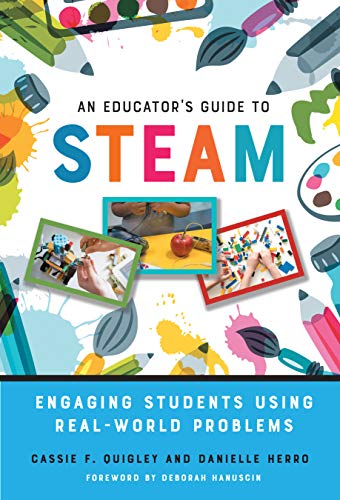

An educator's guide to STEAM : engaging students using real-world problems / Cassie F. Quigley, Danielle Herro ; foreword by Debi Hanuscin.
Editor: New York, NY : Teachers College Press, [2019]Descripción: xi, 153 pages : illustrations ; 24 cmTipo de contenido:- text
- unmediated
- volume
- 9780807761380 (pbk. : alk. paper)
- 9780807761717 (hbk.)
- Science -- Study and teaching (Elementary)
- Science -- Study and teaching (Middle school)
- Arts -- Study and teaching (Elementary)
- Arts -- Study and teaching (Middle school)
- Problem solving -- Study and teaching (Elementary)
- Problem solving -- Study and teaching (Middlle school)
- Interdisciplinary approach in education
- 372.35/044 23
- LB1585 .Q54 2019
| Imagen de cubierta | Tipo de ítem | Biblioteca actual | Biblioteca de origen | Colección | Ubicación en estantería | Signatura topográfica | Materiales especificados | Info Vol | URL | Copia número | Estado | Notas | Fecha de vencimiento | Código de barras | Reserva de ítems | Prioridad de la cola de reserva de ejemplar | Reservas para cursos | |
|---|---|---|---|---|---|---|---|---|---|---|---|---|---|---|---|---|---|---|
| Libro | Biblioteca Encarnación Valdés Colección General bev | 372.35044 Q65a (Navegar estantería(Abre debajo)) | Disponible | 80000002648775 |
Descripciones mejoradas de Syndetics:
This practical book will help readers understand what STEAM is, how it differs from STEM, and how it can be used to engage students in K-8 classrooms.
The authors present a conceptual model with recommendations and classroom examples illustrating various key aspects of STEAM teaching in action, including creating the correct teaching environment, integrating STEAM content, and supporting students as they develop STEAM-related skills. The model includes specific strategies such as problem-based learning, student choice, technology integration, and teacher facilitation . Each chapter incorporates elements of connected learning--a type of learning that draws on students' interests that teachers can capitalize on when using STEAM to address real-world problems.
Readers will find easy-to-understand examples of what STEAM education looks like in a variety of classrooms , and will hear from teachers, instructional coaches, principals, and administrators about what it takes to ensure that STEAM is a schoolwide success.
Book Features:
Straightforward guidance for creating STEAM instructional units for the K-8 classroom. A concise instructional model that addresses misconceptions about STEAM education. Extended vignettes demonstrating teaching practices, student learning, and school-community partnerships. Classroom examples of STEAM learning that rural, urban, traditional, and innovative schools can relate to and build on. Based on the authors' work with over 150 teachers and analysis of teachers' reflective journal entries, STEAM unit plans, classroom instruction, and more.Includes bibliographical references (pages 135-140) and index.
Introduction -- Conceptualizing steam -- Unpacking the conceptual model to guide STEAM teaching -- Visioning, planning, and supporting steam instruction in schools -- Making STEAM relevant to students -- Developing STEAM classrooms -- Understanding the role of teaching across the disciplines in STEAM teaching -- Valuing the a in STEAM -- Making STEAM work -- How to assess STEAM learning -- STEAM across different school settings -- Challenges to STEAM instruction.
Tabla de contenidos provista por Syndetics
- Foreword(p. ix)
- Acknowledgments(p. xi)
- Introduction: Grounding Our STEAM Work(p. 1)
- Our Entry into STEAM Education(p. 1)
- An Example of STEAM in Action(p. 2)
- The Purpose and Usefulness of this Book(p. 5)
- The Organization of the Book(p. 10)
- Part I Conceptualizing Steam
- 1 Unpacking the Conceptual Modal to Guide STEAM Teaching(p. 13)
- STEAM: Understanding the Rising Trend(p. 14)
- Exploring the STEAM Conceptual Model(p. 17)
- Examining the STEAM Conceptual Model Across Grade Levels(p. 26)
- Concluding Thoughts on the STEAM Conceptual Model(p. 28)
- 2 Visioning, Planning, and Supporting STEAM Instruction in Schools(p. 29)
- Visioning STEAM(p. 29)
- Understanding and Defining STEAM(p. 30)
- Building a Foundation for STEAM(p. 31)
- Visioning and Planning Across Grade Levels(p. 38)
- Concluding Thoughts: Common Questions and Answers About Transitioning to STEAM Education(p. 39)
- 3 Making STEAM Relevant to Students(p. 41)
- Exploring Ms. Andrus's Classroom(p. 41)
- Designing a STEAM Unit Around Interests(p. 42)
- Creating STEAM Problem Scenarios(p. 47)
- Involving the Community: Broadening Participation Through Mentors and Experts(p. 54)
- Making STEAM Relevant Across the Grade Levels(p. 57)
- Concluding Thoughts on Making STEAM Relevant(p. 58)
- Part II Developing Steam Classrooms
- 4 Understanding the Role of Teaching Across the Disciplines in STEAM Teaching(p. 61)
- Transdisciplinary Teaching and Learning(p. 61)
- Transdisciplinary Teaching in Action(p. 62)
- Connection to Components of the STEAM Conceptual Model(p. 64)
- Authentic Discipline Integration(p. 65)
- Connection to Authentic Tasks(p. 71)
- A Pathway for Multiple Methods to Solve the Problem(p. 73)
- Strategies to Support Transdisciplinary Teaching(p. 75)
- Transdisciplinary Teaching Across the Grade Levels(p. 76)
- Concluding Thoughts on Transdisciplinary Teaching(p. 78)
- 5 Valuing the A in STEAM(p. 79)
- The Continuum of Arts Integration(p. 80)
- The Value of Art in STEAM(p. 81)
- Art as the Backbone of Problem Solving(p. 82)
- Integration of Arts Across Grade Levels(p. 87)
- Concluding Thoughts on the A in STEAM(p. 89)
- Part III Making Steam Work
- 6 How to Assess STEAM Learning(p. 93)
- A Different Approach to Assessment(p. 93)
- Embedded Formative Assessment(p. 94)
- Authentic Summative Assessments(p. 100)
- Peer and Self-Assessment in STEAM(p. 103)
- STEAM Assessments Across Grade Levels(p. 105)
- Concluding Thoughts on STEAM Assessment(p. 107)
- 7 STEAM Across Different School Settings(p. 109)
- Context One: A New STEAM 5chool(p. 110)
- Context Two: A Traditional Middle School(p. 112)
- Context Three: An Existing 5chool Transitioning to STEAM(p. 114)
- The Key to STEAM Implementation: Remixing Education(p. 116)
- Supporting STEAM Across Grade Levels(p. 118)
- Concluding Thoughts on STEAM Implementation in Different Settings(p. 119)
- 8 Challenges to STEAM Instruction(p. 121)
- The Nature of Challenges with STEAM Education(p. 122)
- Solutions for STEAM Instructional Challenges(p. 127)
- Concluding Thoughts on Challenges in STEAM(p. 130)
- The Future of STEAM: A New Beginning for Educators?(p. 131)
- Revisiting STEAM Versus STEM(p. 131)
- Recognizing the Necessity of STEAM(p. 131)
- Moving Forward with STEAM Education(p. 132)
- Final Thoughts(p. 134)
- References(p. 135)
- Index(p. 141)
- About the Authors(p. 153)
Notas de autor provistas por Syndetics
Cassie F. Quigley is an associate professor of science education at the University of Pittsburgh.Danielle Herro is an associate professor of digital media and learning at Clemson University.