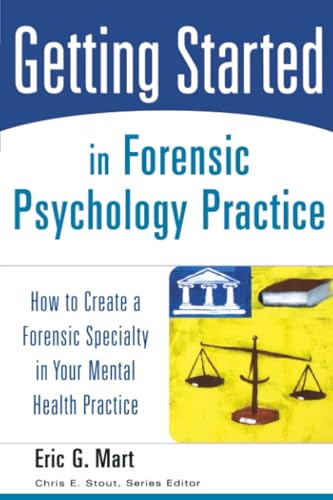

Getting started in forensic psychology practice : how to create a forensic specialty in your mental health practice / Eric G. Mart.
Series Getting started | Getting started inDetalles de publicación: Hoboken, N.J. : John Wiley & Sons, c2006.Descripción: xvi, 350 pages : illustrations ; 23 cmISBN:- 0471753130 (pbk. : alk. paper)
- 9780471753131 (pbk. : alk. paper)
- 614/.15 22
- RA1148 .M29 2006
| Imagen de cubierta | Tipo de ítem | Biblioteca actual | Biblioteca de origen | Colección | Ubicación en estantería | Signatura topográfica | Materiales especificados | Info Vol | URL | Copia número | Estado | Notas | Fecha de vencimiento | Código de barras | Reserva de ítems | Prioridad de la cola de reserva de ejemplar | Reservas para cursos | |
|---|---|---|---|---|---|---|---|---|---|---|---|---|---|---|---|---|---|---|
| Libro | Biblioteca de Mayagüez Colección General mb | RA1148 .M29 2006 (Navegar estantería(Abre debajo)) | c. 1 | Disponible | 50000003285011 |
Descripciones mejoradas de Syndetics:
All the tips and tools you need to start, grow, and sustain a successful forensic psychology practice
Getting Started in Forensic Psychology Practice is the first book of its kind aimed at those mental health professionals and recent graduates interested in entering the growing and lucrative field of forensic psychology. User-friendly and full of helpful tips, this handy guide provides you with tools and techniques for starting a thriving forensic psychology practice, or incorporating a forensic specialty into your current practice.
This comprehensive resource includes information on:
* The difference between clinical and forensic practice
* Advantages and disadvantages of forensic practice
* Preparing for forensic psychological practice
* Planning a forensic psychology business
* How to market your practice
* What lawyers look for in forensic psychologists as expert witnesses>
* Ethics, professional competence, and risk management issues
* Performing evaluations
* Testifying in court and depositions
In addition, Getting Started in Forensic Psychology Practice also features several helpful appendices that include sample evaluations and reports, as well as detailed discussions of child custody evaluation and assessment.
Covering everything from advice on how to dress for court to major concerns such as the problems of insanity defenses, Getting Started in Forensic Psychology Practice puts the best solutions and information at your fingertips. Whether you're a recent graduate or a seasoned practitioner, this invaluable resource will help you minimize the uncertainty of establishing your forensic practice while maximizing the rewards.
Includes bibliographical references (p. 337-340) and index.
What is forensic psychology? -- Is forensic practice for you? -- Preparing for forensic psychological practice -- The business of forensic psychology -- Risk management in forensic practice -- Performing evaluations -- Testifying in court and depositions.
All the tips and tools you need to start, grow, and sustain a successful forensic psychology practice. Getting Started in Forensic Psychology Practice is the first book of its kind aimed at those mental health professionals and recent graduates interested in entering the growing and lucrative field of forensic psychology. User-friendly and full of helpful tips, this handy guide provides you with tools and techniques for starting a thriving forensic psychology practice, or incorporating a forensic specialty into your current practice. This comprehensive resource includes information on:
* The difference between clinical and forensic practice
* Advantages and disadvantages of forensic practice
* Preparing for forensic psychological practice
* Planning a forensic psychology business
* How to market your practice
* What lawyers look for in forensic psychologists as expert witnesses>
* Ethics, professional competence, and risk management issues
* Performing evaluations
* Testifying in court and depositions
In addition, Getting Started in Forensic Psychology Practice also features several helpful appendices that include sample evaluations and reports, as well as detailed discussions of child custody evaluation and assessment. Covering everything from advice on how to dress for court to major concerns such as the problems of insanity defenses, Getting Started in Forensic Psychology Practice puts the best solutions and information at your fingertips. Whether you're a recent graduate or a seasoned practitioner, this invaluable resource will help you minimize the uncertainty of establishing your forensic practice while maximizing the rewards.
Tabla de contenidos provista por Syndetics
- Series Preface(p. xi)
- Acknowledgments(p. xiii)
- Introduction(p. xv)
- 1 What Is Forensic Psychology?(p. 1)
- 2 Is Forensic Practice for You?(p. 19)
- 3 Preparing for Forensic Psychological Practice(p. 59)
- 4 The Business of Forensic Psychology(p. 95)
- 5 Risk Management in Forensic Practice(p. 137)
- 6 Performing Evaluations(p. 195)
- 7 Testifying in Court and Depositions(p. 227)
- Appendix A ABPP Work Sample: Competency to Stand Trial Evaluation(p. 249)
- Appendix B Sample Psychological Report: Competency to Stand Trial Evaluation(p. 261)
- Appendix C ABPP Work Sample: Munchausen Syndrome by Proxy Evaluation(p. 267)
- Appendix D Sample Psychological Report: Munchausen Syndrome by Proxy Evaluation(p. 289)
- Appendix E The Concise Child Custody Evaluation(p. 303)
- Appendix F The Concise Approach to Child Custody Assessment(p. 313)
- Appendix G The Niche Practice in Forensic Psychology(p. 329)
- References(p. 337)
- Index(p. 341)