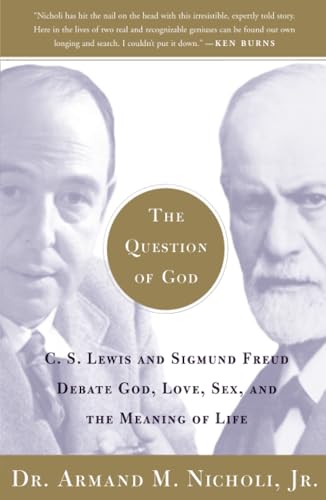

The question of God : C.S. Lewis and Sigmund Freud debate God, love, sex, and the meaning of life / Dr. Armand M. Nicholi, Jr.
Detalles de publicación: New York Free Press 2002Descripción: 295 p. ; 23 cmISBN:- 9780743247856
- BX 5199 .L53 N534 2003
| Imagen de cubierta | Tipo de ítem | Biblioteca actual | Biblioteca de origen | Colección | Ubicación en estantería | Signatura topográfica | Materiales especificados | Info Vol | URL | Copia número | Estado | Notas | Fecha de vencimiento | Código de barras | Reserva de ítems | Prioridad de la cola de reserva de ejemplar | Reservas para cursos | |
|---|---|---|---|---|---|---|---|---|---|---|---|---|---|---|---|---|---|---|
| Libro BET | Biblioteca Escuela de Teología Colección General BET | BX 5199 .L53 N534 2003 (Navegar estantería(Abre debajo)) | Disponible | 41000000000993 |
Descripciones mejoradas de Syndetics:
Throughout the ages, many of the world's greatest thinkers have wrestled with the concept of -- and belief in -- God. It may seem unlikely that any new arguments or insights could be raised, but the twentieth century managed to produce two brilliant men with two diametrically opposed views about the question of God: Sigmund Freud and C. S. Lewis. They never had an actual meeting, but in The Question of God, their arguments are placed side by side for the very first time.
For more than twenty-five years, Armand Nicholi has taught a course at Harvard that compares the philosophical arguments of both men. In The Question of God, Dr. Nicholi presents the writings and letters of Lewis and Freud, allowing them to "speak" for themselves on the subject of belief and disbelief. Both men considered the problem of pain and suffering, the nature of love and sex, and the ultimate meaning of life and death -- and each of them thought carefully about the alternatives to their positions.
The inspiration for the PBS series of the same name, The Question of God does not presuppose which man -- Freud the devout atheist or Lewis the atheist-turned-believer -- is correct in his views. Rather, readers are urged to join Nicholi and his students and decide for themselves which path to follow.
Includes bibliographical references (p. 282-285) and indexes.
PART ONE: WHAT SHOULD WE BELIEVE?
1. The Protagonists: The Lives of Sigmund Freud and
C. S. Lewis 13
2. The Creator: Is There an Intelligence Beyond
the Universe? 36
3. Conscience: Is There a Universal Moral Law? 57
4. The Great Transition: Which Road to Reality? 76
PART TWO: HOW SHOULD WE LIVE?
5. Happiness: What Is the Source of Our Greatest
Enjoyment in Life? 97
6. Sex: Is the Pursuit of Pleasure Our Only
Purpose? 126
7. Love: Is All Love Sublimated Sex? 160
8. Pain: How Can We Resolve the Problem
of Suffering? 187
9. Death: Is Death Our Only Destiny? 216
Epilogue 240
"Many of history's greatest thinkers have wrestled with the ultimate question of belief and nonbelief in God. Though it might seem unlikely that any new arguments could possibly be raised on either side, the twentieth century managed to produce two men who each made brilliant, new, and lasting arguments, one in favor of belief and one opposed. Few spokesmen have ever championed their respective positions better than Sigmund Freud and C.S. Lewis. Sadly, as far as we know, they never met or debated each other directly." "In The Question of God their arguments are placed side by side, as if they were standing at podiums in a shared room. Both thought carefully about the flaws and alternatives to their positions; each considered the other's views. Both men considered the problem of pain and suffering, the nature of love and sex, and the ultimate meaning of life and death. Here, with their debate made explicit, we can take ringside seats at one of history's most profound encounters."--Jacket.
Tabla de contenidos provista por Syndetics
- Prologue(p. 1)
- Part 1 What Should We Believe?
- 1. The Protagonists: The Lives of Sigmund Freud and C. S. Lewis(p. 13)
- 2. The Creator: Is There an Intelligence Beyond the Universe?(p. 36)
- 3. Conscience: Is There a Universal Moral Law?(p. 57)
- 4. The Great Transition: Which Road to Reality?(p. 76)
- Part 2 How Should We Live?
- 5. Happiness: What Is the Source of Our Greatest Enjoyment in Life?(p. 97)
- 6. Sex: Is the Pursuit of Pleasure Our Only Purpose?(p. 126)
- 7. Love: Is All Love Sublimated Sex?(p. 160)
- 8. Pain: How Can We Resolve the Problem of Suffering?(p. 187)
- 9. Death: Is Death Our Only Destiny?(p. 216)
- Epilogue(p. 240)
- Notes(p. 245)
- Bibliography(p. 282)
- Acknowledgments(p. 286)
- Index(p. 287)