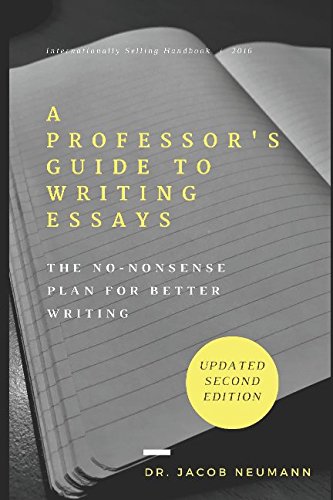

A professor's guide to writing essays : The no-nonsense plan for better writing / Jacob Neuman.
Fecha de copyright: Edinburg, TX: Jacob W. Neuman, 2016Edición: Updated Second editionDescripción: 112 pages ; 23 cmTipo de contenido:- text
- unmediated
- volume
- 9780692822524
- PE1471 .N486 2016
| Imagen de cubierta | Tipo de ítem | Biblioteca actual | Biblioteca de origen | Colección | Ubicación en estantería | Signatura topográfica | Materiales especificados | Info Vol | URL | Copia número | Estado | Notas | Fecha de vencimiento | Código de barras | Reserva de ítems | Prioridad de la cola de reserva de ejemplar | Reservas para cursos | |
|---|---|---|---|---|---|---|---|---|---|---|---|---|---|---|---|---|---|---|
| Libro | Biblioteca de Mayagüez Colección General mb | PE1471 .N486 2016 (Navegar estantería(Abre debajo)) | c. 1 | Disponible | 50000003282463 |
Includes bibliographical references (page 112).
How this book will help you -- Step 1. Make an outline -- Step 2. Write a thesis sentence for your essay -- Step 3. Write topic sentences for each paragraph -- Step 4. Write an introduction that works -- Step 5. Make your case -- Step 6. Ensure your body paragraphs are focused -- Step 7. Conclude with purpose -- Step 8. Write a powerful final sentences -- Step 9. Write complete sentences -- Step 10. Use transitions like they are road signs -- Step 11. Pay Attention to verbs -- Bonus: use citations like a pro -- Avoiding plagiarism -- Quick Guide to writing your essay -- Article cited.
This isn't a typical book on writing essays. First, it's for college students, graduate students, and even high school students - good writing is good writing; all that changes is the length and complexity of what you write. But the plan stays the same. Second, I'm not going to tell you any cute stories about writing. I'm not going to tell you the standard information about writing. Nor am I going to give you a simple formula for writing an essay. They don't work, and in the long run, they won't help you. What I am going to do is give you a plan for how you should approach writing essays. This plan works. If you follow it and practice it, you will learn to write much better essays - all types of essays. Because all essays are essentially the same. Most teachers and books will tell you differently. But I think they are wrong. The rules for good writing don't change depending on a certain "type" of essay. The only thing that changes is how you make your case, how you make your argument (and we cover that in Step 5). In this plan, we're not going to cover every aspect of academic writing. We're going to focus on the things that you absolutely have to do in order to create good essays. How do I know all of this? I've been teaching since 1996. I've taught at every level of schooling, and I've taught students from around the world. Now I work as an associate professor at The University of Texas Rio Grande Valley where I teach people how to teach. I also publish my own academic writing in some of the top journals in my field (you can look up my work on Google Scholar). So, not only do I know what students need to learn to create great essays, I put this information to the test in my own academic work. And in this book, I boil down all of my experience teaching writing plus my experience as a scholar into a simple, direct, and efficient plan that will improve the quality of your essays.