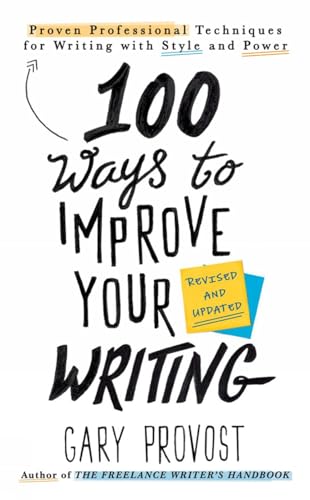
Imagen de portada de Amazon
Imagen de Amazon.com
Imagen de cubierta Syndetics
Portada de Syndetics
Imagen de OpenLibrary

100 ways to improve your writing / Gary Provost.

Por: Fecha de copyright: Broadway, New York : Penguin Random House, 2019Tipo de contenido:
  • text
Tipo de medio:
  • unmediated
Tipo de soporte:
  • volume
ISBN:
  • 9781984803689
Otro título:
  • One Hundred ways to improve your writing
Tema(s): Clasificación LoC:
  • PN145  .P7 2019
Contenidos:
1. Nine ways to improve your writing when you're not writing 2. Nine ways to overcome writer's block -- 3. Five ways to write a strong beginning -- 4. Nine ways to save time and energy -- 5. Ten ways to develop style -- 6. Twelve ways to give your words power -- 7. Eleven ways to make people like what you write -- 8. Ten ways to avoid grammatical errors -- 9. Six ways to avoid punctuation errors -- 10. Twelve ways to avoid making your reader hate you -- 11. Seven ways to edit yourself.
Resumen: This is the one guide that anyone who writes--whether student, business person, or professional writer--should put on the desk beside pencil, pen, typewriter, or word processor. Filled with professional tips and a wealth of instructive examples, this valuable, easy-to-use handbook can help you solve any and all writing problems.
Valoración
    Valoración media: 0.0 (0 votos)
Existencias
Imagen de cubierta Tipo de ítem Biblioteca actual Biblioteca de origen Colección Ubicación en estantería Signatura topográfica Materiales especificados Info Vol URL Copia número Estado Notas Fecha de vencimiento Código de barras Reserva de ítems Prioridad de la cola de reserva de ejemplar Reservas para cursos
Libro Biblioteca de Mayagüez Colección General mb PN145 .P7 2019 (Navegar estantería(Abre debajo)) c. 1 Disponible 50000003282497
Total de reservas: 0

Descripciones mejoradas de Syndetics:

The classic text on writing well, now refreshed and updated--an essential text for writers of all ages.

This is the one guide that anyone who writes--whether student, businessperson, or professional writer--should keep on his or her desk. Filled with professional tips and a wealth of instructive examples, 100 Ways to Improve Your Writing can help solve any writing problem.

In this compact, easy-to-use volume you'll find the eternal building blocks of good writing--from grammar and punctuation to topic sentences--as well as advice on challenges such as writer's block and creating a strong title. It is a must-have resource--perfect for reading cover to cover, or just for keeping on hand for instant reference--now updated and refreshed for the first time.

1. Nine ways to improve your writing when you're not writing 2. Nine ways to overcome writer's block -- 3. Five ways to write a strong beginning -- 4. Nine ways to save time and energy -- 5. Ten ways to develop style -- 6. Twelve ways to give your words power -- 7. Eleven ways to make people like what you write -- 8. Ten ways to avoid grammatical errors -- 9. Six ways to avoid punctuation errors -- 10. Twelve ways to avoid making your reader hate you -- 11. Seven ways to edit yourself.

This is the one guide that anyone who writes--whether student, business person, or professional writer--should put on the desk beside pencil, pen, typewriter, or word processor. Filled with professional tips and a wealth of instructive examples, this valuable, easy-to-use handbook can help you solve any and all writing problems.

Extracto provisto por Syndetics

1   Nine Ways to Improve Your Writing When You're Not Writing   1. Get Some Reference Books   2. Expand Your Vocabulary   3. Improve Your Spelling   4. Read   5. Take a Class   6. Eavesdrop   7. Research   8. Write in Your Head   9. Choose a Time and Place   1. Get Some Reference Books   It would be a shame to bring an entire writing project to a halt just because you didn't know how to spell gyroscope or schnapps. So get a dictionary and keep it in the room where you write, no more than an arm's length away. In fact, get two. Get a hardcover for its comprehensiveness and a paperback for convenience. If you prefer your reference books in digital format, you can get an e-book version or use an online app.   Also, get an encyclopedia. If you can't afford a big set, get a single-volume encyclopedia. If you can't afford a subscription to Encyclop¾dia Britannica or the like online, there are free online encyclopedias such as encyclopedia.com. You can use Wikipedia as a resource for background information or to point you to other sources, but it should not be cited as a source. It is created and edited by volunteers.   And get a thesaurus. Thesaurus means "treasury"; the thesaurus you buy will be a treasury of synonyms, words that are close in meaning to the one you want. It is a book that will lead you to that perfect word you know is loitering on the outskirts of your brain.   Roget's Thesaurus is arranged in two sections. The first section contains hundreds of clusters of related words and phrases. The second section is an index listing all the words in the first section alphabetically and telling you where they appear in that section.   Let's say, for example, that in a letter you want to assure the owner of the company you work for that you will most certainly try to recover the four billion dollars you lost on the papier-m%chZ deal, but recover isn't quite the word you want to use, and you're not sure what is. So you whip out your pocket edition of Roget's Thesaurus, turn to the index, and look up recover. There you'll find the numbers 660, 775, and 790. You turn to cluster 660 and you find recover along with its cousins rally, revive, pull through, reappear, and others. If you don't like anything you find there, you turn to the other numbers, and the thesaurus will lead you to redeem, get back, salvage, and so on.   You can find thesauruses in paperback and hardcover, as well as online, and Roget's is not the only one. I do not recommend the ones that are arranged solely in dictionary form. They are easier to use but only about twelve percent as useful.   After you have acquired a dictionary, an encyclopedia, and a thesaurus, you can acquire other reference books as time, taste, and money allow. Their importance depends largely on what sort of writing you do and how much.   Here are a few reference books you might find useful.   Finding Facts Fast by Alden Todd is a good reference book for any writer who has to do research.   The World Almanac and Book of Facts will tell you how many tomatoes were grown in New Jersey last year and a good many other things you might not find anywhere else.   The Book of Lists by David Wallechinsky, Irving Wallace, and Amy Wallace is fun to read and rich with useful information.   An effective online resource is refseek.com, which is a web search engine that acts as a directory of encyclopedias, directories, almanacs, and other reference resources.   The Careful Writer by Theodore M. Bernstein is an excellent grammar guide.   2. Expand Your Vocabulary   Everybody has heard tips for improving vocabulary. Learn a new word in the morning and use it three times before sunset and it's yours, etc. There are many books that will help you stretch your vocabulary. The best-known one is Thirty Days to a More Powerful Vocabulary by Wilfred Funk and Norman Lewis. Read that book or one like it.   There are websites such as vocabulary.com and lingualift .com if you prefer to work with your vocabulary online. For those on the go, apps such as Vocabulary Builder by Magoosh and Vocab24 by WiFi Study are free and highly rated for improving your vocabulary.   But the most important vocabulary for the writer is not the one that will take in uxorious tomorrow and soubrette the next day. It's the one he or she already has. For the writer of average intelligence and education, learning new words is much less important than learning to use easily the words he or she already knows.   Think for a minute. How many synonyms can you come up with for the noun plan?   There are program, itinerary, scheme, design, agenda, outline, and blueprint. If you concentrated for a minute, you might have come up with ten words that you already knew. But how many of them would have come easily to mind while you were writing a letter to the boss about your potentially lucrative new . . . uh . . . plan?   The only way to make your vocabulary more accessible is to use it. If you want all those short but interesting words waiting at the front of your brain when you need them, you must move them to the front of your brain before you need them.   Stop to think about other word possibilities when you write, and eventually they will come so quickly that you won't have to stop.   Pause before you speak. Then insert some of those good but neglected words.   And when you drive home from work at night, pick out an object along the road and see how many synonyms you can think of before you pass it. There's a house over there. But it's also a dwelling, an abode, a building, a bungalow, perhaps, or maybe a cottage. It's a home for somebody, it's headquarters for a family, and it's a shelter and a structure, too.   3. Improve Your Spelling   There aren't many firm rules that apply to the spelling of English words. Mostly, good spelling is a matter of forming the right mental associations and developing an eye for words that look a little weird.   In the dictionary, look up any word that you're not sure of. If you have been misspelling it, write it correctly ten times. Invent a visual image for the correct spelling. For example: The Sahara desert only has one s, like Sahara, but the dessert after a meal has a second s, like a second helping.   How will better spelling improve your writing? Well, for one thing, you won't write desert when you mean dessert. More important, it will improve your writing by reducing the number of times you annoy the reader. A few misspelled words will jar the reader's concentration, and a lot of misspelled words will wreck your credibility. Right or wrong, the reader will perceive you as . . . well, stupid, to put it bluntly. If you don't have the respect of the reader, your writing will not work.   Spell check is available in most word processing programs; however, it does have its limitations. So although it catches many mistakes that are ungrammatical, spell check is imperfect, missing some mistakes and marking others as incorrect when they are not. If you spell a word correctly, spell check will sometimes let it go, even if the usage is incorrect. Examples are principle vs. principal, there vs. their vs. they're, and dear vs. deer. You need to know how the word should be spelled so you can check the spell checker.   Fifty of the Most Commonly Misspelled Words   acceptable   acknowledgment   apology   appetite   architect   assassinate   autumn   calendar   changeable   conscience   conscious   correspondence   criticism   deceive   discernible   embarrass   eminent   existence   fascinate                grateful   hygiene   imaginable   immediately   irrelevant   jewelry   judgment   lovable   miscellaneous   mischievous   mortgage   necessarily   occasionally   occurrence   omission   orchestra   potatoes   professor   pseudonym   religious                 rhythmic   scissors   syllable   tragedy   umbrella   vanilla   vengeance   weird   wholesome   youthful   zealot   4. Read   If you are an architect, you should certainly read architectural literature. If you are in computers, you must keep up with what's being written about terabytes, hacking, and the latest operating systems. Reading the books and trade magazines as well as checking out the key websites of your particular field will not only keep you informed; it will show you how experienced writers are turning the jargon and the complexities of your vocation into readable prose.   But no matter what your field of expertise, you should also read books, magazines, and newspapers designed for the general reader.   Though the daily paper and online news sites contain much that is swill, they also contain some good writing. From them you can learn to write leanly, to get to the point, and to compress several facts into a single clear sentence.   If you read mysteries and romances, you will discover how writers create curiosity and build tension. You will also learn how to construct an event, a person, or a place with just a few well-chosen words.   Read novels. You will see how words can be used to communicate subtleties and stir emotions, how words can be arranged one way to make you worry, another to make you laugh.   Read magazine articles and you will see how quotes are pared down from lengthy interviews until they contain nothing but the words that matter. Notice how opinions are supported by facts. Watch to see how the writer makes his or her points by calling on outside help such as scientific reports, quotes from books, surveys, etc. Then go to the online version and see whether they have a longer version so you can see what was edited for the print copy.   Read. And listen to what you read. Listen for the sound of the language, the music. Note the punctuation, the spelling, the logical progression of information. And find the things that fail, also. Listen to how two similar sounds close together can cause a disturbing noise in your head. Hear how the use of the wrong word wakes you from your reading spell. Be a critical reader and look upon all that you read as a lesson in good writing.   5. Take a Class   If you don't believe that good writing can be taught, you shouldn't be reading this book. If you do believe good writing can be taught, you could benefit from a class.   You don't have to sign up for a three-credit course at the local university. You can find a creative writing or English composition course in most adult education and extension programs or online.   There are specific courses designed for particular types of writers. For example, there are business writing courses that thoroughly cover the formal English required in business correspondence. A course in nonfiction writing will provide you with some research techniques that you wouldn't get elsewhere. And a course in writing for television would be invaluable if that's your interest, as there are many rules of form a scriptwriter must follow.   Generally, a writing course is as good or as bad as the teacher. Good teachers and bad teachers are found at all levels, so ask around.   Whether it's a course at the local high school or a course at Harvard, in my opinion you should steer clear of any teacher who speaks with a British accent but has never been to England and any teacher who insists you must read Moby Dick before writing your first paper. Point yourself toward the eager, unpretentious teacher who is actually publishing stories, articles, and books.   "But why," you ask, "should I take a writing class at all after reading a wonderful book like this?"   Good question. Three answers.   1. With a teacher and other students reading your work, you will be better able to learn what your particular faults and virtues are.   2. Knowing that the class or teacher is going to read your work, you will work harder at making your writing good.   3. Your own writing mistakes are often invisible to you, but they will become obvious when you see them in the work of fellow students.   6. Eavesdrop   Be nosy. Listen to conversations on the bus, in the elevator. Screen out the words sometimes and listen only to the music. Tune in to teenagers' conversations, and you'll pick up the latest slang. Pretend to be reading on the park bench, and you'll hear how words are used to convey more than they mean. Find out what people are talking about, what they care about. All of this will help you to communicate more effectively through your writing.   This passage from my book The Dorchester Gas Tank is based on a conversation I overheard at a diner in Burlington, Vermont.   "My neighbor's daughter has just got back from Sweden," Bernice says. Her words are slightly muffled because she has stopped in her conversation with Dora to slice open a roll of Italian bread and stuff it with provolone cheese, several thick slices of baloney and enough tomatoes, onions, etc. to sink a ship. Now she chomps on it as if food will soon be obsolete.   "I didn't know they went to Europe," Bernice's sister says.   "Well it's not really Europe. It's in Scandinavia. It's a Danish country."   "Oh yes," Dora says, "the Danish country is very nice, but those people don't like to talk to outsiders."   "Well, it's a sub-language they speak," Bernice says. "It's like German, not fully developed."   "Very guttural," Dora says.   "My neighbor's daughter says some of them are really awful. She went to a cathedral and one of them had stolen a crown from a statue of the Blessed Mother."   "From the Blessed Mother? That's disgraceful."   7. Research   Do your fingers sometimes freeze over the keyboard? Does the blank page seem to stare back at you with an accusing eye? The problem could be that you haven't gathered enough information. You haven't gotten the facts.   Almost everything you will ever write must be built on a foundation of factual information. That includes opinion pieces and most certainly includes stories, plays, and novels.   Before you write, track down the bits of information you are going to need. Get the prices you must quote, the names of people you will mention. Find out when it's going to happen, where it will be, who's going to be speaking, and whether or not dogs are allowed. You cannot write securely on any subject unless you have gathered far more information than you will use.   Here are four ways to get facts.   1. Look it up. If the facts are not in the books on your shelf, try looking them up online or using library resources. Between libraries and the Internet, you have access to just about every piece of information in the world, though in some cases the information might have been printed only in Swahili. In that case, you can use the Internet to help you do a quick translation. Excerpted from 100 Ways to Improve Your Writing: Proven Professional Techniques for Writing with Style and Power by Gary Provost All rights reserved by the original copyright owners. Excerpts are provided for display purposes only and may not be reproduced, reprinted or distributed without the written permission of the publisher.

Notas de autor provistas por Syndetics

Gary Provost was a writing teacher and the author of more than a thousand published articles and stories. His two dozen books include both adult and YA fiction, and nonfiction such as The Freelance Writer's Handbook . His methods continue to be taught at the semiannual writer's conference he established, the Writer's Retreat Workshop (www.wakeupandwritewrw.com).
Compartir
logopucpr-y-vive

Contáctanos

¡Queremos saber de ti!

Tel. 787.841.2000 Ext. 1801

bibliotecavaldes@pucpr.edu

⁣Búscanos en las redes

© 2026 Desarrollado por Ignite Online • All Rights Reserved • Powered by Koha.