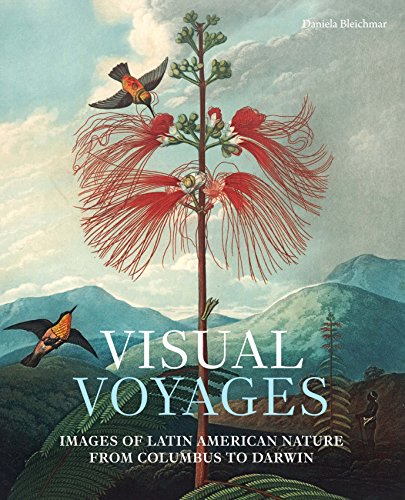

Visual voyages : images of Latin American nature from Columbus to Darwin / Daniela Bleichmar. txt
Editor: New Haven : Yale University Press in association with The Huntington Library, Art Collections, and Botanical Gardens, 2017Descripción: xiii, 226 pages : color illustrations, maps ; 29 cmTipo de contenido:- text
- still image
- cartographic image
- unmediated
- volume
- 9780300224023
- 0300224028
- Images of Latin American nature from Columbus to Darwin
- Natural history illustration -- Latin America -- Exhibitions
- Natural history -- Latin America -- Pictorial works -- Exhibitions
- Scientific expeditions -- Latin America -- Exhibitions
- Natural history in art -- Exhibitions
- International relations
- Natural history
- Natural history illustration
- Natural history in art
- Scientific expeditions
- Latin America -- In art -- Exhibitions
- Latin America -- Relations -- Europe -- Exhibitions
- Europe -- Relations -- Latin America -- Exhibitions
- Europe
- Latin America
- 23 508.0222
- QH46.5 B54 2017
| Imagen de cubierta | Tipo de ítem | Biblioteca actual | Biblioteca de origen | Colección | Ubicación en estantería | Signatura topográfica | Materiales especificados | Info Vol | URL | Copia número | Estado | Notas | Fecha de vencimiento | Código de barras | Reserva de ítems | Prioridad de la cola de reserva de ejemplar | Reservas para cursos | |
|---|---|---|---|---|---|---|---|---|---|---|---|---|---|---|---|---|---|---|
| Libro | CARIBET Biblioteca Arquitectura Colección General CARIBET | General QH46.5 B54 2017 (Navegar estantería(Abre debajo)) | 1 | Disponible | 91000000066225 |
Descripciones mejoradas de Syndetics:
An unprecedented visual exploration of the intertwined histories of art and science, of the old world and the new
From the voyages of Christopher Columbus to those of Alexander von Humboldt and Charles Darwin, the depiction of the natural world played a central role in shaping how people on both sides of the Atlantic understood and imaged the region we now know as Latin America. Nature provided incentives for exploration, commodities for trade, specimens for scientific investigation, and manifestations of divine forces. It also yielded a rich trove of representations, created both by natives to the region and visitors, which are the subject of this lushly illustrated book. Author Daniela Bleichmar shows that these images were not only works of art but also instruments for the production of knowledge, with scientific, social, and political repercussions. Early depictions of Latin American nature introduced European audiences to native medicines and religious practices. By the 17th century, revelatory accounts of tobacco, chocolate, and cochineal reshaped science, trade, and empire around the globe. In the 18th and 19th centuries, collections and scientific expeditions produced both patriotic and imperial visions of Latin America.
Through an interdisciplinary examination of more than 150 maps, illustrated manuscripts, still lifes, and landscape paintings spanning four hundred years, Visual Voyages establishes Latin America as a critical site for scientific and artistic exploration, affirming that region's transformation and the transformation of Europe as vitally connected histories.
Published in association with the Huntington Library, Art Collections, and Botanical Gardens
Exhibition Schedule:
Accompanies the exhibition Visual Voyages: Images of Latin American Nature from Columbus to Darwin at the Huntington Library, San Marino, California, 16 September 2017--8 January 2018.
Published on the occasion of an exhibition of the same name held at The Huntington Library, Art Collections, and Botanical Gardens, September 16, 2017-January 8, 2018.
"Published with the assistance of the Getty Foundation."
"Pacific Standard Time: LA/LA, Latin American & Latino Art in LA"--Title page verso.
Includes bibliographical references (pages 207-218) and index.
Foreword / Catherine Hess --
Introduction --
Rewriting the book of nature --
The value of nature --
Collecting: from wonder to order --
New landscapes --
Notes --
Bibliography --
Acknowledgments --
Index --
Illustration credits.
From the voyages of Christopher Columbus to those of Alexander von Humboldt and Charles Darwin, the depiction of the natural world played a central role in shaping how people on both sides of the Atlantic understood and imaged the region we now know as Latin America. Nature provided incentives for exploration, commodities for trade, specimens for scientific investigation, and manifestations of divine forces. It also yielded a rich trove of representations, created both by natives to the region and visitors, which are the subject of this lushly illustrated book. Author Daniela Bleichmar shows that these images were not only works of art but also instruments for the production of knowledge, with scientific, social, and political repercussions. Early depictions of Latin American nature introduced European audiences to native medicines and religious practices. By the 17th century, revelatory accounts of tobacco, chocolate, and cochineal reshaped science, trade, and empire around the globe. In the 18th and 19th centuries, collections and scientific expeditions produced both patriotic and imperial visions of Latin America. Exhibition: The Huntington Library, San Marino, USA (16.09.2017-08.01.2018).
Reseñas proporcionadas por Syndetics
CHOICE Review
Visual Voyages is the book companion to an exhibit of the same name at the Huntington Library. Bleichmar (art history and history, USC) co-curated the exhibit. The book is a compendium of images from the age of exploration and the scientific revolution, showing how the area now known as Latin America was depicted to a mostly European audience. The text that accompanies the more than 150 illustrations describes the impact and importance these works had in terms of exploration, economics, science, and culture. Though the catalogue includes images of work produced by local and Indigenous artists, the focus is on works produced for the audience "back home"--first the home countries of European explorers and later, and to a lesser extent, the emerging nations themselves. This is not a book about the science or Indigenous perspective of nature, but rather a book about the influence of these images on European-centered culture. Well made and full of high-quality, richly colored illustrations, this volume will be useful to those interested in the history of science, Latin America, scientific illustration, or the art of nature. Summing Up: Recommended. Upper-division undergraduates through faculty; general readers. --Rebecca C. Hedreen, Southern Connecticut State UniversityNotas de autor provistas por Syndetics
Daniela Bleichmar is associate professor of art history and history at the University of Southern California.