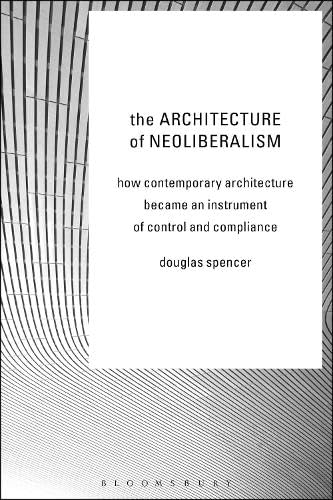

The architecture of neoliberalism : how contemporary architecture became an instrument of control and compliance. / Douglas Spencer. electronic resouce
Editor: New York : Bloomsbury Academic, 2016Descripción: 1 online resourceTipo de contenido:- text
- computer
- online resource
- 9781472581532
- 1472581539
- Architecture and society
- Architecture -- Political aspects
- Neoliberalism
- ARCHITECTURE -- Criticism
- ARCHITECTURE -- History -- Contemporary (1945- )
- POLITICAL SCIENCE -- Political Ideologies -- Conservatism & Liberalism
- Architecture and society
- Architecture -- Political aspects
- Neoliberalism
- ARCHITECTURE / Adaptive Reuse & Renovation
- ARCHITECTURE / Buildings / Landmarks & Monuments
- ARCHITECTURE / Professional Practice
- ARCHITECTURE / Reference
- Theory of architecture
- History of architecture
- Political ideologies
- Architecture
- 23 720.1/03
- NA2543.S6 S6427 2016
| Imagen de cubierta | Tipo de ítem | Biblioteca actual | Biblioteca de origen | Colección | Ubicación en estantería | Signatura topográfica | Materiales especificados | Info Vol | URL | Copia número | Estado | Notas | Fecha de vencimiento | Código de barras | Reserva de ítems | Prioridad de la cola de reserva de ejemplar | Reservas para cursos | |
|---|---|---|---|---|---|---|---|---|---|---|---|---|---|---|---|---|---|---|
| Libro | CARIBET Biblioteca Arquitectura Colección General CARIBET | General NA2543.S6 S6427 2016 (Navegar estantería(Abre debajo)) | 1 | Disponible | 91000000066282 | |||||||||||||
| Libro Electrónico CARIBET | CARIBET Biblioteca Arquitectura Libros Electrónicos CARIBET | Electrónico NA2543.S6 S6427 2016 (Navegar estantería(Abre debajo)) | 1 | Disponible | caribet297807 |
Descripciones mejoradas de Syndetics:
The Architecture of Neoliberalism pursues an uncompromising critique of the neoliberal turn in contemporary architecture. This book reveals how a self-styled parametric and post-critical architecture serves mechanisms of control and compliance while promoting itself, at the same time, as progressive. Spencer's incisive analysis of the architecture and writings of figures such as Zaha Hadid, Patrik Schumacher, Rem Koolhaas, and Greg Lynn shows them to be in thrall to the same notions of liberty as are propounded in neoliberal thought. Analysing architectural projects in the fields of education, consumption and labour, The Architecture of Neoliberalism examines the part played by contemporary architecture in refashioning human subjects into the compliant figures - student-entrepreneurs, citizen-consumers and team-workers - requisite to the universal implementation of a form of existence devoted to market imperatives.
Introduction: Architecture, Neoliberalism and the Game of Truth --
Chapter 1 Necessary Ignorance: The Art of Neoliberal Governmentality --
Foucault and governmentality --
Neoliberalism, human capital and the entrepreneurial self --
Hayek, Polanyi and cybernetics --
Spontaneous orders and complex systems --
Neoliberalism as the ' form of our existence --
Chapter 2 The Spatial Constitution and Alphaville The counterculture and the technical mentality --
Banham, Baudrillard and McLuhan --
Chapter 3 Architectural Theory: From May 68 to the ' Real ' of the Market --
Post-theory and the post-political --
Architecture and Deleuze --
The new agenda for architecture --
Architecture and the market --
DeLanda, Latour and Luhmann --
The real subsumption of theory --
Chapter 4 Labour Theory: Architecture, Work and Neoliberalism --
Architecture and the image of labour --
Ubiquitous workspacetion of the Neoliberal Subject --
Hamilton, Pollock and Kaprow --
Boltanski and Chiapello, Postone, and the thesis of ' immaterial labour ' Zaha Hadid Architects and BMW Leipzig ; The urban diagram of the new factory ; Koolhaas, OMA and CCTV ; Architecture as infrastructure ; Circulation as labour and image ; Chapter 5 Festivals of Circulation: Neoliberal Architectures of Culture, Commerce and Education ; The Pompidou as Fun Palace ; Crowd modelling ; Citizen-consumers: FOA ' s Meydan Retail Complex ; Student-entrepreneurs: Formatting the subject of education
Ravensbourne College: The ' learning landscape ' and the ' univers-city ' Chapter 6 Neoliberalism and Affect: Architecture and the Patterning of Experience ; Architecture and the affective turn ; Jameson, architecture and the totality ; Aesthetics, aisthesis and cognition ; Pattern recognition: The ' period eye ' of neoliberalism ; Conclusion: The Necessity of Critique ; Notes ; Introduction ; Chapter 1 ; Chapter 2 ; Chapter 3 ; Chapter 4 ; Chapter 5 ; Chapter 6 ; Conclusion ; Bibliography
Owing to Legal Deposit regulations this resource may only be accessed from within National Library of Scotland. For more information contact enquiries@nls.uk. StEdNL
Print version record.
Master record variable field(s) change: 050, 072, 082, 650