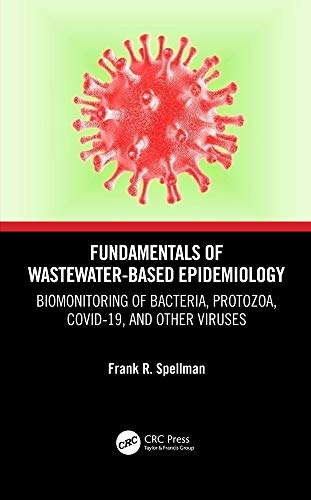
Imagen de portada de Amazon
Imagen de Amazon.com
Imagen de cubierta Syndetics
Portada de Syndetics
Imagen de OpenLibrary

Fundamentals of wastewater-based epidemiology : biomonitoring of bacteria, protozoa, COVID-19, and other viruses / Frank R. Spellman.

Por: Editor: Boca Raton : CRC Press, Taylor & Francis Group, 2021Edición: First editionDescripción: 1 online resourceTipo de contenido:
  • text
Tipo de medio:
  • computer
Tipo de soporte:
  • online resource
ISBN:
  • 9781003170105
  • 1003170102
  • 9781000383768
  • 1000383768
  • 9781000383744
  • 1000383741
Tema(s): Género/Forma: Formatos físicos adicionales: Print version:: Fundamentals of wastewater-based epidemiologyClasificación CDD:
  • 614.4/2 23
Clasificación LoC:
  • TD736  .S64 2021
Contenidos:
Part 1. Setting the Stage -- Chapter 1. And What’s in the Pipes Will Tell -- Chapter 2. Fundamental Epidemiology -- Part 2. Statistical Methods -- Chapter 3. Statistics and Biostatistics Review -- Chapter 4. Basic Concepts -- Chapter 5. Distribution -- Chapter 6. Sampling—Measurement Variables -- Chapter 7. Frequency Measures: Incidence, Prevalence, and Mortality Rates -- Chapter 8. Measures of Association and Public Health Impact -- Part 3. Wastewater -- Chapter 9. The Science of Wastewater -- Chapter 10. Wastewater Spawned Infectious Disease -- Part 4. Wastewater-Based Epidemiology -- Chapter 11. Fundamentals of Biomonitoring, Monitoring, Sampling, and Testing -- Chapter 12. Wastewater Bacteria Sampling, Testing, and Analysis -- Chapter 13. Wastewater Protozoa Sampling, Testing, and Analysis -- Chapter 14. Wastewater Virus Sampling, Testing, and Analysis -- Index
Resumen: "It is common practice to evaluate wastewater to understand drug consumption, from antibiotics to illegal narcotics, and even to analyze dietary habits and trends. Evaluating contaminants in wastewater enables researchers, environmental scientists, and water quality experts to gain valuable information and data. Wastewater-based epidemiology is an emerging science that has proven to be a cost- and time-effective biomonitoring tool. This book provides a roadmap to detecting wastewater-borne pathogenic contaminants such as viruses, bacteria, fungi and others. It provides a basic, fundamental discussion of how sampling and monitoring of wastewater using epidemiological concepts and practices can aid in determining the presence of the COVID-19 virus in a community, for example, and may help predict future outbreaks. Offers a unique discussion of the detection of bacteria, fungi, and COVID-19 and other viruses in wastewater. Presents the fundamentals of wastewater chemistry and microbiology. Explains biomonitoring, sampling, testing, and health surveillance in a practical manner. Fundamentals of wastewater-based epidemiology : biomonitoring of bacteria, fungi, COVID-19, and other viruses is an invaluable resource to a wide array of readers with varying interests and backgrounds in water science and public health"-- Provided by publisher.
Valoración
    Valoración media: 0.0 (0 votos)
Existencias
Imagen de cubierta Tipo de ítem Biblioteca actual Biblioteca de origen Colección Ubicación en estantería Signatura topográfica Materiales especificados Info Vol URL Copia número Estado Notas Fecha de vencimiento Código de barras Reserva de ítems Prioridad de la cola de reserva de ejemplar Reservas para cursos
Libro electrónico Biblioteca de Mayagüez Acceso en línea TD736 .S64 2021 (Navegar estantería(Abre debajo)) Ebook c. 1 Disponible 50000003287082
Libro electrónico Biblioteca Encarnación Valdés Acceso en línea 614.4/2 (Navegar estantería(Abre debajo)) Disponible on1224583561
Total de reservas: 0

Descripciones mejoradas de Syndetics:

It is common practice to evaluate wastewater to understand drug consumption, from antibiotics to illegal narcotics, and even to analyze dietary habits and trends. Evaluating contaminants in wastewater enables researchers, environmental scientists, and water quality experts to gain valuable information and data. Wastewater-based epidemiology is an emerging science that has proven to be a cost- and time-effective biomonitoring tool. This book provides a roadmap for detecting wastewater-borne pathogenic contaminants such as viruses, bacteria, fungi, and others. It provides a basic, fundamental discussion of how sampling and monitoring of wastewater using epidemiological concepts and practices can aid in determining the presence of the COVID-19 virus in a community, for example, and may help predict future outbreaks.


Features

* Offers a unique discussion of the detection of bacteria, fungi, and COVID-19, and other viruses in wastewater

* Presents the fundamentals of wastewater chemistry and microbiology

* Explains biomonitoring, sampling, testing, and health surveillance in a practical manner


Fundamentals of Wastewater-Based Epidemiology: Biomonitoring of Bacteria, Fungi, COVID-19, and Other Viruses is an invaluable resource to a wide array of readers with varying interests and backgrounds in water science and public health.

Includes index.

Includes bibliographical references and index.

Part 1. Setting the Stage -- Chapter 1. And What’s in the Pipes Will Tell -- Chapter 2. Fundamental Epidemiology -- Part 2. Statistical Methods -- Chapter 3. Statistics and Biostatistics Review -- Chapter 4. Basic Concepts -- Chapter 5. Distribution -- Chapter 6. Sampling—Measurement Variables -- Chapter 7. Frequency Measures: Incidence, Prevalence, and Mortality Rates -- Chapter 8. Measures of Association and Public Health Impact -- Part 3. Wastewater -- Chapter 9. The Science of Wastewater -- Chapter 10. Wastewater Spawned Infectious Disease -- Part 4. Wastewater-Based Epidemiology -- Chapter 11. Fundamentals of Biomonitoring, Monitoring, Sampling, and Testing -- Chapter 12. Wastewater Bacteria Sampling, Testing, and Analysis -- Chapter 13. Wastewater Protozoa Sampling, Testing, and Analysis -- Chapter 14. Wastewater Virus Sampling, Testing, and Analysis -- Index

"It is common practice to evaluate wastewater to understand drug consumption, from antibiotics to illegal narcotics, and even to analyze dietary habits and trends. Evaluating contaminants in wastewater enables researchers, environmental scientists, and water quality experts to gain valuable information and data. Wastewater-based epidemiology is an emerging science that has proven to be a cost- and time-effective biomonitoring tool. This book provides a roadmap to detecting wastewater-borne pathogenic contaminants such as viruses, bacteria, fungi and others. It provides a basic, fundamental discussion of how sampling and monitoring of wastewater using epidemiological concepts and practices can aid in determining the presence of the COVID-19 virus in a community, for example, and may help predict future outbreaks. Offers a unique discussion of the detection of bacteria, fungi, and COVID-19 and other viruses in wastewater. Presents the fundamentals of wastewater chemistry and microbiology. Explains biomonitoring, sampling, testing, and health surveillance in a practical manner. Fundamentals of wastewater-based epidemiology : biomonitoring of bacteria, fungi, COVID-19, and other viruses is an invaluable resource to a wide array of readers with varying interests and backgrounds in water science and public health"-- Provided by publisher.

Description based on print version record.

OCLC control number change

Reseñas proporcionadas por Syndetics

CHOICE Review

The world was caught off guard by the global outbreak of COVID-19, caused by the novel SARS-CoV-2 virus. As countries struggled to understand the scope of the outbreak, old technologies were applied in novel ways to help trace the burden of disease in communities. In Fundamentals of Wastewater-Based Epidemiology, Spellman (Old Dominion Univ.) provides an overview of wastewater systems and biomonitoring, especially as relevant to COVID-19. The volume comprises 14 chapters and is organized in four parts ("Setting the Stage," "Statistical Methods," "Wastewater," and "Wastewater-Based Epidemiology"). Overall, the text provides information that would be applicable in introductory courses on wastewater management, limnology, and environmental epidemiology, making it potentially useful as a resource for selected undergraduate readings. More experienced readers will value the book for its overviews of, e.g., epidemiology and related statistical measures; the science of wastewater and wastewater treatment; disease causative agents associated with wastewater; and biomonitoring methods for wastewater analysis (especially as related to viruses, bacteria, protozoa, and Helminthes). Because Spellman's writing can be technical at points, the book will find its most receptive audience among wastewater specialists, be they academic or working in industry, and students in fields such as environmental studies or epidemiology. Summing Up: Recommended. Lower- and upper-division undergraduates. Graduate students, faculty and professionals. Students in two-year technical programs. --Kip R. Thompson, Missouri State University

Notas de autor provistas por Syndetics

Frank R. Spellman is a retired assistant professor of Environmental Health at Old Dominion University, Norfolk, Va. and author of over 60 books. Spellman has been cited in more than 400 publications; serves as a professional expert witness; incident/accident investigator for the U.S. Department of Justice and a private law firm; and consults on Homeland Security vulnerability assessments (VAs) for critical infrastructure including water/wastewater facilities nationwide. Dr. Spellman lectures on sewage treatment, water treatment and homeland security and health and safety topics throughout the country and teaches water/wastewater operator short courses at Virginia Tech (Blacksburg, VA). He holds a BA in public Administration; BS in Business Management; MBA; Master of Science, MS, in Environmental Engineering and PhD Environmental Engineering.
Compartir
logopucpr-y-vive

Contáctanos

¡Queremos saber de ti!

Tel. 787.841.2000 Ext. 1801

bibliotecavaldes@pucpr.edu

⁣Búscanos en las redes

© 2026 Desarrollado por Ignite Online • All Rights Reserved • Powered by Koha.