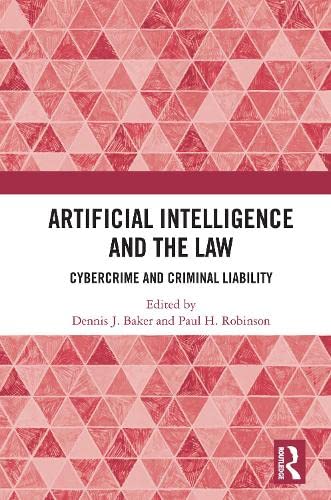

Artificial Intelligence and the Law : Cybercrime and Criminal Liability / Dennis J. Baker and Paul H. Robinson (editors).
Editor: Milton : Taylor & Francis Group, 2020Fecha de copyright: ©2020Descripción: 1 online resource (281 pages)Tipo de contenido:- text
- computer
- online resource
- 9781000210644
- 340.02856300000002
- K564.C6 .A785 2021
| Imagen de cubierta | Tipo de ítem | Biblioteca actual | Biblioteca de origen | Colección | Ubicación en estantería | Signatura topográfica | Materiales especificados | Info Vol | URL | Copia número | Estado | Notas | Fecha de vencimiento | Código de barras | Reserva de ítems | Prioridad de la cola de reserva de ejemplar | Reservas para cursos | |
|---|---|---|---|---|---|---|---|---|---|---|---|---|---|---|---|---|---|---|
| Libro electrónico | Biblioteca de Mayagüez Acceso en línea | K564.C6 .A785 2021 (Navegar estantería(Abre debajo)) | Ebook c. 1 | Disponible | 50000003283784 | |||||||||||||
| Libro electrónico | Biblioteca Encarnación Valdés Acceso en línea | 340.02856300000002 (Navegar estantería(Abre debajo)) | Disponible | EBC6357469 | ||||||||||||||
| Libro electrónico | Biblioteca Mons. Iñaki Mallona (Arecibo) Acceso en línea | Ebooks | Disponible | 60000010175575 |
Descripciones mejoradas de Syndetics:
This volume presents new research in artificial intelligence (AI) and Law with special reference to criminal justice.
It brings together leading international experts including computer scientists, lawyers, judges and cyber-psychologists. The book examines some of the core problems that technology raises for criminal law ranging from privacy and data protection, to cyber-warfare, through to the theft of virtual property. Focusing on the West and China, the work considers the issue of AI and the Law in a comparative context presenting the research from a cross-jurisdictional and cross-disciplinary approach.
As China becomes a global leader in AI and technology, the book provides an essential in-depth understanding of domestic laws in both Western jurisdictions and China on criminal liability for cybercrime. As such, it will be a valuable resource for academics and researchers working in the areas of AI, technology and criminal justice.
Cover -- Half Title -- Title -- Copyright -- Contents -- List of contributors -- 1 Emerging technologies and the criminal law -- 1. Introduction -- 2. Artificial intelligence and criminal justice -- (a) Artificial intelligence -- 3. Privacy, surveillance and biometrics -- 4. Censoring the Internet at large to prevent online harms -- 5. Overview of the chapters herein -- 2 Financial technology: opportunities and challenges to law and regulation -- 1. Introduction -- 2. Fintech -- 3. DLT -- 4. Contract law -- 5. Tort/delict -- 6. Property law -- 7. Separate legal personality -- (a) How the law should be adapted -- (b) International conventions and model laws -- (c) Regulation and regulatory sandboxes -- 8. Conclusion -- 3 Between prevention and enforcement: the role of "disruption" in confronting cybercrime -- 1. Introduction -- 2. The nature of disruption -- 3. The role of intelligence -- 4. The role of disruption in cybercrime -- (a) Enforcement -- (b) Technical means -- (c) Intelligence gathering -- 5. Legislative frameworks and oversight -- 6. Criminal offences -- 7. Investigation powers -- 8. International cooperation -- 9. Conclusion -- 4 Preventive cybercrime and cybercrime by omission in China -- 1. Introduction -- 2. Pre-inchoate criminalisation and early harm prevention -- (a) Background of the latest amendments to PRC criminal law -- (b) The harm justification for criminalising pre‑inchoate cyberharm -- 3. Omissions liability for internet service providers -- (a) Effective governance of cybercrime and the addition of citizens' positive duties -- 4. The constitutional dilemma: the deviation from marketplace norms -- (a) The principle of personal responsibility -- 5. The normativity of private censorship and pre‑inchoate criminalisation -- 6. Conclusion -- 5 Criminal law protection of virtual property in China -- 1. Introduction.
2. Conceptualising virtual property -- (a) General concept of a virtual asset -- 3. Categorising virtual property -- (a) The problem with virtual property in China -- (b) Virtual property articles -- (c) Virtual currency as property -- (d) Questions raised -- 4. Virtual property as property -- 5. The principle of legality -- 6. China's current practice concerning virtual property -- 7. The value of virtual property -- 8. Conclusion -- 6 Criminalising cybercrime facilitation by omission and its remote harm form in China -- 1. Introduction -- 2. Cybercrime: extending the reach of the current law -- 3. Liability for indirect remote harm and direct pre‑inchoate harm -- 4. Internet service provider offences -- (a) Criminalisation and the duty of the ISP to act -- (b) Allowing others to cause harm through failures to prevent -- (c) Responsibility for allowing others to leak data -- (d) Allowing the loss of criminal evidence -- (e) The crime of fabricating and disseminating false information -- 5. Obstacles to applying complicity liability to cybercrimes -- 6. The limits of national jurisdiction -- 7. Conclusion -- 7 Rethinking personal data protection in the criminal law of China -- 1. Introduction -- 2. The legal status of personal data -- (a) Is privacy a public good? -- (b) The current law in China -- 3. Difference from GDPR -- 4. Related criminal offences in China -- 5. Fair labelling and applying the right crime -- 6. Conclusion -- 8 Using conspiracy and complicity for criminalising cyberfraud in China: lessons from the common law -- 1. Introduction -- 2. Cyberfraud in China -- 3. Remote harm offences vs. inchoate and pre‑inchoate offences -- 4. Complicity -- 5. Successive complicity in Japanese law -- 6. Conclusion -- 9 The threat from AI -- 1. Introduction of risk -- 2. The nature of the threat -- 3. Definition and scope of AI.
(a) Machine learning methods -- (b) Learning from incomplete data -- (c) Predicting behaviours and outcomes -- (d) Incomprehension of decisions -- 4. Four apertures of cyberharm -- 5. AI as a weapon -- (a) Targeting and control enhancements due to AI -- (b) Attacker persistence, covertness and effects enhancement due to AI -- (c) Attack (un)mitigatability enhancements due to AI -- (d) Threat to individuals -- (e) Threat to businesses or organisations -- (f) Threat to nations or societies -- (g) Global threats -- 6. AI as an environmental threat -- (a) The question of dual-use -- (b) Vulnerability introduction -- (c) Growth of threat environment -- (d) Polarisation of wealth -- (e) Outliers and oversimplification -- (f) Rule of law and responsibility for harm -- 7. Reflection -- 10 AI vs. IP: criminal liability for intellectual property offences of artificial intelligence entities -- 1. Introduction: the legal problem -- 2. AI entities -- 3. Three models of criminal liability of artificial intelligence entities for commission of IP offences -- (a) Perpetration-by-Another liability -- (b) Natural-Probable-Consequence liability -- (c) Direct liability -- (d) Combination liability -- 4. Punishing AI -- 5. Conclusion -- 11 Don't panic: artificial intelligence and Criminal Law 101 -- 1. Introduction -- (a) The defendant -- 2. The actus reus -- (a) Specific conduct offences -- (b) Specific consequence offences -- (c) State of affairs offences -- 3. The mens rea -- (a) Preliminaries -- (b) Intention -- (c) Knowledge/belief -- (d) Recklessness and negligence -- (e) Consent -- (f) Contemporaneity -- (g) Rationale-based defences -- (h) Application -- 4. Complicity liability -- 5. Inchoate offences -- 6. Conclusion -- Index.
This volume presents new research in artificial intelligence (AI) and Law with special reference to criminal justice. It brings together leading international experts including computer scientists, lawyers, judges and cyber-psychologists. The book examines some of the core problems that technology raises for criminal law ranging from privacy and data protection, to cyber-warfare, through to the theft of virtual property. Focusing on the West and China, the work considers the issue of AI and the Law in a comparative context presenting the research from a cross-jurisdictional and cross-disciplinary approach. As China becomes a global leader in AI and technology, the book provides an essential in-depth understanding of domestic laws in both Western jurisdictions and China on criminal liability for cybercrime. As such, it will be a valuable resource for academics and researchers working in the areas of AI, technology and criminal justice.
Description based on publisher supplied metadata and other sources.
Electronic reproduction. Ann Arbor, Michigan : ProQuest Ebook Central, 2021. Available via World Wide Web. Access may be limited to ProQuest Ebook Central affiliated libraries.
ALA COVID Relief Fund
Notas de autor provistas por Syndetics
Dennis J. Baker, Research Professor, De Montfort University, UK
Paul H. Robinson, Colin S. Diver Professor of Law, University of Pennsylvania, USA