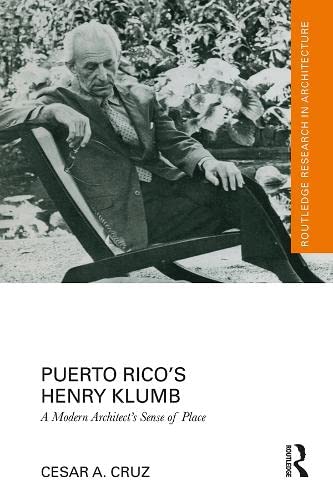

Puerto Rico's Henry Klumb : A Modern Architect's Sense of Place / Cesar A. Cruz.
Series Routledge research in architecture | Routledge Research in Architecture SerEditor: Milton : Taylor & Francis Group, 2020Descripción: 1 online resource (205 pages)Tipo de contenido:- text
- computer
- online resource
- 9780429620393
- 720.92
- NA737 .K577 C789 2020
| Imagen de cubierta | Tipo de ítem | Biblioteca actual | Biblioteca de origen | Colección | Ubicación en estantería | Signatura topográfica | Materiales especificados | Info Vol | URL | Copia número | Estado | Notas | Fecha de vencimiento | Código de barras | Reserva de ítems | Prioridad de la cola de reserva de ejemplar | Reservas para cursos | |
|---|---|---|---|---|---|---|---|---|---|---|---|---|---|---|---|---|---|---|
| Libro Electrónico CARIBET | Biblioteca de Mayagüez Acceso en línea | NA737 .K577 C789 2020 (Navegar estantería(Abre debajo)) | Ebook c. 1 | Disponible | 50000003290391 | |||||||||||||
| Libro Electrónico CARIBET | CARIBET Biblioteca Arquitectura Libros Electrónicos CARIBET | Electrónico NA737.K577 C789 2020 (Navegar estantería(Abre debajo)) | 1 | Disponible | caribet297256 |
Descripciones mejoradas de Syndetics:
This book follows Henry Klumb's life in architecture from Cologne, Germany to Puerto Rico. Arriving on the island, Klumb was a one-time German immigrant, a moderately successful designer, and previously a senior draftsman with Frank Lloyd Wright.
Over the next forty years Klumb would emerge as Puerto Rico's most prolific, locally well-known, and celebrated modern architect. In addition to becoming a leading figure in Latin American modern architecture, Klumb also became one of Frank Lloyd Wright's most accomplished protégés, and an architect with a highly attuned social and environmental consciousness. Cruz explores his life, works, and legacy through the lens of a sense of place, defined as the beliefs that people adopt, actions undertaken, and feelings developed towards specific locations and spaces. He argues that the architect's sense of place was a defining quality of his life and work, most evident in the houses he designed and built in Puerto Rico.
Puerto Rico's Henry Klumb offers a historical narrative, culminating in a series of architectural analyses focusing on four key design strategies employed in Klumb's work: vernacular architecture, the grid and the landscape, dense urban spaces, and open air rooms. This book is aimed at researchers, academics, and postgraduate students interested in Latin American architecture, modernism, and architectural history.
Cover -- Half Title -- Series Page -- Title Page -- Copyright Page -- Dedication -- Table of Contents -- List of figures -- Image credits -- Preface -- Acknowledgements -- 1. Looking into a modern architect's sense of place -- A sense of place - a theoretical underpinning -- Defining place -- Places as sources of meaning, and other factors leading to a sense of place -- Searching for evidence of phenomenological thinking -- Investigative cycles and narrative writing -- 2. From Germany to the modern American metropolises, 1905-1927 -- Henry Klumb's pamphlet series: an introduction -- Klumb's German period, 1905-1927: the setting that began to shape a young modern architect -- Klumb, the early modernists, and higher values -- Klumb and the (un)natural modern city, 1927-1929 -- 3. With Wright in Arizona and Taliesin, 1929-1933 -- Camp Ocotillo -- Taliesin -- 4. Vernacular influences I: the Native American projects, 1938-1941 -- Respecting tradition, nature, and context in Native American architecture -- The Tulsa, Gallup, and San Francisco exhibits -- Klumb in Sells, Arizona -- Lasting impressions of the American Southwest and Klumb's experiences there -- 5. Vernacular influences II: reimagining Puerto Rico's jibaro hut, 1944-1948 -- Klumb's Puerto Rico, February 1944 -- Puerto Rico's post-war modernist project in context -- The jibaro hut in Klumb's pamphlets -- The jibaro hut reimagined through the Teacher's Farms -- A return to the more traditional jibaro hut through the Low Cost Rural Houses -- 6. The grid and the landscape: the Haeussler Residence, 1945 -- Klumb's orthogonal and triangular grids in Puerto Rico's terrain -- The Haeussler Residence -- The Evans Residence -- The Ewing, Fullana, Tugwell, and Foreman homes -- The grid and the landscape within a series of oppositions.
7. Open air rooms: the Emilio Rodriguez and Duchow residences, 1951 and 1958 -- Klumb's initial open air rooms in Puerto Rico - the patio -- The varied moods of nature at Klumb's terraces, verandas, cross-ventilated spaces, and breezeways -- 8. Additional house types: houses in dense urban spaces and modern stilt houses -- Balancing nature with the burgeoning modern city -- The Kogan house -- The Marrero and Velez houses -- Klumb's modern stilt houses -- The jibaro hut reimagined once more -- A career in its twilight, 1967-1984 -- 9. A coda to a sense of place: the Klumb House, 1947-1984 -- Impressions of the Klumb House -- An early personal transition for Klumb in Puerto Rico -- Viewing the Klumb House through the architect's naturalistic worldview -- 10. Conclusions -- Appendix A: Klumb's pamphlet series -- Appendix B: Henry Klumb's "Taliesin" -- Appendix C: Notes on Klumb's Houses -- Index.
This book follows Henry Klumb's life in architecture from Cologne, Germany to Puerto Rico. Arriving on the island, Klumb was a one-time German immigrant, a moderately successful designer, and previously a senior draftsman with Frank Lloyd Wright. Over the next forty years Klumb would emerge as Puerto Rico's most prolific, locally well-known, and celebrated modern architect. In addition to becoming a leading figure in Latin American modern architecture, Klumb also became one of Frank Lloyd Wright's most accomplished protégés, and an architect with a highly attuned social and environmental consciousness. Cruz explores his life, works, and legacy through the lens of a sense of place, defined as the beliefs that people adopt, actions undertaken, and feelings developed towards specific locations and spaces. He argues that the architect's sense of place was a defining quality of his life and work, most evident in the houses he designed and built in Puerto Rico. Puerto Rico's Henry Klumb offers a historical narrative, culminating in a series of architectural analyses focusing on four key design strategies employed in Klumb's work: vernacular architecture, the grid and the landscape, dense urban spaces, and open air rooms. This book is aimed at researchers, academics, and postgraduate students interested in Latin American architecture, modernism, and architectural history.
Description based on publisher supplied metadata and other sources.
Electronic reproduction. Ann Arbor, Michigan : ProQuest Ebook Central, 2021. Available via World Wide Web. Access may be limited to ProQuest Ebook Central affiliated libraries.
Notas de autor provistas por Syndetics
Cesar A. Cruz is an architectural historian and educator. He has taught architectural history and theory, building structures, and design in Illinois, Indiana, and New Mexico. In August 2016 he received his Doctorate in Architecture from the University of Illinois in Urbana-Champaign.