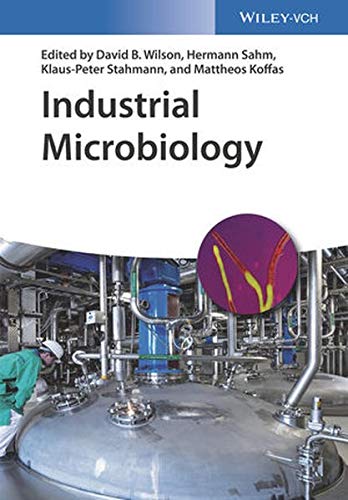

Industrial Microbiology / edited by David B. Wilson, , Hermann Sahm, , Klaus-Peter Stahmann, , and Mattheos Koffas.
Editor: Newark : John Wiley & Sons, Incorporated, 2020Fecha de copyright: ©2020Descripción: 1 online resource (420 pages)Tipo de contenido:- text
- computer
- online resource
- 9783527697298
- 579
- QR41.2 .I538 2020
| Imagen de cubierta | Tipo de ítem | Biblioteca actual | Biblioteca de origen | Colección | Ubicación en estantería | Signatura topográfica | Materiales especificados | Info Vol | URL | Copia número | Estado | Notas | Fecha de vencimiento | Código de barras | Reserva de ítems | Prioridad de la cola de reserva de ejemplar | Reservas para cursos | |
|---|---|---|---|---|---|---|---|---|---|---|---|---|---|---|---|---|---|---|
| Libro electrónico | Biblioteca de Mayagüez Acceso en línea | QR41.2 .I538 2020 (Navegar estantería(Abre debajo)) | Ebook c. 1 | Disponible | 50000003287587 | |||||||||||||
| Libro electrónico | Biblioteca Encarnación Valdés Acceso en línea | 579 (Navegar estantería(Abre debajo)) | Disponible | EBC5983909 |
Descripciones mejoradas de Syndetics:
Focusing on current and future uses of microbes as production organisms, this practice-oriented textbook complements traditional texts on microbiology and biotechnology.
The editors have brought together leading researchers and professionals from the entire field of industrial microbiology and together they adopt a modern approach to a well-known subject. Following a brief introduction to the technology of microbial processes, the twelve most important application areas for microbial technology are described, from crude bulk chemicals to such highly refined biomolecules as enzymes and antibodies, to the use of microbes in the leaching of minerals and for the treatment of municipal and industrial waste. In line with their application-oriented topic, the authors focus on the "translation" of basic research into industrial processes and cite numerous successful examples. The result is a first-hand account of the state of the industry and the future potential for microbes in industrial processes.
Interested students of biotechnology, bioengineering, microbiology and related disciplines will find this a highly useful and much consulted companion, while instructors can use the case studies and examples to add value to their teaching.
Cover -- Title Page -- Copyright -- Contents -- Preface -- Chapter 1 Historical Overview and Future Perspective -- 1.1 Use of Fermentation Procedures Before the Discovery of Microorganisms (Neolithic Era & -- equals -- New Stone Age Until 1850) -- 1.2 Investigation of Microorganisms and Beginning of Industrial Microbiology (1850 Until 1940) -- 1.3 Development of New Products and Procedures: Antibiotics and Other Biomolecules (From 1940) -- 1.4 Genetic Engineering Is Introduced into Industrial Microbiology (From Roughly 1980) -- 1.5 Future Perspectives: Synthetic Microbiology -- References -- Further Reading -- Chapter 2 Bioprocess Engineering -- 2.1 Introduction -- 2.1.1 Role of Bioreactors -- 2.1.2 Basic Bioreactor Configurations -- 2.1.3 Types of Growth Media -- 2.2 Nonstructured Models -- 2.2.1 Nonstructured Growth Models -- 2.2.1.1 Unstructured Models -- 2.2.1.2 Biotechnical Processes -- 2.2.2 Modeling Fermentations -- 2.2.3 Metabolic Pathways -- 2.2.4 Manipulation of Metabolic Pathways -- 2.2.5 Future of Pathway Design -- 2.3 Oxygen Transport -- 2.3.1 Aerobic versus Anaerobic Conditions -- 2.3.2 kLa - Volumetric Mass Transfer Coefficient -- 2.4 Heat Generating Aerobic Processes -- 2.5 Product Recovery -- 2.5.1 Basics -- 2.5.2 In Situ Product Recovery (ISPR) -- 2.6 Modeling and Simulation of Reactor Behavior -- 2.6.1 Basic Approaches and Software -- 2.6.2 Numerical Simulation of Bioreactor Function -- 2.6.3 Contamination of Bioreactors -- 2.7 Scale‐up -- References -- Further Reading -- Chapter 3 Food -- 3.1 Fermented Foods -- 3.1.1 Food Preservation -- 3.1.2 Flavor and Texture -- 3.1.3 Health Benefits -- 3.1.4 Economic Impact -- 3.2 Microorganisms and Metabolism -- 3.2.1 Fermentation Processes -- 3.2.2 Starter Cultures -- 3.3 Yeast Fermentations - Industrial Application of Saccharomyces Species.
3.3.1 Grain Fermentation for Ethanol Production - Beer -- 3.3.2 Grain Fermentation for CO2 Production - Bread -- 3.3.2.1 Yeast Preparation -- 3.3.3 Fruit Fermentation - Wines and Ciders -- 3.4 Vinegar - Incomplete Ethanol Oxidation by Acetic Acid Bacteria Such as Gluconobacter oxydans -- 3.4.1 Substrates: Wine, Cider, and Malt -- 3.4.2 Distilled (White) Vinegar -- 3.4.3 Balsamic and Other Specialty Vinegars -- 3.5 Bacterial and Mixed Fermentations - Industrial Application of Lactic Acid Bacteria, With or Without Yeast or Molds -- 3.5.1 Milk - Cultured Milks - Buttermilk, Yogurt, Kefir, and Cheese -- 3.5.1.1 Bacteriophage Contamination - Death of a Culture -- 3.5.2 Meats - Sausages, Fish Sauces, and Pastes -- 3.5.3 Vegetables - Sauerkrauts and Pickles, Olives -- 3.5.4 Grains and Legumes - Soy Sauce, Miso, Natto, and Tempeh -- 3.5.5 Cocoa and Coffee -- 3.6 Fungi as Food -- 3.6.1 Mushrooms -- 3.6.2 Single‐Cell Protein - Fusarium venenatum -- 3.7 Conclusions and Outlook -- References -- Further Reading -- Chapter 4 Technical Alcohols and Ketones -- 4.1 Introduction -- 4.2 Ethanol Synthesis by Saccharomyces cerevisiae and Clostridium autoethanogenum -- 4.2.1 Application -- 4.2.2 Metabolic Pathways and Regulation -- 4.2.3 Production Strains -- 4.2.4 Production Processes -- 4.2.5 Ethanol - Fuel of the Future? -- 4.2.6 Alternative Substrates for Ethanol Fermentation by Cellulolytic Bacteria and Clostridium autoethanogenum -- 4.3 1,3‐Propanediol Synthesis by Escherichia coli -- 4.3.1 Application -- 4.3.2 Metabolic Pathways and Regulation -- 4.3.3 Production Strains -- 4.3.4 Production Processes -- 4.4 Butanol and Isobutanol Synthesis by Clostridia and Yeast -- 4.4.1 History of Acetone-Butanol-Ethanol (ABE) Fermentation by Clostridium acetobutylicum and C. beijerinckii -- 4.4.2 Application -- 4.4.3 Metabolic Pathways and Regulation -- 4.4.4 Production Strains.
4.4.5 Production Processes -- 4.4.6 Product Toxicity -- 4.5 Acetone Synthesis by Solventogenic Clostridia -- 4.5.1 Application -- 4.5.2 Metabolic Pathways and Regulation -- 4.5.3 Production Strains -- 4.5.4 Production Processes -- 4.6 Outlook -- Further Reading -- Chapter 5 Organic Acids -- 5.1 Introduction -- 5.2 Citric Acid -- 5.2.1 Economic Impact and Applications -- 5.2.2 Biochemistry of Citric Acid Accumulation -- 5.2.3 Industrial Production by the Filamentous Fungus Aspergillus niger -- 5.2.4 Yarrowia lipolytica: A Yeast as an Alternative Production Platform -- 5.3 Lactic Acid -- 5.3.1 Economic Impact and Applications -- 5.3.2 Anaerobic Bacterial Metabolism Generating Lactic Acid -- 5.3.3 Lactic Acid Production by Bacteria -- 5.3.4 Lactic Acid Production by Yeasts -- 5.4 Gluconic Acid -- 5.4.1 Economic Impact and Applications -- 5.4.2 Extracellular Biotransformation of Glucose to Gluconic Acid by Aspergillus niger -- 5.4.3 Production of Gluconic Acid by Bacteria -- 5.5 Succinic Acid -- 5.5.1 Economic Impact and Applications -- 5.5.2 Pilot Plants for Anaerobic or Aerobic Microbes -- 5.6 Itaconic Acid -- 5.6.1 Economic Impact and Applications -- 5.6.2 Decarboxylation as a Driver in Itaconic Acid Accumulation -- 5.6.3 Production Process by Aspergillus terreus -- 5.6.4 Metabolic Engineering for Itaconic Acid Production -- 5.7 Downstream Options for Organic Acids -- 5.8 Perspectives -- 5.8.1 Targeting Acrylic Acid - Microbes Can Replace Chemical Process Engineering -- 5.8.2 Lignocellulose‐Based Biorefineries -- Further Reading -- Chapter 6 Amino Acids -- 6.1 Introduction -- 6.1.1 Importance and Areas of Application -- 6.1.2 Amino Acids in the Feed Industry -- 6.1.3 Economic Significance -- 6.2 Production of Amino Acids -- 6.2.1 Conventional Development of Production Strains -- 6.2.2 Advanced Development of Production Strains.
6.3 l‐Glutamate Synthesis by Corynebacterium glutamicum -- 6.3.1 Synthesis Pathway and Regulation -- 6.3.2 Production Process -- 6.4 l‐Lysine -- 6.4.1 Synthesis Pathway and Regulation -- 6.4.2 Production Strains -- 6.4.3 Production Process -- 6.5 l‐Threonine Synthesis by Escherichia coli -- 6.5.1 Synthesis Pathway and Regulation -- 6.5.2 Production Strains -- 6.5.3 Production Process -- 6.6 l‐Phenylalanine -- 6.6.1 Synthesis Pathway and Regulation -- 6.6.2 Production Strains -- 6.6.3 Production Process -- 6.7 Outlook -- Further Reading -- Chapter 7 Vitamins, Nucleotides, and Carotenoids -- 7.1 Application and Economic Impact -- 7.2 l‐Ascorbic Acid (Vitamin C) -- 7.2.1 Biochemical Significance, Application, and Biosynthesis -- 7.2.2 Regioselective Oxidation with Bacteria in the Production Process -- 7.3 Riboflavin (Vitamin B2) -- 7.3.1 Significance as a Precursor for Coenzymes and as a Pigment -- 7.3.2 Biosynthesis by Fungi and Bacteria -- 7.3.3 Production by Ashbya gossypii -- 7.3.4 Production by Bacillus subtilis -- 7.3.5 Downstream Processing and Environmental Compatibility -- 7.4 Cobalamin (Vitamin B12) -- 7.4.1 Physiological Relevance -- 7.4.2 Biosynthesis -- 7.4.3 Production with Pseudomonas denitrificans -- 7.5 Purine Nucleotides -- 7.5.1 Impact as Flavor Enhancer -- 7.5.2 Development of Production Strains -- 7.5.3 Production of Inosine or Guanosine with Subsequent Phosphorylation -- 7.6 ‐Carotene -- 7.6.1 Physiological Impact and Application -- 7.6.2 Production with Blakeslea trispora -- 7.7 Perspectives -- Further Reading -- Chapter 8 Antibiotics and Pharmacologically Active Compounds -- 8.1 Microbial Substances Active Against Infectious Disease Agents or Affecting Human Cells -- 8.1.1 Distribution and Impacts -- 8.1.2 Diversity of Antibiotics Produced by Bacteria and Fungi -- 8.2 ‐Lactams -- 8.2.1 History, Effect, and Application.
8.2.2 ‐Lactam Biosynthesis -- 8.2.3 Penicillin Production by Penicillium chrysogenum -- 8.2.4 Cephalosporin Production by Acremonium chrysogenum -- 8.3 Lipopeptides -- 8.3.1 History, Effect, and Application -- 8.3.2 Lipopeptide Biosynthesis -- 8.3.3 Daptomycin Production by Streptomyces roseosporus -- 8.3.4 Cyclosporine Production by Tolypocladium inflatum -- 8.4 Macrolides -- 8.4.1 History, Effect, and Application -- 8.4.2 Macrolide Biosynthesis -- 8.4.3 Erythromycin Production by Saccharopolyspora erythraea -- 8.5 Tetracyclines -- 8.5.1 History, Effect, and Application -- 8.5.2 Tetracycline Biosynthesis -- 8.5.3 Tetracycline Production by Streptomyces rimosus -- 8.6 Aminoglycosides -- 8.6.1 History, Effect, and Application -- 8.6.2 Aminoglycoside Biosynthesis -- 8.6.3 Tobramycin Production by Streptomyces tenebrarius -- 8.7 Claviceps Alkaloids -- 8.7.1 History, Effect, and Application -- 8.7.2 Alkaloid Biosynthesis -- 8.7.3 Ergotamine Production by Claviceps purpurea -- 8.8 Perspectives -- 8.8.1 Antibiotic Resistance -- 8.8.2 New Research Model for Compound Identification -- 8.8.3 Future Opportunities -- Further Reading -- Chapter 9 Pharmaceutical Proteins -- 9.1 History, Main Areas of Application, and Economic Importance -- 9.2 Industrial Expression Systems, Cultivation and Protein Isolation, and Legal Framework -- 9.2.1 Development of Production Strains -- 9.2.2 Isolation of Pharmaceutical Proteins -- 9.2.3 Regulatory Requirements for the Production of Pharmaceutical Proteins -- 9.3 Insulins -- 9.3.1 Application and Structures -- 9.3.2 Manufacturing Processes by Escherichia coli and Saccharomyces cerevisiae -- 9.3.2.1 Production of a Fusion Protein in E. coli -- 9.3.2.2 Production of a Precursor Protein, the So‐Called Mini Proinsulin with the Host Strain S. cerevisiae -- 9.4 Somatropin -- 9.4.1 Application -- 9.4.2 Manufacturing Process.
9.5 Interferons - Application and Manufacturing.
Description based on publisher supplied metadata and other sources.
Electronic reproduction. Ann Arbor, Michigan : ProQuest Ebook Central, 2021. Available via World Wide Web. Access may be limited to ProQuest Ebook Central affiliated libraries.
Notas de autor provistas por Syndetics
David Wilson, PhD, was a Professor of Biochemistry, Molecular and Cell Biology at Cornell University in Ithaca (USA).
Hermann Sahm, PhD, is Emeritus Professor of Biotechnology at the University of Düsseldorf (Germany).
Peter Stahmann, PhD, is Professor for Technical Microbiology at the Brandenburg Technical University in Senftenberg (Germany).
Mattheos Koffas, PhD, is Professor of Biology at Rensselaer Polytechnic Institute in Troy (USA).