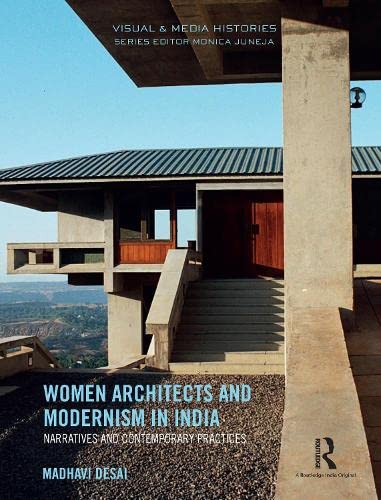

Women Architects and Modernism in India : Narratives and Contemporary Practices. / Madhavi Desai.
Series Visual and Media Histories Ser | Visual and Media Histories SerEditor: London : Taylor & Francis Group, 2016Edición: 1st edDescripción: 1 online resource (431 pages)Tipo de contenido:- text
- computer
- online resource
- 9781315454634
- 720.82
- NA1995 .D473 2017
| Imagen de cubierta | Tipo de ítem | Biblioteca actual | Biblioteca de origen | Colección | Ubicación en estantería | Signatura topográfica | Materiales especificados | Info Vol | URL | Copia número | Estado | Notas | Fecha de vencimiento | Código de barras | Reserva de ítems | Prioridad de la cola de reserva de ejemplar | Reservas para cursos | |
|---|---|---|---|---|---|---|---|---|---|---|---|---|---|---|---|---|---|---|
| Libro electrónico | Biblioteca de Mayagüez Acceso en línea | NA1995 .D473 2017 (Navegar estantería(Abre debajo)) | Ebook c. 1 | Disponible | 50000003293874 | |||||||||||||
| Libro Electrónico CARIBET | CARIBET Biblioteca Arquitectura Libros Electrónicos CARIBET | Electrónico NA1995 D473 2017 (Navegar estantería(Abre debajo)) | 1 | Disponible | caribet297127 |
Descripciones mejoradas de Syndetics:
Studies on architecture in South Asia continue to ignore women in canonical histories of the discipline. This book attempts to recover the stories of the women architects whose careers nearly parallel the development of modernism in colonial and postcolonial India. Writing their experiences into the narrative of mainstream architectural history within the challenge of non-existent archives, it sheds light on seven pioneering women who broke male bastions to go beyond the traditional confines of the era from the 1940s onwards. The author also examines 28 contemporary practices to demonstrate the ways in which architectural modernism in India was shaped by the contribution of women. The book uses a format that weaves together social, professional and biographical factors into a productive account; pluralizes various concepts of design; and redefines the idea of 'work' of women through a greater range of activities, including pedagogy, mentoring and activism. Alluding to challenges faced by women, the study celebrates practices in diverse regional settings even as the designers move in transnational contexts in an increasingly globalizing India.
Extensively illustrated, featuring drawings and photographs, this book will be a milestone in the modernist narrative of South Asia and will be of interest to scholars and researchers of architecture, gender studies, modern Indian history and sociology.
Cover -- Title -- Copyright -- Dedication -- Contents -- List of plates -- Foreword -- Acknowledgements -- Part I Introduction -- Part II Modernism, architecture and women in India -- Part III Early narratives -- 1 Perin Jamshedji Mistri -- 2 Urmila Eulie Chowdhury -- 3 Gira Sarabhai -- 4 Pravina Mehta -- 5 Hema Sankalia -- 6 Hema Patel -- 7 Madhu Sarin -- Part IV Contemporary practices -- 8 Minakshi Jain -- 9 Renu Mistry -- 10 Namita Singh -- 11 Brinda Somaya -- 12 Neera Adarkar -- 13 Meena Mani -- 14 Parul Zaveri -- 15 Nalini Thakur -- 16 Revathi Kamath -- 17 Sheila Sri Prakash -- 18 Vandana Ranjitsinh -- 19 Anjali Yagnik -- 20 Sujatha Shankar -- 21 Sonali Bhagwati -- 22 Suhasini Ayer-Guigan -- 23 Canna Patel -- 24 Chitra Vishwanath -- 25 Shimul Javeri Kadri -- 26 Samira Rathod -- 27 Pratima Joshi -- 28 Gurmeet Rai -- 29 Anupama Kundoo -- 30 Latha Raman Jaigopal -- 31 Mona Doctor-Pingel -- 32 Nisha Mathew -- 33 Shikha Jain -- 34 Archana Chaudhary -- 35 Shilpa Ranade -- Part V Towards conclusions -- Appendix -- Bibliography -- Index.
Studies on architecture in South Asia continue to ignore women in canonical histories of the discipline. This book attempts to recover the stories of the women architects whose careers nearly parallel the development of modernism in colonial and postcolonial India. Writing their experiences into the narrative of mainstream architectural history within the challenge of non-existent archives, it sheds light on seven pioneering women who broke male bastions to go beyond the traditional confines of the era from the 1940s onwards. The author also examines 28 contemporary practices to demonstrate the ways in which architectural modernism in India was shaped by the contribution of women. The book uses a format that weaves together social, professional and biographical factors into a productive account; pluralizes various concepts of design; and redefines the idea of 'work' of women through a greater range of activities, including pedagogy, mentoring and activism. Alluding to challenges faced by women, the study celebrates practices in diverse regional settings even as the designers move in transnational contexts in an increasingly globalizing India. Extensively illustrated, featuring drawings and photographs, this book will be a milestone in the modernist narrative of South Asia and will be of interest to scholars and researchers of architecture, gender studies, modern Indian history and sociology.
Description based on publisher supplied metadata and other sources.
Electronic reproduction. Ann Arbor, Michigan : ProQuest Ebook Central, 2021. Available via World Wide Web. Access may be limited to ProQuest Ebook Central affiliated libraries.
Notas de autor provistas por Syndetics
Madhavi Desai is an adjunct faculty member at the Faculty of Architecture, CEPT (Center for Environmental Planning and Technology) University, Ahmedabad, Gujarat, India. She is the author of Traditional Architecture: House Form of the Islamic Community of the Bohras in Gujarat (2008); co-author of Architecture and Independence: The Search for Identity, India 1880 to 1980 (1997), The Bungalow in Twentieth-Century India: The Cultural Expression of Changing Ways of Life and Aspirations in the Domestic Architecture of Colonial and Post-colonial Society (2012) and Architectural Heritage of Gujarat: Interpretation, Appreciation, Values (2012); and editor of Women and the Built Environment in India (2007).