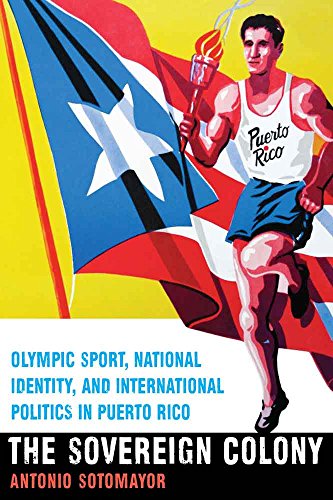

The Sovereign Colony : Olympic Sport, National Identity, and International Politics in Puerto Rico / Antonio Sotomayor.
Editor: Lincoln, NE : Nebraska, 2016Fecha de copyright: ©2016Descripción: 1 online resource (325 pages)Tipo de contenido:- text
- computer
- online resource
- 9780803285408
- 796.48
- GV721.4 .P9 S68 2016
| Imagen de cubierta | Tipo de ítem | Biblioteca actual | Biblioteca de origen | Colección | Ubicación en estantería | Signatura topográfica | Materiales especificados | Info Vol | URL | Copia número | Estado | Notas | Fecha de vencimiento | Código de barras | Reserva de ítems | Prioridad de la cola de reserva de ejemplar | Reservas para cursos | |
|---|---|---|---|---|---|---|---|---|---|---|---|---|---|---|---|---|---|---|
| Libro electrónico | Biblioteca de Mayagüez Acceso en línea | GV721.4 .P9 S68 2016 (Navegar estantería(Abre debajo)) | Ebook c. 1 | Disponible | 50000003295671 | |||||||||||||
| Libro electrónico | Biblioteca Encarnación Valdés Acceso en línea | 796.48 (Navegar estantería(Abre debajo)) | Disponible | EBC4228726 | ||||||||||||||
| Libro electrónico | Biblioteca Mons. Iñaki Mallona (Arecibo) Acceso en línea | 796.48 (Navegar estantería(Abre debajo)) | Ebook | Disponible | 60000010177266 |
Descripciones mejoradas de Syndetics:
Ceded to the United States under the terms of the Treaty of Paris after the Spanish-American War of 1898, Puerto Rico has since remained a colonial territory. Despite this subordinated colonial experience, however, Puerto Ricans managed to secure national Olympic representation in the 1930s and in so doing nurtured powerful ideas of nationalism.
By examining how the Olympic movement developed in Puerto Rico, Antonio Sotomayor illuminates the profound role sports play in the political and cultural processes of an identity that evolved within a political tradition of autonomy rather than traditional political independence. Significantly, it was precisely in the Olympic arena that Puerto Ricans found ways to participate and show their national pride, often by using familiar colonial strictures--and the United States' claim to democratic values--to their advantage. Drawing on extensive archival research, both on the island and in the United States, Sotomayor uncovers a story of a people struggling to escape the colonial periphery through sport and nationhood yet balancing the benefits and restraints of that same colonial status.
The Sovereign Colony describes the surprising negotiations that gave rise to Olympic sovereignty in a colonial nation, a unique case in Latin America, and uses Olympic sports as a window to view the broader issues of nation building and identity, hegemony, postcolonialism, international diplomacy, and Latin American-U.S. relations.
Includes bibliographical references and index.
Introduction -- 1. Sport in Imperial Exchanges -- 2. The Rise of a Colonial Olympic Movement, 1930s -- 3. Legitimizing Colonial Olympism in a Colonial Nation, 1940s -- 4. The Commonwealth and the Search for Colonial Sovereignty through Olympism -- 5. A Cold War Playing Field in the 1966 Central American and Caribbean Games -- 6. The Eternal Overtime? -- Notes -- Bibliography -- Index.
Ceded to the United States under the terms of the Treaty of Paris after the Spanish-American War of 1898, Puerto Rico has since remained a colonial territory. Despite this subordinated colonial experience, however, Puerto Ricans managed to secure national Olympic representation in the 1930s and in so doing nurtured powerful ideas of nationalism. By examining how the Olympic movement developed in Puerto Rico, Antonio Sotomayor illuminates the profound role sports play in the political and cultural processes of an identity that evolved within a political tradition of autonomy rather than traditional political independence. Significantly, it was precisely in the Olympic arena that Puerto Ricans found ways to participate and show their national pride, often by using familiar colonial strictures—and the United States’ claim to democratic values—to their advantage. Drawing on extensive archival research, both on the island and in the United States, Sotomayor uncovers a story of a people struggling to escape the colonial periphery through sport and nationhood yet balancing the benefits and restraints of that same colonial status. The Sovereign Colony describes the surprising negotiations that gave rise to Olympic sovereignty in a colonial nation, a unique case in Latin America, and uses Olympic sports as a window to view the broader issues of nation building and identity, hegemony, postcolonialism, international diplomacy, and Latin American–U.S. relations.
Description based on publisher supplied metadata and other sources.
Electronic reproduction. Ann Arbor, Michigan : ProQuest Ebook Central, 2021. Available via World Wide Web. Access may be limited to ProQuest Ebook Central affiliated libraries.
Reseñas proporcionadas por Syndetics
CHOICE Review
Sotomayor (Latin American and Caribbean studies, Univ. of Illinois) offers an innovative approach to Puerto Rico's coloniality through the prism of sports. He begins by identifying a key paradox: whereas Puerto Rico remains one of the world's last colonies, it also maintains an autonomous presence in the world of Olympic sports. This is no coincidence, he argues. Puerto Ricans used their participation in regional and world sporting competitions to cultivate and preserve a distinctive national identity and to participate in international politics, even as the US consolidated its political sovereignty over the island over the course of the early 20th century, a process the author calls "colonial Olympism." However, Sotomayor also elucidates the ways sport facilitated the consolidation of US rule in Puerto Rico by framing athletic accomplishments in terms of the promises of progress under that rule. By distinguishing between political nationalism and cultural nationalism, the author challenges conventional narratives of colonialism, implicating both Puerto Ricans and North Americans in Puerto Rico's colonial status. This accessible account of Puerto Rican sport provides a great introduction to the complex issues of contemporary coloniality and will be an excellent addition to undergraduate collections. Summing Up: Recommended. All levels/libraries. --Bonnie A. Lucero, University of Texas-Pan AmericanNotas de autor provistas por Syndetics
Antonio Sotomayor is an assistant professor and librarian of Latin American and Caribbean studies at the University of Illinois at Urbana-Champaign.