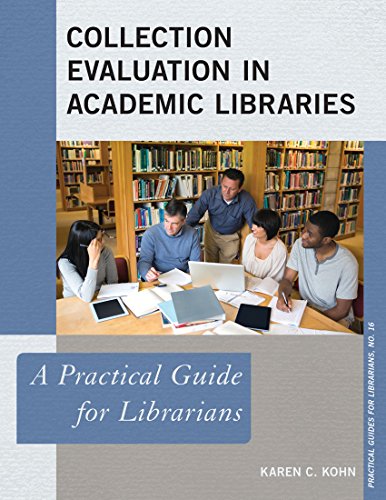
Imagen de portada de Amazon
Imagen de Amazon.com
Imagen de cubierta Syndetics
Portada de Syndetics
Imagen de OpenLibrary

Collection Evaluation in Academic Libraries : A Practical Guide for Librarians / Karen C. Kohn.

Por: Series Practical Guides for LibrariansEditor: Lanham, MD : Rowman & Littlefield Publishers, 2015Fecha de copyright: ©2015Descripción: 1 online resource (205 pages)Tipo de contenido:
  • text
Tipo de medio:
  • computer
Tipo de soporte:
  • online resource
ISBN:
  • 9781442250659
Tema(s): Género/Forma: Formatos físicos adicionales: Print version:: Collection Evaluation in Academic LibrariesClasificación CDD:
  • 025.218
Clasificación LoC:
  • Z675.U5  .K384 2015
Contenidos:
Intro -- Contents -- Illustrations -- Textboxes -- Preface -- Acknowledgments -- Chapter 1. How Collection Evaluation Can Benefit Your Library -- Chapter 2. Approaches to Evaluating Your Collection -- Chapter 3. Before You Start -- Chapter 4. Benchmarking-Collecting and Analyzing the Data -- Chapter 5. Benchmarking-Interpreting and Acting on the Data -- Chapter 6. List-Checking-Collecting and Analyzing the Data -- Chapter 7. List-Checking-Interpreting and Acting on the Data -- Chapter 8. Usage Statistics-Collecting and Analyzing the Data -- Chapter 9. Usage Statistics-Interpreting and Acting on the Data -- Chapter 10. Citation Analysis-Collecting and Analyzing the Data -- Chapter 11. Citation Analysis-Interpreting and Acting on the Data -- Chapter 12. Sharing What You Found -- Index -- About the Author.
Resumen: Librarians have long used data to describe their collections. Traditional measures have simply been inputs and outputs: volumes acquired, processed, owned, or circulated. With the growth since the 1990s of cultures of assessment, librarians have sought statistics that are evaluative rather than simply descriptive. More recently, exponentially increasing journal prices and an economic recession have intensified the need to make careful purchasing decisions and to justify these to administrators. A methodical evaluation of a library collection can help librarians understand and meet user needs and can help communicate to administrators that the library is a good use of the institution’s money. Collection Evaluation in Academic Libraries: A Practical Guide for Librarians equips collections managers to select and implement a method or several methods of evaluating their library collections. It includes sections on four tools for evaluation: • Comparison to peer institutions • Core lists • Usage statistics from circulation and ILL • Citation analysis Chapters on each of these approaches present the advantages and disadvantages of each method, instructions on data collection and analysis—with screenshots—and suggested action steps after completing the analysis. With a unique combination of step-by-step instructions and discussions of the purpose and role of data, this book provides an unusually thorough guide to collection evaluation. It will be indispensable for collection development librarians and anyone looking to strengthen the culture of assessment within the library.
Valoración
    Valoración media: 0.0 (0 votos)
Existencias
Imagen de cubierta Tipo de ítem Biblioteca actual Biblioteca de origen Colección Ubicación en estantería Signatura topográfica Materiales especificados Info Vol URL Copia número Estado Notas Fecha de vencimiento Código de barras Reserva de ítems Prioridad de la cola de reserva de ejemplar Reservas para cursos
Libro electrónico Biblioteca de Mayagüez Acceso en línea Z675.U5 .K384 2015 (Navegar estantería(Abre debajo)) Ebook c. 1 Disponible 50000003283396
Libro electrónico Biblioteca Encarnación Valdés Acceso en línea 025.218 (Navegar estantería(Abre debajo)) Disponible EBC2081421
Total de reservas: 0

Descripciones mejoradas de Syndetics:

Librarians have long used data to describe their collections. Traditional measures have simply been inputs and outputs: volumes acquired, processed, owned, or circulated. With the growth since the 1990s of cultures of assessment, librarians have sought statistics that are evaluative rather than simply descriptive. More recently, exponentially increasing journal prices and an economic recession have intensified the need to make careful purchasing decisions and to justify these to administrators. A methodical evaluation of a library collection can help librarians understand and meet user needs and can help communicate to administrators that the library is a good use of the institution's money.


Collection Evaluation in Academic Libraries: A Practical Guide for Librarians equips collections managers to select and implement a method or several methods of evaluating their library collections.


It includes sections on four tools for evaluation:


* Comparison to peer institutions

* Core lists

* Usage statistics from circulation and ILL

* Citation analysis


Chapters on each of these approaches present the advantages and disadvantages of each method, instructions on data collection and analysis--with screenshots--and suggested action steps after completing the analysis. With a unique combination of step-by-step instructions and discussions of the purpose and role of data, this book provides an unusually thorough guide to collection evaluation. It will be indispensable for collection development librarians and anyone looking to strengthen the culture of assessment within the library.


Includes bibliographical references and index.

Intro -- Contents -- Illustrations -- Textboxes -- Preface -- Acknowledgments -- Chapter 1. How Collection Evaluation Can Benefit Your Library -- Chapter 2. Approaches to Evaluating Your Collection -- Chapter 3. Before You Start -- Chapter 4. Benchmarking-Collecting and Analyzing the Data -- Chapter 5. Benchmarking-Interpreting and Acting on the Data -- Chapter 6. List-Checking-Collecting and Analyzing the Data -- Chapter 7. List-Checking-Interpreting and Acting on the Data -- Chapter 8. Usage Statistics-Collecting and Analyzing the Data -- Chapter 9. Usage Statistics-Interpreting and Acting on the Data -- Chapter 10. Citation Analysis-Collecting and Analyzing the Data -- Chapter 11. Citation Analysis-Interpreting and Acting on the Data -- Chapter 12. Sharing What You Found -- Index -- About the Author.

Librarians have long used data to describe their collections. Traditional measures have simply been inputs and outputs: volumes acquired, processed, owned, or circulated. With the growth since the 1990s of cultures of assessment, librarians have sought statistics that are evaluative rather than simply descriptive. More recently, exponentially increasing journal prices and an economic recession have intensified the need to make careful purchasing decisions and to justify these to administrators. A methodical evaluation of a library collection can help librarians understand and meet user needs and can help communicate to administrators that the library is a good use of the institution’s money. Collection Evaluation in Academic Libraries: A Practical Guide for Librarians equips collections managers to select and implement a method or several methods of evaluating their library collections. It includes sections on four tools for evaluation: • Comparison to peer institutions • Core lists • Usage statistics from circulation and ILL • Citation analysis Chapters on each of these approaches present the advantages and disadvantages of each method, instructions on data collection and analysis—with screenshots—and suggested action steps after completing the analysis. With a unique combination of step-by-step instructions and discussions of the purpose and role of data, this book provides an unusually thorough guide to collection evaluation. It will be indispensable for collection development librarians and anyone looking to strengthen the culture of assessment within the library.

Description based on publisher supplied metadata and other sources.

Electronic reproduction. Ann Arbor, Michigan : ProQuest Ebook Central, 2021. Available via World Wide Web. Access may be limited to ProQuest Ebook Central affiliated libraries.

Reseñas proporcionadas por Syndetics

Library Journal Review

Step-by-step instructions for information gathering and analysis and generally using Excel files are the basis of this guide, though reference is also made to the two major collection evaluation software tools: OCLC's (Online Computer Library Center) WorldShare Collection Evaluation and ProQuest's Intota Assessment. Both tools automate the process of data compilation and peer comparison to some extent but are not necessary to accomplish the twin goals of collection evaluation and improved collection development. As Kohn (collection development manager, Arcadia Univ.) points out, the analysis of appropriate data is also useful in weeding decisions and to reinforce increased budget requests. With lengthy overviews of the traditional methods of library collection analysis: list checking, holdings counts, circulation counts, and citation analysis, this manual also includes some guidance on the use of COUNTER reports for electronic holdings. Where this guide shines is in its final chapter on how to present the results to specific audiences. VERDICT New librarians will find this guide invaluable for creating a collection evaluation plan for their libraries and even experienced librarians will likely unearth something new, even though most of this ground is well-trodden.-Margaret Sylvia, St. Mary's Univ. Lib., San Antonio © Copyright 2015. Library Journals LLC, a wholly owned subsidiary of Media Source, Inc. No redistribution permitted.

Booklist Review

In this guide to an important and always-evolving area of academic librarianship, Kohn, a collection-development manager at Arcadia University, explores how academic libraries can implement the most current and effective methods for assessing their collections. Due to shrinking budgets, rising prices, and the increasing need to justify collection-development policies to the administration, it is critical that librarians make informed decisions when it comes to their collections. This book is well organized and comprehensive, with illustrations, charts, and extensive references. Each chapter is devoted to different collection-development strategies, which include collecting, analyzing, interpreting, using, and communicating the data. This latest edition to the Practical Guides for Librarians series is a must for collection-development librarians and for academic librarians who need to learn more about this essential area of librarianship.--Robinson, Lyndsie Copyright 2015 Booklist

Notas de autor provistas por Syndetics

Karen Kohn is the Collection Development Manager at Landman Library, Arcadia University, where she has conducted a usage-based collection evaluation and an analysis of student bibliographies. She has a MS in Library and Information Science from the University of Illinois at Urbana-Champaign and an MA in Sociology from Temple University. Ms Kohn has published articles in College & Research Libraries and the Journal of Web Librarianship and has presented on collection evaluation at the Charleston Conference: Issues in Book and Serials Acquisitions and the Acquisitions Institute at Timberline Lodge. Slides from both of these conferences are available online, and links are available on request.
Compartir
logopucpr-y-vive

Contáctanos

¡Queremos saber de ti!

Tel. 787.841.2000 Ext. 1801

bibliotecavaldes@pucpr.edu

⁣Búscanos en las redes

© 2026 Desarrollado por Ignite Online • All Rights Reserved • Powered by Koha.