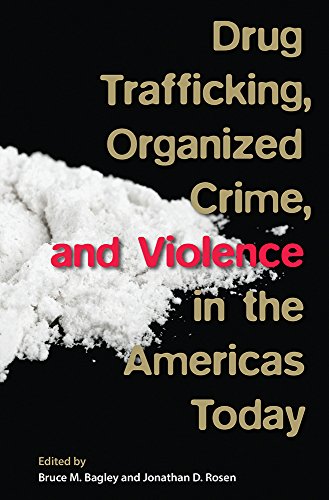

Drug Trafficking, Organized Crime, and Violence in the Americas Today / edited by Bruce M. Bagley and Jonathan D. Rosen.
Editor: Gainesville : University Press of Florida, 2015Fecha de copyright: ©2015Descripción: 1 online resource (459 pages)Tipo de contenido:- text
- computer
- online resource
- 9780813055336
- 363.45097
- HV5840 .L3 .D773 2015
| Imagen de cubierta | Tipo de ítem | Biblioteca actual | Biblioteca de origen | Colección | Ubicación en estantería | Signatura topográfica | Materiales especificados | Info Vol | URL | Copia número | Estado | Notas | Fecha de vencimiento | Código de barras | Reserva de ítems | Prioridad de la cola de reserva de ejemplar | Reservas para cursos | |
|---|---|---|---|---|---|---|---|---|---|---|---|---|---|---|---|---|---|---|
| Libro electrónico | Biblioteca de Mayagüez Acceso en línea | HV5840 .L3 .D773 2015 (Navegar estantería(Abre debajo)) | Ebook c. 1 | Disponible | 50000003285821 | |||||||||||||
| Libro electrónico | Biblioteca Encarnación Valdés Acceso en línea | 363.45097 (Navegar estantería(Abre debajo)) | Disponible | EBC2030222 |
Descripciones mejoradas de Syndetics:
In 1971, Richard Nixon declared a war on drugs. Despite foreign policy efforts and attempts to combat supply lines, the United States has been for decades, and remains today, the largest single consumer market for illicit drugs on the planet.
This volume argues that the war on drugs has been ineffective at best and, at worst, has been highly detrimental to many countries. Leading experts in the fields of public health, political science, and national security analyze how U.S. policies have affected the internal dynamics of Mexico, Colombia, Bolivia, Peru, Brazil, Argentina, Central America, and the Caribbean islands. Together, they present a comprehensive overview of the major trends in drug trafficking and organized crime in the early twenty-first century.
In addition, the editors and contributors identify emerging issues and propose several policy options to address them. This accessible and expansive volume provides a framework for understanding the limits and liabilities in the U.S.-championed war on drugs throughout the Americas.
Includes index.
Cover -- Drug Trafficking, Organized Crime, and Violence in the Americas Today -- Title -- Copyright -- CONTENTS -- List of Figures -- List of Tables -- Preface: On the Study of Drug Trafficking and Organized Crime Networks in Latin America and the Caribbean in the Twenty-First Century -- Acknowledgments -- Introduction. Drug Trafficking and Organized Crime in Latin America and the Caribbean in the Twenty-First Century: Challenges to Democracy -- PART I. U.S. DRUG POLICIES AT HOME AND ABROAD -- 1. Coca, Cocaine, and Consumption: Trends and Antitrends -- 2. Illegal Drugs as a National Security Threat: Securitization of Drugs in the U.S. Official Discourse -- 3. The War on Drugs and the Role of SOUTHCOM -- 4. Mission Creep: The U.S. Military's Counterdrug Role in the Americas -- 5. Security Challenges at the U.S.-Mexican Border: Understanding the Security Threats to State and Local Governments -- 6. Drug-Control Policies in the United States: Patterns, Prevalence, and Problems of Drug Use in the United States -- PART II. DRUG TRAFFICKING AND ORGANIZED CRIME: COUNTRY AND REGIONAL ANALYSES -- COLOMBIA -- 7. Colombia and Its Wars against Drug Trafficking, 1970-2010 -- 8. Illicit Drugs in the Colombia-U.S. Relationship: Review and Prospects -- 9. Escalating Heroin Consumption and the Spread of HIV in Colombia: An Emerging Public Health Threat -- BOLIVIA -- 10. Bolivian Drug Policy under the Morales Administration -- PERU -- 11. The Vicious Cycle: The Resurgence of Drug Production and Drug Trafficking in Peru -- MEXICO, CENTRAL AMERICA, AND THE CARIBBEAN -- 12. In Search of the Mérida Initiative: From Antecedents to Practical Results -- 13. Police Reform in Mexico: A Never-Ending Story -- 14. Democracy, Security, and Organized Crime in Central America -- 15. Seeking Out the State: Organized Crime, Violence, and Statetropism in the Caribbean -- BRAZIL.
16. The Power of Organized Crime in Brazil: From Public and Social Challenges to the Effectiveness of Reforms -- ARGENTINA -- 17. Under (Loose) Control: Drug Trafficking in Argentina in Times of Paradigm Change -- PART III. REGIONAL AND INTERNATIONAL DRUG-CONTROL POLICIES -- 18. The Role of the Inter-American Drug Abuse Control Commission: Confronting the Problem of Illegal Drugs in the Americas -- 19. The Strategies of the European Union against Drug Trafficking -- 20. Analytical Conclusions: The Search for Alternative Drug Policies in the Americas -- List of Contributors -- Index.
In 1971, Richard Nixon declared a war on drugs. Despite foreign policy efforts and attempts to combat supply lines, the United States has been for decades, and remains today, the largest single consumer market for illicit drugs on the planet. In this volume, Bruce Bagley and Jonathan Rosen illustrate that the war on drugs has been ineffective at best and, at worst, has been highly detrimental to countries throughout the region. They present a clear picture of drug trafficking and its role in organized crime while discussing the major trends of the war on drugs in the twenty-first century, as well as its future. With this comprehensive overview, Bagley and Rosen develop a framework for understanding the limits and liabilities in the U.S.-championed war on drugs throughout the Americas.
Description based on publisher supplied metadata and other sources.
Electronic reproduction. Ann Arbor, Michigan : ProQuest Ebook Central, 2021. Available via World Wide Web. Access may be limited to ProQuest Ebook Central affiliated libraries.
Reseñas proporcionadas por Syndetics
CHOICE Review
This edited volume provides an extensive overview of the drug trade in the Americas and its impact on politics, economics, and society throughout the region. The strength of this book is its breadth. With an excellent introduction, the editors concisely outline how the drug market operates and what roles different countries have played in each part of the commodity chain. Additional chapters explain how the drug trade evolved over time, noting in particular how illicit markets adapt to law enforcement efforts. The editors complement this regional overview with case studies of drug politics in select Latin American countries. These case studies complement one another well and highlight the distinct challenges countries of the region face, ranging from those that mainly cultivate coca (e.g., Peru and Bolivia) to those that are largely transit countries (e.g., Argentina). After empirically evaluating regional and national trends, the authors sharply critique the US war on drugs and conclude the volume with an assessment of anti-drug efforts in the EU and potential alternative strategies for the Americas. This book is a great resource for undergraduate or graduate students interested in the international drug trade. Summing Up: Highly recommended. Upper-division undergraduates and above. --Mary Fran T. Malone, University of New HampshireNotas de autor provistas por Syndetics
Bruce M. Bagley , professor and former associate dean of the Graduate School of International Studies at the University of Miami, is coauthor of International Relations in Latin America . Jonathan D. Rosen , professor of international studies at the Universidad del Mar in Mexico, is the author of The Losing War: Plan Colombia and Beyond.
Contributors: Sigrid Arzt | Bruce M. Bagley | Jeanene McCoy Bengoa | Oscar Bernal | Lilian Bobea | Marten W. Brienen | Carolina Cepeda | Daniel H. Ciccarone | Khatchik DerGhougassian | Roberto Domínguez | Zelde Espinel Ben-Amy | Glen Evans | Betty Horwitz | Adam Isacson | Alberto Lozano-Vázquez | Duane C. McBride | Clyde McCoy | J. Bryan Page | Jorge Rebolledo Flores | Elvira María Restrepo | Rocío A. Rivera Barradas | Francisco Rojas Aravena | Jonathan D. Rosen | James M. Shultz | Arlene B. Tickner | Juan Gabriel Tokatlian | Yulia Vorobyeva | Marcelo Rocha e Silva Zorovich