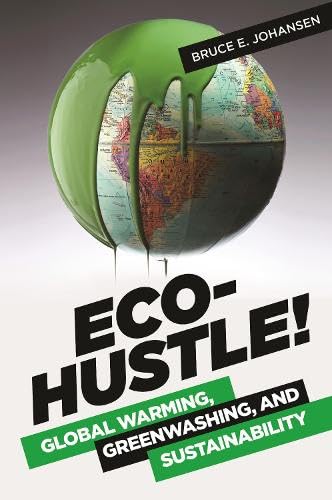

Eco-Hustle! Global Warming, Greenwashing, and Sustainability : Global Warming, Greenwashing, and Sustainability / Bruce E. Johansen.
Editor: Santa Barbara, CA : ABC-CLIO, LLC, 2015Fecha de copyright: ©2015Descripción: 1 online resource (289 pages)Tipo de contenido:- text
- computer
- online resource
- 9781440832529
- 363.738/74
- QC981.8.G56 J6377 2015
| Imagen de cubierta | Tipo de ítem | Biblioteca actual | Biblioteca de origen | Colección | Ubicación en estantería | Signatura topográfica | Materiales especificados | Info Vol | URL | Copia número | Estado | Notas | Fecha de vencimiento | Código de barras | Reserva de ítems | Prioridad de la cola de reserva de ejemplar | Reservas para cursos | |
|---|---|---|---|---|---|---|---|---|---|---|---|---|---|---|---|---|---|---|
| Libro electrónico | Biblioteca de Mayagüez Acceso en línea | QC981.8.G56 J6377 2015 (Navegar estantería(Abre debajo)) | Ebook c. 1 | Disponible | 50000003285870 | |||||||||||||
| Libro electrónico | Biblioteca Encarnación Valdés Acceso en línea | 363.738/74 (Navegar estantería(Abre debajo)) | Disponible | EBC1996436 |
Descripciones mejoradas de Syndetics:
How many of our efforts to save the environment are effective? Learn how our system is simply masking the symptoms of global warming. Climate change is more than just a buzzword. It is a reality that society and industry have failed to deal with effectively. "Greenwashing," a term that author Bruce E. Johansen defines as the "environmental sleight of hand" performed by technology and advertising, has us convinced that certain "green" practices are sustainable. In his book, Johansen examines the sanctioned activities and practices commonly touted as environmentally responsible and points out their failings. He explains why the global climate change problem is more urgent than many people think, and provides real-world examples of companies that are taking measures with genuine benefits to the environment.Presenting information relevant to every inhabitant of earth and that environmentalists, climate scientists, and students and educators in environmental studies will find essential reading, this book brings questions about legislation and economics to the forefront and asks whether today's system can support a true effort at sustainable living. It presents honest--and what some readers may find surprising--answers to inquiries into what is really "good for the environment," such as why corn ethanol may be worse for the atmosphere than oil and why coal capture and sequestration may be the worst "green" idea yet.
Cover -- Half Title -- Title Page -- Copyright -- Contents -- Introduction -- I. Problems -- 1. Why So Urgent? Thermal Inertia, Feedbacks, and Tomorrow's News -- 2. Raining on the Corn-Ethanol Parade -- 3. Cap and Hustle and Other Eco-Scams: Making a Buck while the Earth Burns -- 4. "Clean Coal," and Other Oxymoronic Orwellianisms -- 5. Carbon Capture and Sequestration: A Bad Idea Whose Time Has Come-and Gone -- 6. Geo-engineering: Sulfur as Savior? -- 7. Greening the Pentagon? The Carbon Footprint of War -- 8. Degrees of Denial: The Contrarians' Alternative Universe -- II. Solutions -- 9. Accounting, Insurance, and Taxation as if It Really Matters -- 10. Genuine Greening in the Corporate World -- Conclusion: Can the System Solve the Problem? -- Selected Bibliography -- Index -- About the Author.
Climate change is more than just a buzzword. It is a reality that society and industry have failed to deal with effectively. "Greenwashing," a term that author Bruce E. Johansen defines as the "environmental sleight of hand" performed by technology and advertising, has us convinced that certain "green" practices are sustainable. In his book, Johansen examines the sanctioned activities and practices commonly touted as environmentally responsible and points out their failings. He explains why the global climate change problem is more urgent than many people think, and provides real-world examples of companies that are taking measures with genuine benefits to the environment. Presenting information relevant to every inhabitant of earth and that environmentalists, climate scientists, and students and educators in environmental studies will find essential reading, this book brings questions about legislation and economics to the forefront and asks whether today's system can support a true effort at sustainable living. It presents honest-and what some readers may find surprising-answers to inquiries into what is really "good for the environment," such as why corn ethanol may be worse for the atmosphere than oil and why coal capture and sequestration may be the worst "green" idea yet.
Description based on publisher supplied metadata and other sources.
Electronic reproduction. Ann Arbor, Michigan : ProQuest Ebook Central, 2021. Available via World Wide Web. Access may be limited to ProQuest Ebook Central affiliated libraries.