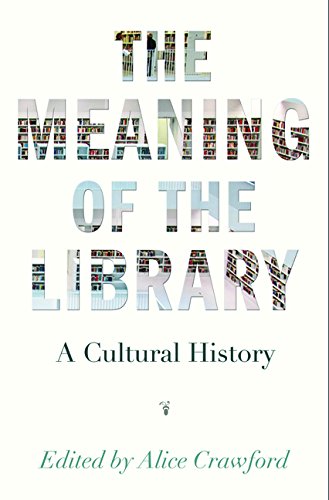
Imagen de portada de Amazon
Imagen de Amazon.com
Imagen de cubierta Syndetics
Portada de Syndetics
Imagen de OpenLibrary

The Meaning of the Library : A Cultural History / edited by Alice Crawford.

Colaborador(es): Editor: Princeton : Princeton University Press, 2015Fecha de copyright: ©2015Descripción: 1 online resource (349 pages)Tipo de contenido:
  • text
Tipo de medio:
  • computer
Tipo de soporte:
  • online resource
ISBN:
  • 9781400865741
Tema(s): Género/Forma: Formatos físicos adicionales: Print version:: The Meaning of the LibraryClasificación CDD:
  • 027/.009
Clasificación LoC:
  • Z1001  .C384 2015
Contenidos:
INTRODUCTION -- PART 1. THE LIBRARY THROUGH TIME -- Chapter 1. Adventures in Ancient Greek and Roman Libraries -- Chapter 2. The Image of the Medieval Library -- Chapter 3. The Renaissance Library and the Challenge of Print -- Chapter 4. From Printing Shop to Bookshelves: How Books Began the Journey to Enlightenment Libraries -- Chapter 5. "The Advantages of Literature": The Subscription Library in Georgian Britain -- Chapter 6. Literature and the Library in the Nineteenth Century -- PART 2. THE LIBRARY IN IMAGINATION -- Chapter 7. The Library in Fiction -- Chapter 8. The Library in Poetry -- Chapter 9. The Library in Film: Order and Mystery -- PART 3. THE LIBRARY NOW AND IN THE FUTURE -- Chapter 10. "Casting and Gathering": Libraries, Archives, and the Modern Writer -- Chapter 11. Meanings of the Library Today -- Chapter 12. The Modern Library and Global Democracy -- SELECTED BIBLIOGRAPHY -- CONTRIBUTORS -- INDEX.
Resumen: From Greek and Roman times to the digital era, the library has remained central to knowledge, scholarship, and the imagination. The Meaning of the Library is a generously illustrated examination of this key institution of Western culture. Tracing what the library has meant since its beginning, examining how its significance has shifted, and pondering its importance in the twenty-first century, notable contributors-including the Librarian of Congress and the former executive director of the HathiTrust-present a cultural history of the library. In an informative introduction, Alice Crawford sets out the book's purpose and scope, and an international array of scholars, librarians, writers, and critics offer vivid perspectives about the library through their chosen fields. The Meaning of the Library will appeal to all who are interested in this vital institution's heritage and ongoing legacy.
Valoración
    Valoración media: 0.0 (0 votos)
Existencias
Imagen de cubierta Tipo de ítem Biblioteca actual Biblioteca de origen Colección Ubicación en estantería Signatura topográfica Materiales especificados Info Vol URL Copia número Estado Notas Fecha de vencimiento Código de barras Reserva de ítems Prioridad de la cola de reserva de ejemplar Reservas para cursos
Libro electrónico Biblioteca de Mayagüez Acceso en línea Z1001 .C384 2015 (Navegar estantería(Abre debajo)) Ebook c. 1 Disponible 50000003291878
Libro electrónico Biblioteca Encarnación Valdés Acceso en línea 027/.009 (Navegar estantería(Abre debajo)) Disponible EBC1980088
Total de reservas: 0

Descripciones mejoradas de Syndetics:

The importance of the library, from ancient times to the digital era

From Greek and Roman times to the digital era, the library has remained central to knowledge, scholarship, and the imagination. The Meaning of the Library is a generously illustrated examination of this key institution of Western culture. Tracing what the library has meant since its beginning, examining how its significance has shifted, and pondering its importance in the twenty-first century, notable contributors--including the Librarian of Congress and the former executive director of the HathiTrust--present a cultural history of the library. In an informative introduction, Alice Crawford sets out the book's purpose and scope, and an international array of scholars, librarians, writers, and critics offer vivid perspectives about the library through their chosen fields. The Meaning of the Library will appeal to all who are interested in this vital institution's heritage and ongoing legacy.

INTRODUCTION -- PART 1. THE LIBRARY THROUGH TIME -- Chapter 1. Adventures in Ancient Greek and Roman Libraries -- Chapter 2. The Image of the Medieval Library -- Chapter 3. The Renaissance Library and the Challenge of Print -- Chapter 4. From Printing Shop to Bookshelves: How Books Began the Journey to Enlightenment Libraries -- Chapter 5. "The Advantages of Literature": The Subscription Library in Georgian Britain -- Chapter 6. Literature and the Library in the Nineteenth Century -- PART 2. THE LIBRARY IN IMAGINATION -- Chapter 7. The Library in Fiction -- Chapter 8. The Library in Poetry -- Chapter 9. The Library in Film: Order and Mystery -- PART 3. THE LIBRARY NOW AND IN THE FUTURE -- Chapter 10. "Casting and Gathering": Libraries, Archives, and the Modern Writer -- Chapter 11. Meanings of the Library Today -- Chapter 12. The Modern Library and Global Democracy -- SELECTED BIBLIOGRAPHY -- CONTRIBUTORS -- INDEX.

From Greek and Roman times to the digital era, the library has remained central to knowledge, scholarship, and the imagination. The Meaning of the Library is a generously illustrated examination of this key institution of Western culture. Tracing what the library has meant since its beginning, examining how its significance has shifted, and pondering its importance in the twenty-first century, notable contributors-including the Librarian of Congress and the former executive director of the HathiTrust-present a cultural history of the library. In an informative introduction, Alice Crawford sets out the book's purpose and scope, and an international array of scholars, librarians, writers, and critics offer vivid perspectives about the library through their chosen fields. The Meaning of the Library will appeal to all who are interested in this vital institution's heritage and ongoing legacy.

Description based on publisher supplied metadata and other sources.

Electronic reproduction. Ann Arbor, Michigan : ProQuest Ebook Central, 2021. Available via World Wide Web. Access may be limited to ProQuest Ebook Central affiliated libraries.

Reseñas proporcionadas por Syndetics

Publishers Weekly Review

Editor Crawford culls together a collection of essays from lectures originally given at St. Andrews University in Kentucky, where she is a librarian. The collection is meant to survey the various conceptions through which Western civilization has understood its binding institution, with an eye toward understanding the library in its current digital upheaval. The historical chapters chisel away at the monolithic idea of the library as an attempt to collect all human knowledge by showing how the institution worked in specific times and places. Topics covered include the library's genesis in ancient Greece, the magnificent Renaissance libraries and their tragic misfortunes, adventures smuggling books during the Enlightenment, and tensions between authors and institutions, as contemporary research libraries seek to build noteworthy manuscript collections. Anglophones who have spent time in the stacks will enjoy hunting for familiar elements among the historical bedrock, including the emergence of the powerful democratic notion of the public library in the 19th century. Erudite essays explore the library in fiction, poetry, and film, from the "Epic of Gilgamesh" and the poetry of Robert Burns to Truffaut's Farenheit 451. All told, however, the book is addressed to academics and librarians more than to lay bibliophiles. (July) © Copyright PWxyz, LLC. All rights reserved.

CHOICE Review

Bringing together a succinct collection on the history of libraries, deciding what and whom to exclude or include, is the challenge that Crawford (Univ. of St. Andrews, Scotland) takes on in this survey of the library's past importance and future portent in Western--progressively global--civilization. The 13 contributors are librarians, scholars, and writers, including James H. Billington, a former librarian of Congress, and Robert Darnton, a Harvard University librarian. Eight essayists are from the UK--three from the editor's own institution, which hosted the lecture series that inspired these disquisitions. Study pieces treat knowledge depositories in classical, medieval, Renaissance, and Enlightenment times through the 19th and subsequent centuries, and some examine subscription and research libraries as well as archives. The emphasis is on facilities serving the relatively few literate patrons before the democratization of knowledge through public outreach and increasing access to diverse, digitized materials. Several essayists conclude that digital vehicles are not just print by other means but have audio and visual as well as textual elements--often interactive--that supplement and sustain rather than supplant the older forms. These pleasant peregrinations exploring the roles that libraries--primarily research libraries--have played as preservers, proponents, and providers of culture will appeal widely to library scholars and bibliophiles. Summing Up: Recommended. All libraries/levels. --Frederick J. Augustyn, Library of Congress

Booklist Review

If there's one thing to be learned from this anthology of essays about the significance of libraries across history, it is that a library can have at least as many meanings as it has patrons. Age-old questions arise: Does a collection of physical texts mire the reader in a dead past, or do books act as springboard, launching the reader to new heights? Today's library issues may not be so different from those of old: Robert Darnton points out that 300 years ago piracy was perhaps even more rampant than it is today. One essay traces the library's role in fiction, and another does the same, but in poetry. The academics who have contributed these learned essays tend to write for one another's approval and not for a general audience. Nevertheless, for both scholar and casual reader, comprehensive bibliographic notes constitute a multilingual gold mine of historical resources on libraries.--Knoblauch, Mark Copyright 2015 Booklist

Notas de autor provistas por Syndetics

Alice Crawford is digital humanities research librarian at the University of St Andrews Library in Scotland. Her books include Paradise Pursued: The Novels of Rose Macaulay .
Compartir
logopucpr-y-vive

Contáctanos

¡Queremos saber de ti!

Tel. 787.841.2000 Ext. 1801

bibliotecavaldes@pucpr.edu

⁣Búscanos en las redes

© 2026 Desarrollado por Ignite Online • All Rights Reserved • Powered by Koha.