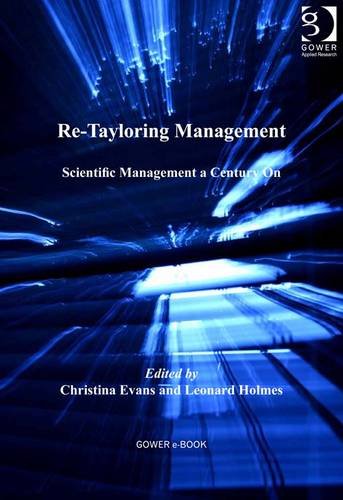

Re-Tayloring Management : Scientific Management a Century On / edited by Leonard Holmes and Christina Evans.
Editor: Abingdon : Taylor & Francis Group, 2013Fecha de copyright: ©2013Descripción: 1 online resource (179 pages)Tipo de contenido:- text
- computer
- online resource
- 9781409450764
- 658.001
- T55.9.T377 R48 2013
| Imagen de cubierta | Tipo de ítem | Biblioteca actual | Biblioteca de origen | Colección | Ubicación en estantería | Signatura topográfica | Materiales especificados | Info Vol | URL | Copia número | Estado | Notas | Fecha de vencimiento | Código de barras | Reserva de ítems | Prioridad de la cola de reserva de ejemplar | Reservas para cursos | |
|---|---|---|---|---|---|---|---|---|---|---|---|---|---|---|---|---|---|---|
| Libro electrónico | Biblioteca de Mayagüez Acceso en línea | T55.9 .T377 R48 2013 (Navegar estantería(Abre debajo)) | Ebook c. 1 | Disponible | 50000003290631 | |||||||||||||
| Libro electrónico | Biblioteca Encarnación Valdés Acceso en línea | 658.001 (Navegar estantería(Abre debajo)) | Disponible | EBC1160544 |
Descripciones mejoradas de Syndetics:
Over a century has passed and yet there is growing evidence that knowledge workers across the globe today are as constrained by F.W. Taylor's much maligned The Principles of Scientific Management, as factory workers in the early twentieth century. Re-Tayloring Management looks critically at Taylor's philosophy, contrasting this with more contemporary perspectives that have emerged with the professionalization of management and the growth in business and management education. The evidence suggest the 'ghost of Taylor' is very much alive in high skill/low cost knowledge and service roles across the globe. That despite the complexity and uncertainty that organizations face, managers are obsessed with maintaining tighter control. This approach flies in the face of contemporary job design principles with its emphasis on OCyjob craftingOCO, where individuals are encouraged to craft their role in a way that is congruent with their identity."
Chapter 1 Introduction -- PART I MANAGEMENT IN AN HISTORICAL CONTEXT -- Chapter 2 Stem Cell, Pathogen or Fatal Remedy? The Relationship of Taylor's Principles of Management to the Wider Management Movement -- Chapter 3 The Influence of Taylor on UK Business and Management Education -- Chapter 4 Managerial Performance and the Expertise of Managing: Prescriptive, Descriptive or Ascriptive? -- PART II TAYLOR'S LEGACY IN THE CONTEMPORARY KNOWLEDGE AND SERVICE ECONOMY -- Chapter 5 Call Centre Work: Taylorism with a Facelift -- Chapter 6 Digital Taylorism: Hybrid Knowledge Professionals in the UK ICT Sector -- Chapter 7 'Taylorism' without 'Taylor'? Some Reflections on 'Taylorism' and New Public Management -- Chapter 8 If It Moves, Measure It: Taylor's Impact on UK Higher Education -- PART III MANAGEMENT A CENTURY ON: CONTRADICTIONS, DILEMMAS AND PROSPECTS -- Chapter 9 Modern-Day 'Schmidts': The Legacy of Taylorism in Elite 'Professional' Roles -- Chapter 10 Job Design: From Top-Down Managerial Control to Bottom-Up 'Job Crafting' -- Chapter 11 Continuities, Discontinuities and Prospects for the Future of Management -- Index.
Over a century has passed and yet there is growing evidence that knowledge workers across the globe today are as constrained by F.W. Taylor's much-maligned The Principles of Scientific Management, as factory workers were in the early twentieth century. Re-Tayloring Management looks critically at Taylor's philosophy on management and contrasts it with other perspectives that have since emerged, along with the professionalization of management and the growth in business and management education. The contributors demonstrate that despite the complexity and uncertainty that organizations face, instead of designing work systems where knowledge and service workers have the freedom to apply knowledge and skills at the point they are most needed, managers are obsessed with maintaining tighter control. This approach conflicts with contemporary job design principles, which emphasise 'job crafting', whereby individuals are encouraged to craft their role in a way that is congruent with their identity. Drawing on insights from academics with diverse backgrounds and interests, and organised around 'past', 'present' and 'future' themes, this book is a thought-provoking read for professional managers, as well as for postgraduate students and academics teaching and researching organizational studies and management.
Description based on publisher supplied metadata and other sources.
Electronic reproduction. Ann Arbor, Michigan : ProQuest Ebook Central, 2021. Available via World Wide Web. Access may be limited to ProQuest Ebook Central affiliated libraries.