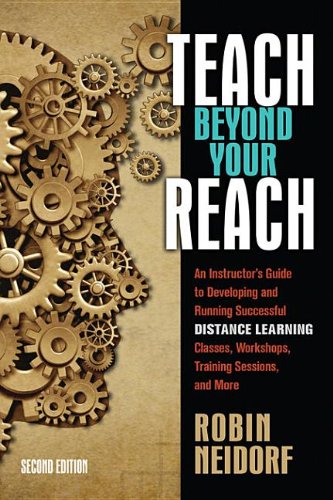

Teach Beyond Your Reach : An Instructor's Guide to Developing and Running Successful Distance Learning Classes, Workshops, Training Sessions, and More / Robin Neidorf.
Editor: Medford : Information Today, Inc., 2012Fecha de copyright: ©2012Edición: Second editionDescripción: 1 online resource (225 pages)Tipo de contenido:- text
- computer
- online resource
- 9781937290382
- 371.35
- LC5800 .N45 2012
| Imagen de cubierta | Tipo de ítem | Biblioteca actual | Biblioteca de origen | Colección | Ubicación en estantería | Signatura topográfica | Materiales especificados | Info Vol | URL | Copia número | Estado | Notas | Fecha de vencimiento | Código de barras | Reserva de ítems | Prioridad de la cola de reserva de ejemplar | Reservas para cursos | |
|---|---|---|---|---|---|---|---|---|---|---|---|---|---|---|---|---|---|---|
| Libro electrónico | Biblioteca de Mayagüez Acceso en línea | LC5800 .N45 2012 (Navegar estantería(Abre debajo)) | Ebook c. 1 | Disponible | 50000003291332 | |||||||||||||
| Libro electrónico | Biblioteca Encarnación Valdés Acceso en línea | 371.35 (Navegar estantería(Abre debajo)) | Disponible | EBC1098141 | ||||||||||||||
| Libro electrónico | Biblioteca Mons. Iñaki Mallona (Arecibo) Acceso en línea | 371.35 (Navegar estantería(Abre debajo)) | Ebooks | Disponible | 60000010177951 |
Descripciones mejoradas de Syndetics:
Taking a practical, curriculum-focused approach, this guide for both new and experienced distance educators allows them to develop and deliver quality courses and training sessions. Providing practices and examples, and surveying the tools of the trade, this fully updated and revised edition covers key issues including instructional design, course craft, adult learning styles, student-teacher interaction, and strategies for building a community of learners. Discussing how distance learning enables students of all kinds to earn college and graduate degrees, professional certificates, and a wide range of skills and credentials, this book details the rapidly expanding role of distance learning in higher education and the types of organizations that now offer Web-based training courses and teleseminars to their employees, clients, and other associates.
Introduction: Those Who Can, Teach -- Becoming a Teacher -- Why Write This Book? -- My Experiences With Distance Learning -- But What Exactly Is Distance Learning? -- Who Should Read This Book? -- How This Book Is Organized -- Content Overview: It's All About Interaction -- Those Who Can, Teach ... Beyond Their Reach -- Chapter 1: New Tools of the Trade -- Who Chooses Your Tools? -- Common Distance Learning Platforms -- Effective Educational Components -- Flexible Combinations: Blended Learning -- Right Tool, Right Place: A Few Sample Approaches -- A View to the Future -- Chapter 2: What to Expect When You're Expecting Students -- Understanding Adult Learners -- Attitudes Toward Education -- Learning Styles -- Generational Differences -- The End-Game: Motivation and Learner-Centered Experiences -- Adult Learners Need ... -- Now Let's Build a Course -- Chapter 3: Content, Part I: Instructional Design -- What Is Instructional Design? -- General Instructional Design Principles -- Distance Learning Design Particulars -- Putting the "Process" in the Design Process -- Crafting a Topic Syllabus -- Chapter 4: Content, Part II: Development -- Get It in Writing -- Where to Begin? -- A Quick Peek at the End Result -- Activities First -- Core Content Development -- Build on Core Content With Discussion and Activities -- Instructional Events -- Challenges Unique to Distance Instruction -- Special Considerations for Digital Platforms -- Take a Deep Breath and Jump -- Beta Testing -- Budgeting Time -- Chapter 5: Time to Go to Class -- Strive for Predictability -- Be Prepared -- Plan for the Inevitable -- Train the Students to Your Expectations -- Be Responsive -- Hold Office Hours -- Foster Dialogue -- Repeat Yourself -- Provide Timely Feedback -- Model Your Expectations -- Manage Conflict.
Be Resourceful -- Create Culture -- Best Practices for Asynchronous Classrooms -- Best Practices for Synchronous Classrooms -- Beyond the Classroom: Accept Feedback -- Easy Does It-and Enjoy! -- Chapter 6: Individual Learners -- It's All About Them -- Getting to Know You -- Being Proactive and Reactive -- Enabling Customization -- Motivating Your Students -- Being Resourceful -- Providing Feedback -- Grading -- Respecting Privacy -- It's Not Easy to Have Relationships -- Chapter 7: Creating a Community of Learners -- Logistics and Psychology -- Face to Face? -- Building on the Classroom Environment -- Group Work -- Getting Them Talking: Stages of the Teaming Process -- Peer Evaluation -- Making Magic -- Counterforces to Black Magic -- Communication x Time x Outcomes = Community -- Chapter 8: Beyond the Formal Classroom -- Informal Learning Opportunities -- Adapting Your Style -- Why Bother? -- Avoiding Common Errors -- Chapter 9: Distance Learning as a Collaborative Enterprise -- Roles and Responsibilities -- Shared Understanding of Goals -- The Big Picture -- Distance Learning Is in Beta -- About the Author -- Index.
Taking a practical, curriculum-focused approach, this guide for both new and experienced distance educators allows them to develop and deliver quality courses and training sessions. Providing practices and examples, and surveying the tools of the trade, this fully updated and revised edition covers key issues including instructional design, course craft, adult learning styles, student-teacher interaction, and strategies for building a community of learners. Discussing how distance learning enables students of all kinds to earn college and graduate degrees, professional certificates, and a wide range of skills and credentials, this book details the rapidly expanding role of distance learning in higher education and the types of organizations that now offer Web-based training courses and teleseminars to their employees, clients, and other associates.
Description based on publisher supplied metadata and other sources.
Electronic reproduction. Ann Arbor, Michigan : ProQuest Ebook Central, 2021. Available via World Wide Web. Access may be limited to ProQuest Ebook Central affiliated libraries.