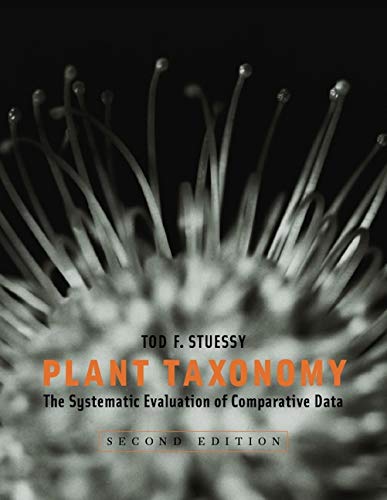

Plant Taxonomy : The Systematic Evaluation of Comparative Data / Tod F. Stuessy.
Editor: New York : Columbia University Press, 2009Fecha de copyright: ©2009Edición: Second editionDescripción: 1 online resource (566 pages)Tipo de contenido:- text
- computer
- online resource
- 9780231518642
- 581.012
- QK95 .S78 2009
| Imagen de cubierta | Tipo de ítem | Biblioteca actual | Biblioteca de origen | Colección | Ubicación en estantería | Signatura topográfica | Materiales especificados | Info Vol | URL | Copia número | Estado | Notas | Fecha de vencimiento | Código de barras | Reserva de ítems | Prioridad de la cola de reserva de ejemplar | Reservas para cursos | |
|---|---|---|---|---|---|---|---|---|---|---|---|---|---|---|---|---|---|---|
| Libro electrónico | Biblioteca de Mayagüez Acceso en línea | QK95 .S78 2009 (Navegar estantería(Abre debajo)) | Ebook c. 1 | Disponible | 50000003289963 | |||||||||||||
| Libro electrónico | Biblioteca Encarnación Valdés Acceso en línea | 581.012 (Navegar estantería(Abre debajo)) | Disponible | EBC908734 | ||||||||||||||
| Libro electrónico | Biblioteca Mons. Iñaki Mallona (Arecibo) Acceso en línea | 581.012 (Navegar estantería(Abre debajo)) | Ebook | Disponible | 60000010177514 |
Descripciones mejoradas de Syndetics:
The field of plant taxonomy has transformed rapidly over the past fifteen years, especially with regard to improvements in cladistic analysis and the use of new molecular data. The second edition of this popular resource reflects these far-reaching and dramatic developments with more than 3,000 new references and many new figures. Synthesizing current research and trends, Plant Taxonomy now provides the most up-to-date overview in relation to monographic, biodiversity, and evolutionary studies, and continues to be an essential resource for students and scholars.
This text is divided into two parts: Part 1 explains the principles of taxonomy, including the importance of systematics, characters, concepts of categories, and different approaches to biological classification. Part 2 outlines the different types of data used in plant taxonomic studies with suggestions on their efficacy and modes of presentation and evaluation. This section also lists the equipment and financial resources required for gathering each type of data. References throughout the book illuminate the historical development of taxonomic terminology and philosophy while citations offer further study. Plant Taxonomy is also a personal story of what it means to be a practicing taxonomist and to view these activities within a meaningful conceptual framework. Tod F. Stuessy recalls the progression of his own work and shares his belief that the most creative taxonomy is done by those who have a strong conceptual grasp of their own research.
A few definitions -- The relevance of systematics -- The importance and universality of classification -- Characters -- The anatomy of classification and the artificial approach -- Natural and phyletic approaches -- The phenetic approach -- The cladistic approach -- Evaluations of the three major approaches and explicit phyletics -- The taxonomic hierarchy -- The species -- The subspecies, variety, and form -- The genus -- The family and higher categories -- Morphology -- Anatomy -- Embryology -- Palynology -- Phytochemistry -- Cytology and cytogenetics -- Molecular biology -- Genetics and population genetics -- Reproductive biology -- Ecology -- The gathering and storage of data -- The presentation of data.
The field of plant taxonomy has transformed rapidly over the past fifteen years, especially with regard to improvements in cladistic analysis and the use of new molecular data. The second edition of this popular resource reflects these far-reaching and dramatic developments with more than 3,000 new references and many new figures. Synthesizing current research and trends, Plant Taxonomy now provides the most up-to-date overview in relation to monographic, biodiversity, and evolutionary studies, and continues to be an essential resource for students and scholars. This text is divided into two parts: Part 1 explains the principles of taxonomy, including the importance of systematics, characters, concepts of categories, and different approaches to biological classification. Part 2 outlines the different types of data used in plant taxonomic studies with suggestions on their efficacy and modes of presentation and evaluation. This section also lists the equipment and financial resources required for gathering each type of data. References throughout the book illuminate the historical development of taxonomic terminology and philosophy while citations offer further study. Plant Taxonomy is also a personal story of what it means to be a practicing taxonomist and to view these activities within a meaningful conceptual framework. Tod F. Stuessy recalls the progression of his own work and shares his belief that the most creative taxonomy is done by those who have a strong conceptual grasp of their own research.
Description based on publisher supplied metadata and other sources.
Electronic reproduction. Ann Arbor, Michigan : ProQuest Ebook Central, 2021. Available via World Wide Web. Access may be limited to ProQuest Ebook Central affiliated libraries.