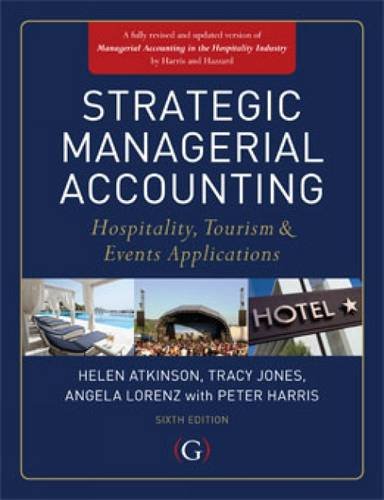

Strategic Managerial Accounting : Hospitality, Tourism and Events Applications / Tracy Jones, Helen Atkinson, Angela Lorenz and Peter Harris.
Editor: Oxford : Goodfellow Publishers, Limited, 2012Fecha de copyright: ©2012Edición: Sixth editionDescripción: 1 online resource (340 pages)Tipo de contenido:- text
- computer
- online resource
- 9781908999023
- 658.1511
- HF5657.4 .J664 2012
| Imagen de cubierta | Tipo de ítem | Biblioteca actual | Biblioteca de origen | Colección | Ubicación en estantería | Signatura topográfica | Materiales especificados | Info Vol | URL | Copia número | Estado | Notas | Fecha de vencimiento | Código de barras | Reserva de ítems | Prioridad de la cola de reserva de ejemplar | Reservas para cursos | |
|---|---|---|---|---|---|---|---|---|---|---|---|---|---|---|---|---|---|---|
| Libro electrónico | Biblioteca de Mayagüez Acceso en línea | HF5657.4 .J664 2012 (Navegar estantería(Abre debajo)) | Ebook c. 1 | Disponible | 50000003291225 | |||||||||||||
| Libro electrónico | Biblioteca Encarnación Valdés Acceso en línea | 658.1511 (Navegar estantería(Abre debajo)) | Disponible | EBC902474 |
Descripciones mejoradas de Syndetics:
Strategic Managerial Accounting: Hospitality, Tourism & Events Applications 6edn explores the nature of these industry sectors and how these impact on the strategic managerial accounting (SMA) tools used by decision makers in the industry.Formerly known as Managerial Accounting in the Hospitality Industry by Harris and Hazzard, this new edition builds on this successful and well known text, retaining its practical approach and active learning style, extending to consider strategic management accounting and to include tourism and events management industry contexts.This new 6th edition incorporates discussion, explanations and illustrations of the theoretical underpinning of hospitality, tourism and events related to SMA and managerial accounting concepts and techniques, together with specific examples of industry application. It has a user friendly chapter structure, with pedagogic features including objectives, learning activities, self check questions, references, and key points summaries. Each chapter includes 'theoretical context' sections which put the applied learning in the context of current research and thinking to bring the theory to life.Key features of this text are:* A complete revision and expansion of the well known and successful Harris and Hazzard text;* Includes several brand new chapters such as: Event and Function Management Accounting techniques, Sustainability & Environmental Management Accounting (EMA), Not-for-profit Organisations, Current Issues in Strategic Management Accounting;* Uses international real life case studies to illustrate from across the hospitality, tourism and events sectors including charity (not-for-profit) sector and music events;* Links to applied and generic research on each topic;* Includes International Financial Reporting Standards (IFRS) terminology suitable for an international audience. With a complete suite of online tutor resources, this book is essential reading for all year 2/3 undergraduate and postgraduate students studying hospitality, tourism and events management.
1 A Strategic Managerial Accounting Perspective to Hospitality, Tourism and Events Operations -- 1.1 Introduction and objectives -- 1.2 Defining accounting and finance -- 1.3 The hospitality, tourism and events focus -- 1.4 Characteristics of hospitality, tourism and events -- 1.5 The role of managers in strategic managerial accounting -- Summary of key points -- 2 Financial Statements for Decision Making -- 2.1 Introduction and objectives -- 2.2 Alternative accounting statements -- 2.3 The difference between profit and cash -- 2.4 Key external financial reporting frameworks - IFRS -- 2.5 Key management accounting reporting framework - USALI -- 2.6 The purpose of such statements in aiding managers -- Summary of key points -- 3 Costs and their Behaviour -- 3.1 Introduction and objectives -- 3.2 Classifying costs -- 3.3 Behaviour - fixed, variable and semi-variable costs -- 3.4 Cost concepts, analysis and applications -- Summary of key points -- 4 Cost Volume Profit Analysis (CVP) -- 4.1 Introduction and objectives -- 4.2 CVP terminology and concept -- 4.3 CVP calculations -- 4.4 CVP in an industry context -- 4.5 Computerised 'What if?' analysis -- Summary of key points -- 5 Short-term Decision Making -- 5.1 Introduction and objectives -- 5.2 Relevant costs in decision making -- 5.3 Opportunity costs -- 5.4 Differences between short-term and long-term decisions -- 5.5 Types of short-term decisions -- 5.6 Long-term implications of short-term decisions -- 5.7 Scarce resources -- 5.8 Uncertainty -- 5.9 Outsourcing -- Summary of key points -- 6 Pricing Decisions -- 6.1 Introduction and objectives -- 6.2 Pricing approaches -- 6.3 Relationship of cost/cost structure to price -- 6.4 Developing a pricing strategy -- Summary of key points -- 7 Revenue and Yield Management.
7.1 Introduction and objectives -- 7.2 The concept of revenue management -- 7.3 Characteristics for revenue management -- 7.4 Revenue management in different environments -- 7.5 Revenue maximisation or profit maximisation? -- Summary of key points -- 8 Costing and Customer Profitability Analysis -- 8.1 Introduction and objectives -- 8.2 Market decisions -- 8.3 The accounting/marketing interface -- 8.4 Activity-Based Costing (ABC) -- 8.5 Activity-based management (ABM) -- 8.6 Customer profitability analysis (CPA) -- 8.7 Profit sensitivity analysis (PSA) -- Summary of key points -- 9 The Use of Budgets in Organisations -- 9.1 Introduction and objectives -- 9.2 The role of budgets -- 9.3 Master budget preparation -- 9.4 Budgetary control -- 9.5 Behavioural aspects of budgeting -- 9.6 Beyond Budgeting/Better Budgeting -- Summary of key points -- 10 Event and Function Management Acounting Techniques -- 10.1 Introduction and objectives -- 10.2 Features of the events and function sector -- 10.3 Event planning phase management accounting tools -- 10.4 Management accounting tools for use during the event -- 10.5 Post-event performance review management accounting tools -- Summary of key points -- 11 Financial Analysis of Performance -- 11.1 Introduction and objectives -- 11.2 Methods of analysis -- 11.3 Scanning, trend analysis and time series -- 11.4 Comparative and common-size statement analysis -- 11.5 Types of ratios -- 11.6 Ratio analysis illustration -- 11.7 Financial ratios -- 11.8 Interpretation of results -- 11.9 Operating ratios -- Summary of key points -- 12 Working Capital Management -- 12.1 Introduction and objectives -- 12.2 Understanding working capital -- 12.3 Working capital financing policy -- 12.4 Working capital characteristicsMost businesses will have different working capital requirements because of three main areas:.
12.5 Working capital ratios -- 12.6 Management of inventory -- 12.7 Managing accounts receivable -- 12.8 Managing accounts payable -- 12.9 Management of cash -- Summary -- 13 Business Finance -- 13.1 Introduction and objectives -- 13.2 Short-term sources of finance -- 13.3 Long-term sources of finance -- 13.4 The weighted average cost of capital (WACC) -- 13.5 SMEs and micro businesses -- 13.6 Sector-specific financing -- Summary -- 14 Capital Investment Appraisal -- 14.1 Introduction and objectives -- 14.2 The value of investment appraisal -- 14.3 Example data -- 14.4 Accounting rate of return (ARR) -- 14.5 Payback period (PBP) -- 14.6 The time value of money -- 14.7 Discounted payback period -- 14.8 Net present value (NPV) -- 14.9 Internal rate of return (IRR) -- 14.10 Profitability index -- 14.11 Uncertainty in investment projects -- 14.12 Integrated strategic approaches -- Summary of key points -- 15 Performance Measurement -- 15.1 Introduction and objectives -- 15.2 Performance measurement history and development -- 15.3 Key frameworks and models -- 15.4 Performance measurement in hospitality, tourism and events industries -- 15.5 Benchmarking performance -- Summary of key points -- 16 Strategic Management Accounting -- 16.1 Introduction and objectives -- 16.2 Why strategic management accounting? Definitions and evolution -- 16.3 Linking strategy and accounting (strategic versus traditional accounting) -- 16.4 Boston Matrix, risk return and cash -- 16.5 Value generation and value drivers -- 16.6 Product lifecycle, profit cash and investment -- 16.7 The Balanced Scorecard (BSC) -- 16.8 Activity-based management (ABM) -- 16.9 Other management accounting tools considered to be strategic -- Summary of key points -- 17 Critical Success Factors and Management Information Needs -- 17.1 Introduction and objectives.
17.2 Management information needs -- 17.3 Defining critical success factors (CSFs) -- 17.4 The relationship between goals, CSFs and measures -- 17.5 The use of CSFs in an organisation -- Summary of key points -- 18 Sustainability and Environmental Management Accounting -- 18.1 Introduction and objectives -- 18.2 The triple bottom line (people, planet and profits) -- 18.3 Managing a sustainable business -- 18.4 EMA reporting -- 18.5 Environmental management accounting guidelines -- Summary of key points -- 19 Not-for-profit Organisations -- 19.1 Introduction and objectives -- 19.2 Defining a not-for-profit organisation -- 19.3 Their significance to the hospitality, tourism and events sectors -- 19.4 The implications for management accounting approaches -- Summary of key points -- 20 Current Issues in Strategic Managerial Accounting -- 20.1 Introduction and objectives -- 20.2 Management accounting change over time -- 20.3 Use of management accounting in hospitality, tourism and events -- 20.4 The role of the management accountant -- 20.5 Contemporary applied research -- 20.6 Managerial accounting and the reader -- Summary of key points -- A Answers to self-check questions.
Strategic Managerial Accounting: Hospitality, Tourism & Events Applications 6edn explores the nature of these industry sectors and how these impact on the strategic managerial accounting (SMA) tools used by decision makers in the industry.Formerly known as Managerial Accounting in the Hospitality Industry by Harris and Hazzard, this new edition builds on this successful and well known text, retaining its practical approach and active learning style, extending to consider strategic management accounting and to include tourism and events management industry contexts.This new 6th edition incorporates discussion, explanations and illustrations of the theoretical underpinning of hospitality, tourism and events related to SMA and managerial accounting concepts and techniques, together with specific examples of industry application. It has a user friendly chapter structure, with pedagogic features including objectives, learning activities, self check questions, references, and key points summaries. Each chapter includes 'theoretical context' sections which put the applied learning in the context of current research and thinking to bring the theory to life.Key features of this text are:* A complete revision and expansion of the well known and successful Harris and Hazzard text;* Includes several brand new chapters such as: Event and Function Management Accounting techniques, Sustainability & Environmental Management Accounting (EMA), Not-for-profit Organisations, Current Issues in Strategic Management Accounting;* Uses international real life case studies to illustrate from across the hospitality, tourism and events sectors including charity (not-for-profit) sector and music events;* Links to applied and generic research on each topic;* Includes International Financial Reporting Standards (IFRS) terminology suitable for an international audience. With a complete suite of online tutor resources, this book is essential reading for all year 2/3 undergraduate and postgraduate students studying hospitality, tourism and events management.
Description based on publisher supplied metadata and other sources.
Electronic reproduction. Ann Arbor, Michigan : ProQuest Ebook Central, 2021. Available via World Wide Web. Access may be limited to ProQuest Ebook Central affiliated libraries.