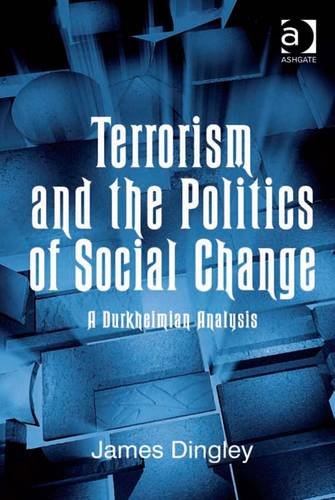

Terrorism and the Politics of Social Change : A Durkheimian Analysis / James Dingley.
Editor: Farnham : Taylor & Francis Group, 2010Fecha de copyright: ©2010Descripción: 1 online resource (212 pages)Tipo de contenido:- text
- computer
- online resource
- 9780754696162
- Durkheim, Emile, 1858-1917. -- Political and social views
- Durkheim, Émile, -- 1858-1917 -- Political and social views.;Terrorism -- Social aspects.;Terrorism -- Religious aspects.;War and society.;Political violence.;Social change
- Terrorism -- Social aspects
- Terrorism -- Religious aspects
- War and society
- Political violence
- Social change
- 303.625
- HV6431 .D554 2010
| Imagen de cubierta | Tipo de ítem | Biblioteca actual | Biblioteca de origen | Colección | Ubicación en estantería | Signatura topográfica | Materiales especificados | Info Vol | URL | Copia número | Estado | Notas | Fecha de vencimiento | Código de barras | Reserva de ítems | Prioridad de la cola de reserva de ejemplar | Reservas para cursos | |
|---|---|---|---|---|---|---|---|---|---|---|---|---|---|---|---|---|---|---|
| Libro electrónico | Biblioteca de Mayagüez Acceso en línea | HV6431 .D554 2010 (Navegar estantería(Abre debajo)) | Ebook c. 1 | Disponible | 50000003291423 | |||||||||||||
| Libro electrónico | Biblioteca Encarnación Valdés Acceso en línea | 303.625 (Navegar estantería(Abre debajo)) | Disponible | EBC529668 | ||||||||||||||
| Libro electrónico | Biblioteca Mons. Iñaki Mallona (Arecibo) Acceso en línea | 303.625 (Navegar estantería(Abre debajo)) | Ebook | Disponible | 60000010173224 |
Descripciones mejoradas de Syndetics:
In this up-to-the-moment and politically relevant work, James Dingley dissects the role of social relations, culture and religion in impelling men and women to behave violently in defence of their own known socio-cultural context when challenged by external forces. It is a decisive contribution to our understanding of the political and social relevance of terrorism as we know and experience it today.
Introduction -- 1 War and Violence: Understanding the Breeds -- 2 Terrorism: Understanding the Heavens -- 3 The Heavens Described -- 4 Making the Man - Terrorism Charted and Defined -- 5 Terrorism in the Modern World -- 6 Durkheim, Sociology and Understanding Terrorism -- Conclusion -- Bibliography -- Index.
Terrorism and political violence have invariably accompanied the progressive modernization of states; a socio-cultural reaction to the problems of social change and development. To understand this phenomenon, it is necessary to consider the nature of traditional society and how it differs from modernity. Starting with a basic history of modern terrorism, James Dingley uses a Durkheimian sociological framework to dissect the role of social relations, culture and religion in impelling men and women to defend their socio-cultural context with violence against the challenge of external forces. Placing emphasis on a historical and social understanding of violence and key issues such as nationalism, religion, science, the Enlightenment and Romanticism for understanding terrorism in all its forms, this book allows for a more critical examination of terrorism as a response to changes in the organization and cultural goals in a society. It is a decisive contribution to our understanding of the political and social relevance of terrorism as we know and experience it today.
Description based on publisher supplied metadata and other sources.
Electronic reproduction. Ann Arbor, Michigan : ProQuest Ebook Central, 2021. Available via World Wide Web. Access may be limited to ProQuest Ebook Central affiliated libraries.