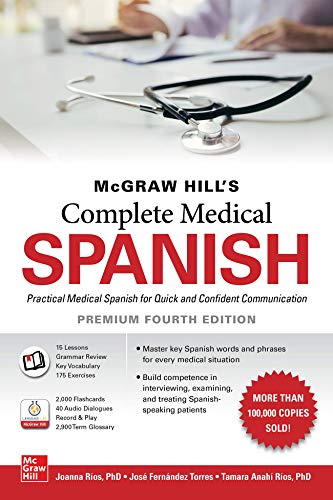

McGraw Hill's Complete Medical Spanish
McGraw-Hil 2021Edición: 4a. edTipo de contenido:- 9781260467895
Descripciones mejoradas de Syndetics:
Build Your Competence and Confidence to Communicate Effectively with Your Spanish-speaking Patients
McGraw Hill's Complete Medical Spanish goes far beyond a phrasebook or dictionary. This time-tested resource provides you with the skills and confidence to interact with Spanish-speaking patients and their families, and deliver the high quality of care they deserve. Through sample dialogs, numerous exercises, and more than 200 illustrations, this program will help you:
Master a Spanish vocabulary of more than 3,000 key terms Confidently interview patients, take histories, conduct physical exams, prescribe medication, and give follow-up instructions in Spanish Become culturally competent and more aware of major differences between Latino and Anglo-American cultures and how they impact healthcare decisions. New to this edition : Sections on musculoskeletal exam, physical therapy, speech therapy, mental health, women's health, children's behavioral problems, pandemics * Questionnaires for GAD7, OASIS *Assessments for OASIS, CAGE* MoCA Test
This bestselling guide is supported by bonus content in McGraw Hill's Language Lab app:
Audio recordings of 40 dialogs and monologs to help improve your pronunciation and fluency 2,000 flashcards to help memorize key vocabulary
Ideal for: physicians, nurse practitioners, physician assistants, nurses (including NPs, LVNs, LPNs, MAs), hospital technicians, physical therapists, and medical administrators with little or no Spanish-language experience.
Tabla de contenidos provista por Syndetics
- Acknowledgments(p. xv)
- Introduction(p. xvii)
- 1
- 1.1 Greetings(p. 2)
- 1.2 The alphabet(p. 4)
- 1.3 Nouns: gender and number(p. 8)
- 1.4 Parts of the body(p. 15)
- 1.5 "What is this?"(p. 18)
- 1.6 "Where is ...?"(p. 20)
- 1.7 "What do you need?"(p. 21)
- 1.8 Chief complaint(p. 23)
- 2
- 2.1 Numbers(p. 28)
- 2.2 Vital signs(p. 29)
- 2.3 Question words, relative pronouns, prepositions, and other words(p. 31)
- 2.4 Internal organs(p. 33)
- 2.5 Cognates(p. 38)
- 2.6 Giving instructions(p. 42)
- 3
- 3.1 Conjugation(p. 45)
- 3.2 Common -ar verbs(p. 51)
- 3.3 "Necesitar"(p. 55)
- 3.4 "Estar"(p. 58)
- 3.5 More numbers(p. 62)
- 3.6 Common symptoms(p. 62)
- 3.7 Qualifying and quantifying pain(p. 69)
- 4
- 4.1 Hospital and rehabilitation facility items(p. 73)
- 4.2 "Ser"(p. 74)
- 4.3 Telling time(p. 75)
- 4.4 Adjectives(p. 78)
- 4.5 "Hay"(p. 83)
- 4.6 Conjugation of -er verbs(p. 84)
- 4.7 Conjugation of -ir verbs(p. 88)
- 4.8 Pediatrics | La pediatría(p. 92)
- 4.9 Expressing destination and future actions(p. 94)
- 4.10 Emergency room | La sala de emergencia(p. 99)
- 4.11 "Ser" v. "estar"(p. 102)
- 5
- 5.1 The family | La familia(p. 105)
- 5.2 More verb tenses(p. 109)
- 5.3 Illnesses | Enfermedades(p. 111)
- 5.4 Types of food | Tipos de comidas(p. 120)
- 5.5 Diet | La dieta(p. 125)
- 5.6 Indirect object pronouns(p. 126)
- 5.7 Irregular -er and -ir verbs(p. 129)
- 6
- 6.1 Irregular verbs in the present tense(p. 134)
- 6.2 Days of the week | Los días de la semana(p. 144)
- 6.3 Months of the year | Los meses del año(p. 148)
- 6.4 Authority figures and home remedies(p. 150)
- 6.5 The imperative mood or command form(p. 151)
- 6.6 A physical exam | Un examen físico(p. 157)
- 6.7 A neurological exam | Un examen neurológico(p. 159)
- 7
- 7.1 Key Power Verbs/Power Punch Verbs(p. 162)
- 7.2 Prescription and diet instructions(p. 165)
- 7.3 Pap smear | El examen de Papanicolau (citología)(p. 171)
- 7.4 Beware of direct translations(p. 174)
- 7.5 Giving directions | Las instrucciones y direcciones(p. 175)
- 7.6 Present progressive tense(p. 177)
- 7.7 Blood test | Muestra - análisis de sangre(p. 181)
- 7.8 Urine test | La muestra de la orina(p. 182)
- 7.9 Sputum test | La muestra de esputo(p. 184)
- 7.10 Skin tests | Pruebas de la piel(p. 184)
- 7.11 Taking X rays | Las radiografías(p. 186)
- 7.12 Results and diagnosis | Resultados y diagnósticos(p. 186)
- 8
- 8.1 Possessive adjectives(p. 189)
- 8.2 "Se impersonal"(p. 193)
- 8.3 Demonstrative adjectives(p. 196)
- 8.4 The preterit tense(p. 197)
- 8.5 Irregular verbs in the preterit(p. 204)
- 8.6 Well-baby visit(p. 208)
- 8.7 Emergency room visit: ear infection | La sala de emergencia: una infección del oído(p. 209)
- 8.8 Emergency room visit: an asthma attack | La sala de emergencia: un ataque de asma(p. 211)
- 9
- 9.1 Reflexive verbs(p. 215)
- 9.2 Direct object pronouns(p. 221)
- 9.3 Tener que/necesitar, es necesario/hay que | To have to, one should/must(p. 224)
- 9.4 Abdominal pain | Dolor abdominal(p. 226)
- 9.5 A trip to the dentist's office | Una visita al dentista(p. 228)
- 9.6 An appointment with the ophthalmologist | Una cita con el oftalmólogo(p. 230)
- 9.7 Dermatology | La dermatología(p. 232)
- 9.8 The pharmacy | La farmacia(p. 233)
- 10
- 10.1 "Preguntar" y "pedir"(p. 236)
- 10.2 "Conocer" y "saber"(p. 237)
- 10.3 Pronombres Posesivos | Possessive pronouns(p. 239)
- 10.4 Otro tiempo del futuro | Another future tense form(p. 242)
- 10.5 Presente y pasado progresivo | The present and past progressive tenses(p. 243)
- 10.6 The use of acabar de ...(p. 245)
- 10.7 Enfermedades venéreas/Enfermedades tra(n)smitidas sexualmente | Sexually transmitted diseases (STDs or STIs)(p. 246)
- 10.8 Tiempos del presente y pasado perfecto | The present and past perfect tenses(p. 248)
- 10.9 "Por" v. "para"(p. 251)
- 10.10 La forma de tu en el mandato | The tú form of the command(p. 254)
- 11
- 11.1 El tiempo condicional | The conditional tense(p. 258)
- 11.2 Un niño que necesita bajar de peso | A child who needs to lose weight(p. 262)
- 11.3 El tiempo imperfecto | The imperfect tense(p. 264)
- 11.4 Instrucciones prenatales | Prenatal instructions(p. 270)
- 11.5 Pronombres de complemento directo | Direct object pronouns(p. 271)
- 11.6 Pronombres de complemento indirecto | Indirect object pronouns(p. 272)
- 11.7 Pronombres de complemento directo e indirecto usados juntos | Using direct and indirect object pronouns together(p. 274)
- 11.8 El parto | The delivery(p. 278)
- 12
- 12.1 El subjuntivo | The subjunctive mood(p. 283)
- 12.2 Una vislta posparto | A postpartum visit(p. 290)
- 12.3 El imperfecto del subjuntivo | The imperfect subjunctive(p. 291)
- 12.4 Un paciente con alta presión | A patient with high blood pressure(p. 298)
- 12.5 El condicional y el im perfecto del subjuntivo con la cláusula "si"(p. 299)
- 13
- 13.1 El perfecto del subjuntivo | The present perfect subjunctive(p. 303)
- 13.2 El pluscuamperfecto del subjuntivo | The pluperfect subjunctive or the past perfect subjunctive(p. 305)
- 13.3 La primera visita de un paciente con diabetes | The first visit of a patient with diabetes(p. 309)
- 13.4 How the heck does one use the pluperfect?(p. 311)
- 13.5 Instrucciones para tomar la píldora anticonceptiva | Instructions for taking birth control pills(p. 314)
- 13.6 A review of all verb tenses covered(p. 316)
- 14
- 14.1 Victima de una violación | A rape victim(p. 320)
- 14.2 Víctima de un accidente de carro en Urgencias | Victim of a car accident in the ER(p. 322)
- 14.3 Visita musculoesquelética/Visita de medicina del deporte | Musculoskeletal visit/Sports medicine visit(p. 324)
- 14.4 Terapia ocupacional | Occupational therapy(p. 327)
- 14.5 Terapia del habla | Speech therapy(p. 329)
- 14.6 Terapia física | Physical therapy(p. 332)
- 14.7 Salud mental | Mental health(p. 335)
- 14.8 Una quemadura | A burn(p. 336)
- 14.9 Un paciente recuperando el conocimiento | Patient regaining consciousness(p. 337)
- 14.10 Autoexamen (Autoexploración) mensual de los senos | Monthly breast self-examination(p. 338)
- 14.11 Salud de la mujer | Women's health(p. 339)
- 14.12 Monologo de neonatología | Monologue on neonatology(p. 341)
- 14.13 Infarto de miocardio o trombosis cerebrovascular | Myocardial infarction or cerebrovascular thrombosis(p. 343)
- 14.14 Patrón de crecimiento y desarrollo | Pattern for growth and development(p. 345)
- 14.15 Enfermería | Nursing(p. 348)
- 14.16 (P)siquiatría y (p)sicología | Psychiatry and psychology(p. 351)
- 14.17 Problemas de comportamiento en los niños | Behavioral problems with children(p. 358)
- 14.18 Pandemics viruses, including COVID-19 | Los virus pandémicos, incluyendo COVID-19(p. 361)
- 15
- 15.1 Cultural competency/cross-cultural communication(p. 365)
- 15.2 Herbal remedies(p. 383)
- 15.3 Medicines | Medicinas(p. 384)
- 15.4 Illnesses and symptoms (by body system)(p. 384)
- Appendix A Useful Documents and Forms(p. 391)
- A1 Advance Directives and Do Not Resuscitate (DNR) Orders(p. 391)
- A2 Questions About DNR Code Status(p. 392)
- A3 Questions for Determining Geriatric Depression Scale(p. 393)
- A4 Communication with Advanced Disease Patients (Palliative Care)(p. 394)
- A5 Primary Care Post Traumatic Stress Disorder (PTSD) Screening(p. 396)
- A6 Patient Health Questionnaire (PHQ-9)(p. 396)
- A7 Mini Mental Status Examination MMSE (Examen Mental Breve)(p. 398)
- A8 Questionnaire for Adverse Childhood Experience (ACE)(p. 399)
- A9 Questions for Alcohol Abuse (CAGE)(p. 401)
- A10 Questionnaire for Generalized Anxiety Disorder Questionnaire (GAD-7)(p. 402)
- A11 Montreal Cognitive Assessment (MoCA Test)(p. 403)
- A12 Overall Anxiety Severity and Impairment Scale (OASIS)(p. 405)
- Appendix B Verb Tables(p. 409)
- Appendix C Dialogues and Monologues: English Translations(p. 421)
- Appendix D Answer Key(p. 453)
- English-Spanish Glossary(p. 469)
- Spanish-English Glossary(p. 489)
- Index(p. 507)