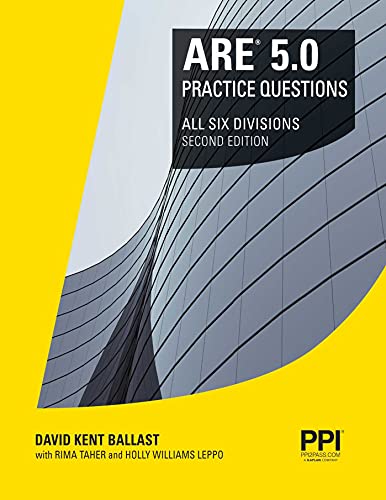

ARE 5.0 practice questions : all six divisions. / David Kent Ballast, FAIA, NCARB, CSI, with Rima Taher, PhD, PE, and Holly Williams Leppo, AIA. txt
Editor: Belmont, CA : Professional Publications, Inc., 2021Edición: Second editionDescripción: 1 volume (various pagings) : ill. ; plans ; 28 cmTipo de contenido:- text
- unmediated
- volume
- 9781591266822
- 1591266823
- NA123 B38 2021
| Imagen de cubierta | Tipo de ítem | Biblioteca actual | Biblioteca de origen | Colección | Ubicación en estantería | Signatura topográfica | Materiales especificados | Info Vol | URL | Copia número | Estado | Notas | Fecha de vencimiento | Código de barras | Reserva de ítems | Prioridad de la cola de reserva de ejemplar | Reservas para cursos | |
|---|---|---|---|---|---|---|---|---|---|---|---|---|---|---|---|---|---|---|
| Libro Referencia CARIBET | CARIBET Biblioteca Arquitectura Colección de Referencia CARIBET | Referencia NA123 B38 2021 (Navegar estantería(Abre debajo)) | 1 | Disponible | 91000000064501 |
Descripciones mejoradas de Syndetics:
A must-have book in preparation for each of the six divisions of ARE 5.0
ARE 5.0 Practice Questions , PPI's best-selling ARE practice book by Holly Williams Leppo, David Kent Ballast, and Rima Taher, prepares you for each of the six divisions of the exam with a variety of practice questions and case studies. This new edition builds on the previous edition with new questions and updates to cover content feedback received from NCARB for the ARE 5.0 Exam Review . The questions that were found to be appropriate during the review were kept in the new edition.
Key Features: Over 550 challenging practice questions for each subtopic that break down the information in the six exam divisions, allowing you to focus on specific areas 2 case studies at the end of each division designed to test your ability to examine and use multiple pieces of information to make decisions about scenarios that could be encountered in the practice of architecture Clearly written solutions that are thorough and easy to follow, with units that are meticulously identified and carried through in all calculations to support theory and application of key concepts Questions include alternative item types including multiple choice, case study, check-all-that-apply, quantitative-fill-in-the-blank, drag-and-place, and hotspot to familiarize you with the types of questions you'll encounter in the exam Pages tabbed in six different colors, one for each division, for easy lookup of a particular exam division Chapters correspond to David Ballast's ARE 5.0 Exam Review so you can read a chapter of ARE 5.0 Exam Review and then practice from the same chapter of ARE 5.0 Practice Questions Binding: Paperback Publisher: PPI, a Kaplan Company
All Six ARE 5.0 Exam Divisions Covered
Practice Management, 78 questions, 2 case studies Project Management, 61 questions, 2 case studies Programming & Analysis, 99 questions, 2 case studies Project Planning & Design, 138 questions, 2 case studies Project Development & Documentation, 117 questions, 2 case studies Construction & Evaluation, 71 questions, 2 case studies NOTE: In the first printing of this title, there was a misprint involving how questions in the PPD section were sorted. A correction document to map the existing questions in the corrected order is available on the PPI website. Printings 2 and 3 have this issue fixed.
Looking for updates to this book? PPI's website has an up-to-date list of all corrections and updates to our books.
Include index.
CODES AND STANDARDS USED IN THIS BOOK --
DIVISION 1: PRACTICE MANAGEMENT --
Business Operations --
Financial and Risk Management --
Delivery of Services --
Case Studies --
DIVISION 2: PROJECT MANAGEMENT --
Project Planning and Management --
Contracts --
Project Execution and Quality Control --
Case Studies --
DIVISION 3: PROGRAMMING & ANALYSIS --
Building Context --
Codes and Regulations During Programming --
Site Analysis --
Building Analysis --
Selection of Structural Systems --
Case Studies --
DIVISION 4: PROJECT PLANNING & DESIGN --
Locating Buildings and Site Improvement --
Applying Sustainable Principles to a Design --
Impact of Neighborhood Context on Project Design --
Zoning & Environmental Influences on Site & Building Design --
Applying Building Codes to Building Design --
Integrating Multiple Codes into a Project Design --
Determining Mechanical, Electrical, and Plumbing Systems --
Determining Structural Systems --
Determining Special Systems --
Materials and Assemblies for the Envelope Structure --
Selecting Building Envelope Materials and Assemblies --
Interior Materials and Assemblies --
Determining Building Configuration --
Integrating Building Systems into a Project Design --
Integrating Program Requirements into a Project Design --
Integrating Contextual Conditions into a Project Design --
Evaluating Design Alternatives --
Evaluating Building Costs --
Evaluating Costs During Design --
Case Studies --
DIVISION 5: PROJECT DEVELOPMENT & DOCUMENTATION --
Integration of Building Systems --
Integration of Specialty Systems --
Loads on Buildings --
Structural Fundamentals --
Beams and Columns --
Trusses --
Foundations --
Connections --
Building Code Requirements on Structural Design --
Wood Construction --
Steel Construction --
Concrete Construction --
Wall Construction --
Lateral Forces—Wind --
Lateral Forces—Earthquakes --
Construction Documentation --
The Project Manual and Specifications --
Detailed Regulatory and Cost Reviews --
DIVISION 6: CONSTRUCTION & EVALUATION --
Case Studies --
Preconstruction Activities --
Construction Administration --
Project Closeout --
Case Studies --
Notas de autor provistas por Syndetics
David Kent Ballast, FAIA, CSI, NCIDQ Certification No. 9425, is the owner of Architectural Research Consulting, a firm offering information and management services to architects, interior designers, and the construction industry. Mr. Ballast taught interior construction and other courses for twenty years at Arapahoe Community College. A licensed architect in Colorado and an NCIDQ certificate holder, Mr. Ballast has authored many books published by PPI on design topics and ARE review.Holly Williams Leppo, AIA is an NCARB-certified registered architect, a certified interior designer, and a LEED Accredited Professional. She holds a bachelor of arts degree in integrative arts from The Pennsylvania State University and a master of architecture degree from Washington University in St. Louis.
Rima Taher, Ph.D, P.E., is a Senior University Lecturer at the Hillier College of Architecture & Design, at NJIT, and is a part-time instructor in the graduate program at the NJIT-Department of Civil & Environmental Engineering. She is a licensed professional engineer in New Jersey and practices as a civil/structural engineer with her own consulting firm "Taher Engineering LLC". Dr. Taher has a bachelor of civil engineering from INSA de Lyon, Lyon, France. She has a master's degree and a doctorate in civil engineering/building technology from École Nationale des Ponts et Chaussées, in Paris, France. Dr. Taher participated in some building technology research in the field of building design for high winds and hurricanes, and she has several published articles in this field as well as a book, Building Design for Wind Forces. Dr. Taher is currently serving as the President of the ASCE/SEI (Structural Engineering Institute) Chapter of North Jersey.