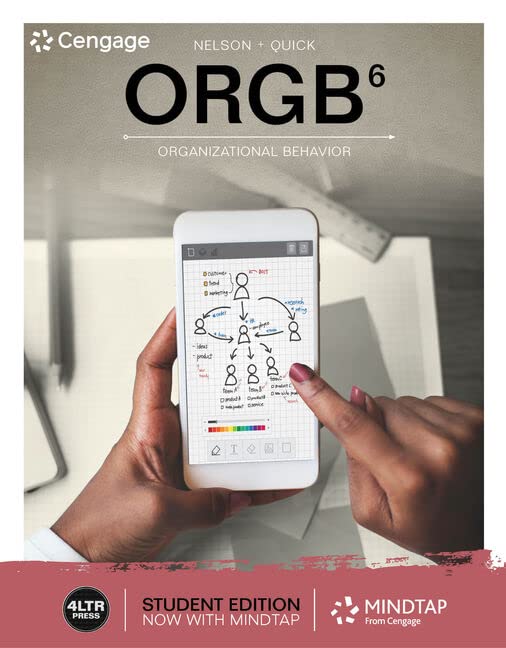

Orgb6 / Debra L. Nelson, James Campbell Quick.
Idioma: Inglés Editor: Mason, OH : Cengage Learning, 2017Edición: Sixth editionDescripción: vii, 378 pages : illustrations ; 28 cmTipo de contenido:- text
- unmediated
- volume
- 9781337407830
- Organizational behavior
- 23 658.314
- HD58.7 .N44 2019
| Imagen de cubierta | Tipo de ítem | Biblioteca actual | Biblioteca de origen | Colección | Ubicación en estantería | Signatura topográfica | Materiales especificados | Info Vol | URL | Copia número | Estado | Notas | Fecha de vencimiento | Código de barras | Reserva de ítems | Prioridad de la cola de reserva de ejemplar | Reservas para cursos | |
|---|---|---|---|---|---|---|---|---|---|---|---|---|---|---|---|---|---|---|
| Libro | Biblioteca de Mayagüez Colección General mb | HD58.7 .N44 2019 (Navegar estantería(Abre debajo)) | c. 1 | Disponible | 50000003270088 | |||||||||||||
| Libro | Biblioteca Encarnación Valdés Colección General bev | 658.314 N424o6 (Navegar estantería(Abre debajo)) | Disponible | 80000002628611 |
Descripciones mejoradas de Syndetics:
Through ongoing research into students' workflows and preferences, ORGB from 4LTR Press combines an easy-reference, paperback textbook with Chapter Review Cards and an innovative online experience--all at an affordable price. New for this edition, students explore ORGB anywhere, anytime and on most devices with ORGB Online! With the intuitive StudyBits functionality, students study more effectively and can visually monitor their own progress. Coupled with straightforward course management, assessment and analytics for instructors, ORGB with Online engages students of all generations and learning styles, and integrates seamlessly into your Organizational Behavior. ORGB features many new "Fast Facts," "Hot Trends," new feature boxes, updated data, and current examples in the business world. Additionally, the number of test bank questions has also increased to reflect new material and provide more in-depth assessment opportunities.
"Student edition now with Mintap" -- On cover.
Includes bibliographical references and index.
Part 1: Introduction -- 1. Organizational behavior and opportunities -- 2. Challenges for managers -- Part 2: Individuals processes and behavior -- 3. Personality, perception and attribution -- 4. Attitudes, emotions, and ethics -- 5. Motivation at work -- 6. Learning and performance management -- 7. Stress and Well-being at work -- Part 3: Interpersonal processes and behavior -- 8. Communication -- 9. Work teams and groups -- 10. Decision making by individuals and groups -- 11. Power and political behavior -- 12. Leadership and fellowship -- 13. Conflict and negotiation -- Part: 4 Organizational processes and structure -- 14. Jobs and design of work -- 15. Organizational design and structure -- 16. Organizational culture -- 17. Career management -- 18. Managing change.
Tabla de contenidos provista por Syndetics
- Part 1 Introduction
- 1 Organizational Behavior and Opportunity(p. 2)
- 1-1 Human Behavior in Organizations(p. 2)
- 1-2 Behavior in Times of Change(p. 5)
- 1-3 The Organizational Context(p. 6)
- 1-4 The Formal and Informal Organization(p. 7)
- 1-5 Diversity of Organizations(p. 9)
- 1-6 Change Creates Opportunities(p. 9)
- 1-7 Learning about Organizational Behavior(p. 13)
- 2 Challenges for Managers(p. 16)
- 2-1 Competing in the Global Economy(p. 16)
- 2-2 Cultural Differences and Work-Related Attitudes(p. 21)
- 2-3 The Diverse Workforce(p. 22)
- 2-4 Ethics, Character, and Personal Integrity(p. 28)
- 2-5 Ethical Dilemmas Facing the Modern Organization(p. 29)
- Part 2 Individual Processes and Behavior
- 3 Personality, Perception, and Attribution(p. 34)
- 3-1 Individual Differences and Organizational Behavior(p. 34)
- 3-2 Personality and Organizations(p. 36)
- 3-3 Application of Personality Theory in Organizations(p. 40)
- 3-4 Social Perception(p. 45)
- 3-5 Barriers to Social Perception(p. 47)
- 3-6 Attribution in Organizations(p. 50)
- 4 Attitudes, Emotions, and Ethics(p. 52)
- 4-1 Attitudes(p. 52)
- 4-2 Attitude Formation(p. 54)
- 4-3 Job Satisfaction(p. 56)
- 4-4 Organizational Citizenship versus Counterproductive Work Behavior(p. 57)
- 4-5 Persuasion and Attitude Change(p. 59)
- 4-6 Emotions and Moods at Work(p. 61)
- 4-7 Ethical Behavior(p. 63)
- 4-8 Factors That Affect Ethical Behavior(p. 65)
- 5 Motivation at Work(p. 70)
- 5-1 Motivation and Work Behavior(p. 70)
- 5-2 Maslow's Need Hierarchy(p. 73)
- 5-3 McClelland's Need Theory(p. 75)
- 5-4 Herzberg's Two-Factor Theory(p. 77)
- 5-5 Two New Ideas in Motivation(p. 78)
- 5-6 Social Exchange and Equity Theory(p. 79)
- 5-7 Expectancy Theory of Motivation(p. 82)
- 5-8 Cultural Differences in Motivation(p. 84)
- 6 Learning and Performance Management(p. 86)
- 6-1 Behavioral Models of Learning in Organizations(p. 86)
- 6-2 Social and Cognitive Theories of Learning(p. 91)
- 6-3 Goal Setting at Work(p. 92)
- 6-4 Performance: A Key Construct(p. 94)
- 6-5 Performance Feedback(p. 96)
- 6-6 Rewarding Performance(p. 98)
- 6-7 Correcting Poor Performance(p. 99)
- 7 Stress and Well-Being at Work(p. 104)
- 7-1 What Is Stress?(p. 104)
- 7-2 Four Approaches to Stress(p. 105)
- 7-3 The Stress Response(p. 107)
- 7-4 Sources of Work Stress(p. 107)
- 7-5 The Consequences of Stress(p. 111)
- 7-6 Individual Differences in the Stress-Strain Relationship(p. 114)
- 7-7 Preventive Stress Management(p. 116)
- Part 3 Interpersonal Processes and Behavior
- 8 Communication(p. 124)
- 8-1 Interpersonal Communication(p. 124)
- 8-2 Communication Skills for Effective Managers(p. 129)
- 8-3 Barriers and Gateways to Communication(p. 130)
- 8-4 Civility and Incivility(p. 132)
- 8-5 Nonverbal Communication(p. 134)
- 8-6 Positive, Healthy Communication(p. 137)
- 8-7 Communicating through New Technologies and Social Media(p. 138)
- 9 Work Teams and Groups(p. 142)
- 9-1 Groups and Work Teams(p. 142)
- 9-2 Why Work Teams?(p. 143)
- 9-3 Group Behavior(p. 145)
- 9-4 Group Formation and Development(p. 146)
- 9-5 Task and Maintenance Functions(p. 150)
- 9-6 Factors That Influence Group Effectiveness(p. 151)
- 9-7 Empowerment and Self-Managed Teams(p. 154)
- 9-8 Upper Echelons: Teams at the Top(p. 156)
- 10 Decision Making by Individuals and Groups(p. 160)
- 10-1 The Decision-Making Process(p. 160)
- 10-2 Models and Limits of Decision Making(p. 162)
- 10-3 Individual Influences on Decision Making(p. 165)
- 10-4 The Group Decision-Making Process(p. 170)
- 10-5 Diversity and Culture in Decision Making(p. 175)
- 10-6 Participation in Decision Making(p. 176)
- 11 Power and Political Behavior(p. 180)
- 11-1 The Concept of Power(p. 180)
- 11-2 Forms and Sources of Power in Organizations(p. 181)
- 11-3 Using Power Ethically(p. 184)
- 11-4 Symbols of Power(p. 186)
- 11-5 Political Behavior in Organizations(p. 188)
- 11-6 Managing Political Behavior in Organizations(p. 192)
- 12 Leadership and Followership(p. 198)
- 12-1 Leadership versus Management(p. 199)
- 12-2 Early Trait Theories(p. 200)
- 12-3 Behavioral Theories(p. 201)
- 12-4 Contingency Theories(p. 204)
- 12-5 Recent Leadership Theories(p. 210)
- 12-6 Emerging Issues in Leadership(p. 212)
- 12-7 Followership(p. 214)
- 12-8 Guidelines for Leadership(p. 215)
- 13 Conflict and Negotiation(p. 218)
- 13-1 The Nature of Conflicts in Organizations(p. 218)
- 13-2 Causes of Conflict in Organizations(p. 221)
- 13-3 Forms of Group Conflict in Organizations(p. 224)
- 13-4 Individual Conflict in Organizations(p. 225)
- 13-5 Conflict Management Strategies and Techniques(p. 229)
- 13-6 Conflict Management Styles(p. 232)
- Part 4 Organizational Processes and Structure
- 14 Jobs and the Design of Work(p. 236)
- 14-1 Work in Organizations(p. 236)
- 14-2 Traditional Approaches to Job Design(p. 239)
- 14-3 Alternative Approaches to Job Design(p. 244)
- 14-4 Contemporary Issues in the Design of Work(p. 248)
- 15 Organizational Design and Structure(p. 252)
- 15-1 Key Organizational Design Processes(p. 253)
- 15-2 Basic Design Dimensions(p. 258)
- 15-3 Five Structural Configurations(p. 259)
- 15-4 Contextual Variables(p. 261)
- 15-5 Forces Reshaping Organizations(p. 267)
- 15-6 Emerging Organizational Structures(p. 269)
- 15-7 Factors That Can Adversely Affect Structure(p. 270)
- 16 Organizational Culture(p. 272)
- 16-1 Levels of Organizational Culture(p. 272)
- 16-2 Functions of Organizational Culture(p. 277)
- 16-3 The Relationship of Culture to Performance(p. 278)
- 16-4 The Leader's Role in Shaping and Reinforcing Culture(p. 279)
- 16-5 Organizational Socialization(p. 281)
- 16-6 Assessing Organizational Culture(p. 283)
- 16-7 Changing Organizational Culture(p. 284)
- 16-8 Challenges to Developing a Positive, Cohesive Culture(p. 286)
- 17 Career Management(p. 290)
- 17-1 Occupational and Organizational Choice Decisions(p. 291)
- 17-2 Foundations for a Successful Career(p. 296)
- 17-3 The Career Stage Model(p. 297)
- 17-4 The Establishment Stage(p. 298)
- 17-5 The Advancement Stage(p. 299)
- 17-6 The Maintenance Stage(p. 305)
- 17-7 The Withdrawal Stage(p. 306)
- 17-8 Career Anchors(p. 308)
- 18 Managing Change(p. 310)
- 18-1 Forces for Change in Organizations(p. 310)
- 18-2 The Scope of Change(p. 315)
- 18-3 Resistance to Change(p. 316)
- 18-4 Lewin's Model for Managing Change(p. 318)
- 18-5 Determining the Need for Organization Development interventions(p. 320)
- 18-6 Group-Focused Techniques for OD Intervention(p. 321)
- 18-7 Individual-Focused Techniques for OD Intervention(p. 323)
- Endnotes(p. 329)
- Index(p. 363)