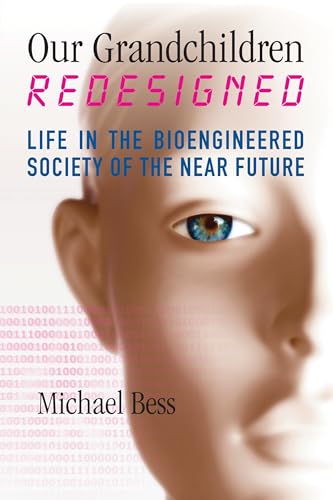

Our Grandchildren Redesigned: Life in the Bioengineered Society of the Near Future / Michael Bess.
Idioma: Inglés Beacon Press, 2015 Boston, MA :Descripción: xviii, 298 pTipo de contenido:- txt
- volume
- 9780807066621
- Life in the Bioengineered Society of the Near Future
- 23 610.28
| Imagen de cubierta | Tipo de ítem | Biblioteca actual | Biblioteca de origen | Colección | Ubicación en estantería | Signatura topográfica | Materiales especificados | Info Vol | URL | Copia número | Estado | Notas | Fecha de vencimiento | Código de barras | Reserva de ítems | Prioridad de la cola de reserva de ejemplar | Reservas para cursos | |
|---|---|---|---|---|---|---|---|---|---|---|---|---|---|---|---|---|---|---|
| Libro | Biblioteca Encarnación Valdés Colección General bev | 610.28 B557o (Navegar estantería(Abre debajo)) | Disponible | 80000002598459 |
Descripciones mejoradas de Syndetics:
A panoramic overview of biotechnologies that can endlessly boost human capabilities and the drastic changes these "superhuman" traits could trigger
Biotechnology is moving fast. In the coming decades, advanced pharmaceuticals, bioelectronics, and genetic interventions will be used not only to heal the sick but to boost human physical and mental performance to unprecedented levels. People will have access to pills that make them stronger and faster, informatic devices will interface seamlessly with the human brain, and epigenetic modification may allow people to reshape their own physical and mental identities at will.
Until recently, such major technological watersheds--like the development of metal tools or the industrialization of manufacturing--came about incrementally over centuries or longer. People and social systems had time to adapt: they gradually developed new values, norms, and habits to accommodate the transformed material conditions. But contemporary society is dangerously unprepared for the dramatic changes it is about to experience down this road on which it is already advancing at an accelerating pace.
The results will no doubt be mixed. People will live longer, healthier lives, will fine-tune their own thought processes, and will generate staggeringly complex and subtle forms of knowledge and insight. But these technologies also threaten to widen the rift between rich and poor, to generate new forms of social and economic division, and to force people to engage in constant cycles of upgrades and boosts merely to keep up. Individuals who boost their traits beyond a certain threshold may acquire such extreme capabilities that they will no longer be recognized as unambiguously human.
In this important and timely book, prize-winning historian Michael Bess provides a clear, nontechnical overview of cutting-edge biotechnology and paints a vivid portrait of a near-future society in which bioenhancement has become a part of everyday life. He surveys the ethical questions raised by the enhancement enterprise and explores the space for human agency in dealing with the challenges that these technologies will present.
Headed your way over the coming decades: new biotechnologies that can powerfully alter your body and mind.
The possibilities are tantalizing:
* Rejuvenation therapies offering much longer lives (160 and even beyond) in full vigor and mental acuity
* Cognitive enhancement through chemical or bioelectronic means (the rough equivalent of doubling or tripling IQ scores)
* Epigenetic tools for altering some of your genetically influenced traits at any point in your lifetime (body shape, athletic ability, intelligence, personality)
* Bioelectronic devices for modulating your own brain processes, including your "pleasure centers" (a potentially non-stop high)
* Direct control of machines by thought, and perhaps direct communication with other people, brain-to-brain (a new dimension of sharing and intimacy)
But some of the potential consequences are also alarming:
* A growing rift between the biologically enhanced and those who can't afford such modifications
* A constant cycle of upgrades and boosts as the bar of "normal" rises ever higher-- "Humans 95, Humans XP, Humans 8"
* The fragmentation of humankind into rival "bioenhancement clusters"
* A gradually blurring boundary between "person" and "product"
* Extreme forms of self-modification, with some individuals no longer recognized as unambiguously human
Includes bibliographical references (pages 218-228) and index
Envisioning the future : between the Jetsons and the Singularity -- Pharmaceuticals -- Bioelectronics -- Genetics and epigenetics -- Wild cards : nanotechnology, artificial intelligence, robotics, synthetic biology -- Should we re-engineer the human condition? -- Who gets enhanced? -- A fragmenting species? : cultural preferences inscribed into biology -- If I ran the zoo. adventures along the plant/animal/human/machine borderlands -- Mechanization of the self -- Turbocharging moral character -- Shared intimacies: monitoring and transmitting mental contents -- Virtual reality and (yawn) this other reality -- Til death do us no longer part. Implications of extremely long healthspans -- New sounds for the old guitar : sex, food, privacy, the arts, warfare -- Why extreme modifications should be postponed, or, the Singularity can wait -- Humane values in a world of moderate enhancements -- What you and I can do today -- Enhancing humility : some concluding thoughts.
Tabla de contenidos provista por Syndetics
- Welcome to the Future(p. xiii)
- Part I Humans Redesigned
- 1 Envisioning the Future: Between the Jetsons and the Singularity(p. 2)
- 2 Pharmaceuticals(p. 13)
- 3 Bioelectronics(p. 25)
- 4 Genetics and Epigenetics(p. 40)
- 5 Wild Cards: Nanotechnology, Artificial Intelligence, Robotics, Synthetic Biology(p. 55)
- Part II Justice
- 6 Should We Reengineer the Human Condition?(p. 74)
- 7 Who Gets Enhanced?(p. 84)
- 8 A Fragmenting Species? Cultural Preferences Inscribed into Biology(p. 94)
- 9 If I Ran the Zoo: Adventures along the Plant-Animal -Human-Machine Borderlands(p. 106)
- Part III Identity
- 10 Mechanization of the Self(p. 118)
- 11 Turbocharging Moral Character(p. 128)
- 12 Shared Intimacies: Monitoring and Transmitting Mental Information(p. 132)
- 13 Virtual Reality and (Yawn) This Other Reality(p. 141)
- 14 Till Death Do Us No Longer Part: Implications of Extremely Long Health Spans(p. 150)
- 15 New Sounds for the Old Guitar: Sex, Food, Privacy, the Arts, Warfare(p. 160)
- Part IV Choices
- 16 Why Extreme Modifications Should Be Postponed: Or, the Singularity Can Wait(p. 176)
- 17 Humane Values in a World of Moderate Enhancements(p. 187)
- 18 What You and I Can Do Today(p. 202)
- 19 Enhancing Humility: Some Concluding Thoughts(p. 210)
- Selected Filmography(p. 217)
- Selected Bibliography / Further Reading(p. 218)
- Acknowledgments(p. 229)
- Notes(p. 232)
- Index(p. 286)