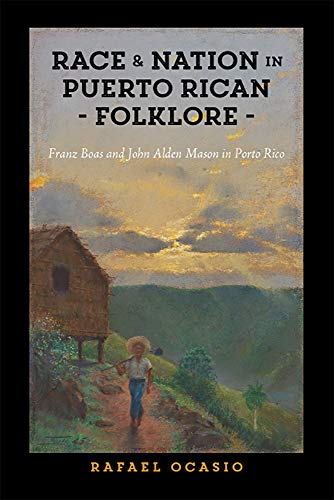

Race and nation in Puerto Rican folklore : Franz Boas and John Alden Mason in Porto Rico / Rafael Ocasio.
Series Critical Caribbean studies seriesEditor: New Brunswick, New Jersey : Rutgers University Press, [2020]Descripción: 239 pages ; 23 cmTipo de contenido:- text
- unmediated
- volume
- 9781978810211
- 9781978810204
- Boas, Franz, 1858-1942 -- Travel -- Puerto Rico
- Mason, John Alden, 1885-1967 -- Travel -- Puerto Rico
- Folklore -- Study and teaching -- Puerto Rico -- History
- Ethnology -- Puerto Rico -- History
- Oral tradition -- Puerto Rico
- National characteristics, Puerto Rican
- Puerto Ricans -- Ethnic identity
- Puerto Rico -- Race relations
- Puerto Rico -- Social life and customs
- Puerto Rico -- Relations -- United States
- United States -- Relations -- Puerto Rico
- 398.2097295 23
- GR47.P8 O23 2020
| Imagen de cubierta | Tipo de ítem | Biblioteca actual | Biblioteca de origen | Colección | Ubicación en estantería | Signatura topográfica | Materiales especificados | Info Vol | URL | Copia número | Estado | Notas | Fecha de vencimiento | Código de barras | Reserva de ítems | Prioridad de la cola de reserva de ejemplar | Reservas para cursos | |
|---|---|---|---|---|---|---|---|---|---|---|---|---|---|---|---|---|---|---|
| Libro | Biblioteca de Mayagüez Sala de Referencia mb | GR47.P8 O23 2020 (Navegar estantería(Abre debajo)) | c. 1 | Disponible | 50000003279808 |
Descripciones mejoradas de Syndetics:
Race and Nation in Puerto Rican Folklore: Franz Boas and John Alden Mason in Porto Rico explores the historic research trip taken to Puerto Rico in 1915. As a component of the Scientific Survey of Porto Rico and the Virgin Islands, Boas intended to perform field research in the areas of anthropology and ethnography while other scientists explored the island's natural resources. A young anthropologist working under Boas, John Alden Mason, rescued hundreds of oral folklore samples, ranging from popular songs, poetry, conundrums, sayings, and, most particularly, folktales while documenting native Puerto Rican cultural practices. Through his extensive excursions, Mason came in touch with the rural lives of Puerto Rican peasants, the jíbaros , who served as both his cultural informants and writers of the folklore samples. These stories, many of which are still part of the island's literary traditions and collected in a bilingual companion volume by Rafael Ocasio, reflect a strong Puerto Rican identity coalescing in the face of the U.S. political intervention on the island. A fascinating slice of Puerto Rican history and culture sure to delight any reader!
Includes bibliographical references and index.
Introduction: Retention and reinvention of Puerto Rican oral folklore tales -- Porto Rico as a colonial scientific laboratory : documenting Puerto Rican oral folklore -- A post-Spanish American War national identity : editing Puerto Rican folktales in a socio-political vacuum -- Jíbaros' authorship through self-literary characterization -- Telling a story about class and ethnicity through fairy tales, Cuentos puertorriqueños and Leyendas -- An (un)colored Puerto Rican culture : unpublished Negro fieldwork in old Loíza -- Tropicalizing the Puerto Rican racial past : the quest of an Indian area.
"Race and Nation in Puerto Rican Folklore: Franz Boas and John Alden Mason in Porto Rico, 1915 explores the founding father of American anthropology's historic trip to Puerto Rico in 1915. As a component of the Scientific Survey of Porto Rico and the Virgin Islands, Boas intended to perform field research in the areas of anthropology and ethnography there while other scientists explored the island's natural resources. Native Puerto Rican cultural practices were also heavily explored through documentation of the island's oral folklore. A young anthropologist working under Boas, John Alden Mason, rescued hundreds of oral folklore samples, ranging from popular songs, poetry, conundrums, sayings, and, most particularly, folktales. Through extensive excursions, Mason came in touch with the rural practices of Puerto Rican peasants, the Jíbaros, who served as both his cultural informants and writers of the folklore samples. These stories, many of which are still part of the island's literary traditions, reflect a strong Puerto Rican identity coalescing in the face of the U.S. political intervention on the island. A fascinating slice of Puerto Rican history and culture sure to delight any reader!"--