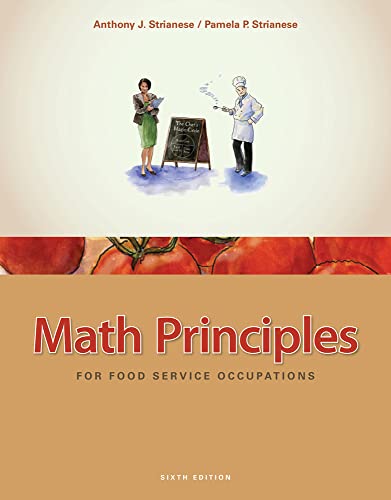

Math principles for food service occupations / Anthony J. Strianese, Pamela P. Strianese.
Detalles de publicación: Clifton Park, NY : Delmar, Cengage Learning, c2012.Edición: Sixth editionDescripción: xxi, 373 pages : color illustrations ; 29 cmTipo de contenido:- text
- online resource
- computer
- 9781435488823
- 1435488822
- TX911.3.M33 S75 2012
| Imagen de cubierta | Tipo de ítem | Biblioteca actual | Biblioteca de origen | Colección | Ubicación en estantería | Signatura topográfica | Materiales especificados | Info Vol | URL | Copia número | Estado | Notas | Fecha de vencimiento | Código de barras | Reserva de ítems | Prioridad de la cola de reserva de ejemplar | Reservas para cursos | |
|---|---|---|---|---|---|---|---|---|---|---|---|---|---|---|---|---|---|---|
| Libro | Biblioteca de Mayagüez Colección General mb | TX911.3 .M33 S75 2012 (Navegar estantería(Abre debajo)) | c. 1 | Prestado | 30/10/2026 | 50000003277877 |
Descripciones mejoradas de Syndetics:
MATH PRINCIPLES FOR FOOD SERVICE OCCUPATIONS, 6E stresses the direct relevance of math skills in the food service industry while teaching the basic math principles that affect everything from basic recipe preparation to managing food and labor costs in a restaurant operation. All the mathematical problems and concepts presented are explained in a simplified, logical, step-by-step manner. New to this edition, illustrations in full color add visual appeal to the text and help culinary students to master important concepts. Now in its 6th edition, this book demonstrates the importance of understanding and using math concepts to effectively make money in this demanding business. Part 1 explains how to use the calculator. Part 2 reviews basic math fundamentals. The following parts address math essentials and cost controls in food preparation and math essentials in food service record keeping, while the last part of the book concentrates on managerial math. New topics to this 6th edition include controlling beverage costs; clarifying and explaining the difference between fluid ounces and avoirdupois ounces; and an entire new section on yield testing and how to conduct these tests. There are new methods using helpful memory devices and acronyms to help readers remember procedures and formulas, such as BLT, NO, and the Big Ounce. New strategies and charts are also shown and explained on how to use purchases in order to control food and beverage costs and how transfers affect food and beverage costs. In addition, sections have been added on how to control costs using food (or liquor, or labor) cost percentage guidelines. The content in MATH PRINCIPLES FOR FOOD SERVICE OCCUPATIONS, 6E meets the required knowledge and competencies for business and math skills as required by the American Culinary Federation.
Includes index.
Includes bibliographical references and index.
Part I: THE CALCULATOR -- 1. Using the Calculator -- Part II: REVIEW OF BASIC MATH FUNDAMENTALS -- 2. Numbers, Symbols of Operations, and the Mill -- 3. Addition, Subtraction, Multiplication, and Division -- 4. Fractions, Decimals, Ratios, and Percents -- Part III: MATH ESSENTIALS AND COST CONTROLS IN FOOD PREPARATION -- 5. Weights and Measures -- 6. Using the Metric System of Measure -- 7. Portion Control -- 8. Converting Recipes, Yields, and Baking Formulas -- 9. Food, Recipe, and Labor Costing -- Part IV: MATH ESSENTIALS IN FOOD SERVICE RECORD KEEPING -- 10. Determining Cost Percentages and Pricing the Menu -- 11. Inventory Procedures and Controlling Costs -- 12. Purchasing and Receiving -- 13. Daily Production Reports and Determining Liquor Costs -- Part V: ESSENTIALS OF MANAGERIAL MATH -- 14. Front of the House and Managerial Mathematical Operations -- 15. Personal Taxes, Payroll, and Financial Statements -- Appendix A -- Glossary -- Index.
MATH PRINCIPLES FOR FOOD SERVICE OCCUPATIONS, 6E stresses the direct relevance of math skills in the food service industry while teaching the basic math principles that affect everything from basic recipe preparation to managing food and labor costs in a restaurant operation. All the mathematical problems and concepts presented are explained in a simplified, logical, step-by-step manner. New to this edition, illustrations in full color add visual appeal to the text and help culinary students to master important concepts. Now in its 6th edition, this book demonstrates the importance of understanding and using math concepts to effectively make money in this demanding business. Part 1 trains your students to use the calculator. Part 2 reviews basic math fundamentals. Subsequent parts address math essentials and cost controls in food preparation and math essentials in food service record keeping, while the last part of the book concentrates on managerial math. New topics to this 6th edition include controlling beverage costs; clarifying and explaining the difference between fluid ounces and avoirdupois ounces; and an entire new section on yield testing and how to conduct these tests. There are new methods using helpful memory devices and acronyms to help the student remember procedures and formulas, such as BLT, NO, and the Big Ounce. New strategies and charts are also shown and explained on how to use purchases in order to control food and beverage costs and how transfers affect food and beverage costs. In addition, sections have been added on how to control costs using food (or liquor, or labor) cost percentage guidelines. The content in MATH PRINCIPLES FOR FOOD SERVICE OCCUPATIONS, 6E meets the required knowledge and competencies for business and math skills as required by the American Culinary Federation.
Tabla de contenidos provista por Syndetics
- Forward
- Preface
- Acknowledgments
- Part I The Calculator
- 1 Using the Calculator
- Part II Review of Basic Math Fundamentals
- 2 Numbers, Symbols of Operations, and the Mill
- 3 Addition, Subtraction, Multiplication, and Division
- 4 Fractions, Decimals, Ratios, and Percents
- Part III Math Essentials and Cost Controls in Food Preparation
- 5 Weights and Measures
- 6 Using the Metric System of Measure
- 7 Portion Control
- 8 Converting Recipes, Yields, and Baking Formulas
- 9 Food, Recipe, and Labor Costing
- Part IV Math Essentials in Food Service Record Keeping
- 10 Determining Cost Percentages and Pricing the Menu
- 11 Inventory Procedures and Controlling Costs
- 12 Purchasing and Receiving
- 13 Daily Production Reports and Determining Liquor Costs
- Part V Essentials of Managerial Math
- 14 Front of the House and Managerial Mathematical Operations
- 15 Personal Taxes, Payroll, and Financial Statements
- Appendix A
- Glossary
- Index