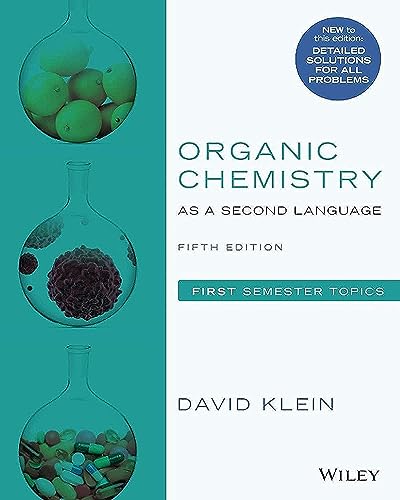

Organic chemistry as a second language : first semester topics / David Klein (Johns Hopkins University).
Editor: Hoboken, NJ : Wiley, [2020]Edición: 5e [Fifth edition]Descripción: pages cmTipo de contenido:- text
- unmediated
- volume
- 9781119493488 (pbk. : alk. paper)
- 547.0071/1 23
- QD256 .K54145 2020
| Imagen de cubierta | Tipo de ítem | Biblioteca actual | Biblioteca de origen | Colección | Ubicación en estantería | Signatura topográfica | Materiales especificados | Info Vol | URL | Copia número | Estado | Notas | Fecha de vencimiento | Código de barras | Reserva de ítems | Prioridad de la cola de reserva de ejemplar | Reservas para cursos | |
|---|---|---|---|---|---|---|---|---|---|---|---|---|---|---|---|---|---|---|
| Libro | Biblioteca de Mayagüez Colección General mb | QD256 .K54145 2020 (Navegar estantería(Abre debajo)) | c. 1 | Disponible | 50000003277869 |
Descripciones mejoradas de Syndetics:
Organic chemistry can be a challenging subject. Most students view organic chemistry as a subject requiring hours upon hours of memorization. Author David Klein's Second Language books prove this is not true--organic chemistry is one continuous story that actually makes sense if you pay attention. Offering a unique skill-building approach, these market-leading books teach students how to ask the right questions to solve problems, study more efficiently to avoid wasting time, and learn to speak the language of organic chemistry.
Covering the initial half of the course, Organic Chemistry as a Second Language: First Semester Topics reviews critical principles and explains their relevance to the rest of the course. Each section provides hands-on exercises and step-by-step explanations to help students fully comprehend classroom lectures and textbook content. Now in its fifth edition, this valuable study resource covers the characteristics of molecules, the nature of atomic bonds, the relationships between different types of molecules, drawing and naming molecules, and essential molecular reactions.
Includes bibliographical references and index.
Bond-line drawings -- Resonance -- Acid-base reactions -- Geometry -- Nomenclature -- Conformations -- Configurations -- Mechanisms -- Substitution reactions -- Elimination reactions -- Addition reactions -- Alkynes -- Alcohols -- Ethers and epoxides -- Synthesis.
Organic chemistry can be a challenging subject. Most students view organic chemistry as a subject requiring hours upon hours of memorization. Author David Klein's Second Language books prove this is not true—organic chemistry is one continuous story that actually makes sense if you pay attention. Offering a unique skill-building approach, these market-leading books teach students how to ask the right questions to solve problems, study more efficiently to avoid wasting time, and learn to speak the language of organic chemistry. Covering the initial half of the course, Organic Chemistry as a Second Language: First Semester Topics reviews critical principles and explains their relevance to the rest of the course. Each section provides hands-on exercises and step-by-step explanations to help students fully comprehend classroom lectures and textbook content. Now in its fifth edition, this valuable study resource covers the characteristics of molecules, the nature of atomic bonds, the relationships between different types of molecules, drawing and naming molecules, and essential molecular reactions.
Notas de autor provistas por Syndetics
David Klein is a lecturer at Johns Hopkins University where he teaches Organic and General Chemistry. He is a dynamic and creative teacher and uses analogy to help students grasp difficult topics. Klein's unique informal voice and manner of presentation help students truly master key topics in this course. He is also the author of Organic Chemistry as a Second Language ; response to this book has been phenomenal.