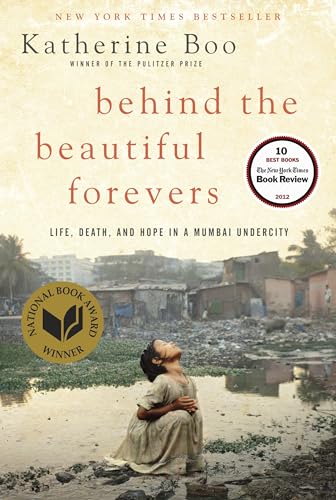

Behind the beautiful forevers / Katherine Boo.
Detalles de publicación: New York : Random House, c2012.Edición: 1st edDescripción: xxii, 256 pages ; 25 cmTipo de contenido:- 9781400067558 (hbk : alk. paper)
- 1400067553 (hbk : alk. paper)
- Dust jacket title: Behind the beautiful forevers : life, death, and hope in a Mumbai undercity
- 305.569
- HV4140.M86 B66 2012
| Imagen de cubierta | Tipo de ítem | Biblioteca actual | Biblioteca de origen | Colección | Ubicación en estantería | Signatura topográfica | Materiales especificados | Info Vol | URL | Copia número | Estado | Notas | Fecha de vencimiento | Código de barras | Reserva de ítems | Prioridad de la cola de reserva de ejemplar | Reservas para cursos | |
|---|---|---|---|---|---|---|---|---|---|---|---|---|---|---|---|---|---|---|
| Libro | Biblioteca Encarnación Valdés Colección General bev | 305.569 B7241b (Navegar estantería(Abre debajo)) | Disponible | 80000002639808 |
Descripciones mejoradas de Syndetics:
NEW YORK TIMES BESTSELLER * NATIONAL BOOK AWARD WINNER * ONE OF TIME 'S TEN BEST NONFICTION BOOKS OF THE DECADE * ONE OF THE NEW YORK TIMES 'S 100 BEST BOOKS OF THE 21ST CENTURY * A KIRKUS REVIEWS BEST NONFICTION BOOK OF THE CENTURY * AN OPRAH DAILY BEST NONFICTION BOOK OF THE PAST TWO DECADES
"Inspiring . . . extraordinary . . . [Katherine Boo] shows us how people in the most desperate circumstances can find the resilience to hang on to their humanity. Just as important, she makes us care."-- People
"A tour de force of social justice reportage and a literary masterpiece."--Judges, PEN/John Kenneth Galbraith Award
ONE OF THE TEN BEST BOOKS OF THE YEAR: The New York Times, The Washington Post, O: The Oprah Magazine, USA Today, New York, The Miami Herald, San Francisco Chronicle, Newsday
In this breathtaking book by Pulitzer Prize winner Katherine Boo, a bewildering age of global change and inequality is made human through the dramatic story of families striving toward a better life in Annawadi, a makeshift settlement in the shadow of luxury hotels near the Mumbai airport.
As India starts to prosper, the residents of Annawadi are electric with hope. Abdul, an enterprising teenager, sees "a fortune beyond counting" in the recyclable garbage that richer people throw away. Meanwhile Asha, a woman of formidable ambition, has identified a shadier route to the middle class. With a little luck, her beautiful daughter, Annawadi's "most-everything girl," might become its first female college graduate. And even the poorest children, like the young thief Kalu, feel themselves inching closer to their dreams. But then Abdul is falsely accused in a shocking tragedy; terror and global recession rock the city; and suppressed tensions over religion, caste, sex, power, and economic envy turn brutal.
With intelligence, humor, and deep insight into what connects people to one another in an era of tumultuous change, Behind the Beautiful Forevers, based on years of uncompromising reporting, carries the reader headlong into one of the twenty-first century's hidden worlds--and into the hearts of families impossible to forget.
WINNER OF: The PEN Nonfiction Award * The Los Angeles Times Book Prize * The American Academy of Arts and Letters Award * The New York Public Library's Helen Bernstein Book Award
A BEST BOOK OF THE YEAR: The New Yorker, People, Entertainment Weekly, The Wall Street Journal, The Boston Globe, The Economist, Financial Times, Foreign Policy, The Seattle Times, The Nation, St. Louis Post-Dispatch, The Denver Post, Minneapolis Star Tribune, The Week, Kansas City Star, Slate, Publishers Weekly
Prologue: Between roses -- Undercitizens -- Annawadi -- Asha -- Sunil -- Manju -- The business of burning -- Ghost house -- A hole she called a window -- A come-apart -- The master -- Market city -- Marquee effect -- Parrots, caught and sold -- Proper sleep -- Up and out -- Nine nights of dance -- Something shining -- The trial -- Ice -- Black and white -- A school, a hospital, a cricket field.
The dramatic and sometimes heartbreaking story of families striving toward a better life in one of the twenty-first century's great, unequal cities. In this fast-paced book, based on three years of uncompromising reporting, a bewildering age of global change and inequality is made human. Annawadi is a makeshift settlement in the shadow of luxury hotels near the Mumbai airport, and as India starts to prosper, Annawadians are electric with hope. Abdul, a reflective and enterprising Muslim teenager, sees fortune in the recyclable garbage of richer people. Asha, a woman of formidable wit and deep scars from a rural childhood, has identified an alternate route to the middle class: political corruption. And even the poorest Annawadians, like Kalu, a fifteen-year-old scrap-metal thief, believe themselves inching closer to good times. But then, as the tenderest individual hopes intersect with the greatest global truths, the true contours of a competitive age are revealed.--From publisher description.
Tabla de contenidos provista por Syndetics
- Prologue: between roses(p. ix)
- Part 1 undercitizens
- 1 Annawadi(p. 3)
- 2 Asha(p. 17)
- 3 Sunil(p. 31)
- 4 Manju(p. 50)
- Part 2 the business of burning
- 5 Ghost House(p. 71)
- 6 The Hole She Called a Window(p. 84)
- 7 The Come-Apart(p. 99)
- 8 The Master(p. 117)
- Part 3 a little wildness
- 9 . Marquee Effect(p. 135)
- 10 Parrots, Caught and Sold(p. 152)
- 11 Proper Sleep(p. 166)
- Part 4 up and out
- 12 Nine Nights of Dance(p. 177)
- 13 Something Shining(p. 190)
- 14 The Trial(p. 200)
- 15 Ice(p. 213)
- 16 Black and White(p. 221)
- 17 A School, a Hospital, a Cricket Field(p. 233)
- Author's Note(p. 247)
- Acknowledgments(p. 255)
Extracto provisto por Syndetics
Reseñas proporcionadas por Syndetics
Library Journal Review
This is Pulitzer Prize-winning journalist Boo's (The New Yorker) first book. She takes a look at the stark lives of the inhabitants of Annawadi, a slum across from Mumbai's Sahar Airport, to reveal the wrenching inequality and urban poverty still endemic in India's democracy. Using recorded and videotaped conversations, interviews, documents, and the assistance of interlocutors, Boo profiles the lives of some of the slum dwellers from November 2007 to March 2011. There is Abdul, a young adult scavenger with a profitable trade in recyclables. The one-legged Fatima's home is divided from Abdul's by merely a sheet. Readers follow the treacherous paths of these and other lives. A fateful chain of events leads to a criminal case against Abdul and his family. Boo presents glimpses of the corrupt police who feed on those without political power or education. She claims she witnessed most of the events described in the book. VERDICT A tour de force, this book is powerful yet far from harrowing. Highly recommended for all collections. [See Prepub Alert, 8/21/11.]-Ravi Shenoy, Naperville P.L., IL (c) Copyright 2012. Library Journals LLC, a wholly owned subsidiary of Media Source, Inc. No redistribution permitted.Publishers Weekly Review
A Mumbai slum offers rare insight into the lives and socioeconomic and political realities for some of the disadvantaged riding the coattails (or not) of India's economic miracle in this deeply researched and brilliantly written account by New Yorker writer and Pulitzer Prize-winning journalist Boo. Divided into four parts, the narrative brings vividly to the page life as it is led today in Annawadi, a squalid and overcrowded migrant settlement of some 3,000 people squatting since 1991 on a half-acre of land owned by the Sahar International Airport. (Boo derives her title from a richly ironic real-world image: a brightly colored ad for floor tiles repeating "Beautiful Forever" across a wall shutting out Annawadi from the view of travelers leaving the airport.) Among her subjects is the fascinating Abdul, a sensitive and cautiously hopeful Muslim teenager tirelessly trading in the trash paid for by recycling firms. Crucially, Boo's commanding ability to convey an interior world comes balanced by concern for the structural realities of India's economic liberalization (begun the same year as Annawadi's settlement), and her account excels at integrating the party politics and policy strategies behind eruptions of deep-seated religious, caste, and gender divides. Boo's rigorous inquiry and transcendent prose leave an indelible impression of human beings behind the shibboleths of the New India. (Feb.) (c) Copyright PWxyz, LLC. All rights reserved.Booklist Review
While the distance between rich and poor is growing in the U.S., the gap between the haves and have-nots in India is staggering to behold. This first book by a New Yorker staff writer (and Pulitzer Prize-winning reporter for the Washington Post) jolts the reader's consciousness with the opposing realities of poverty and wealth in a searing visit to the Annawaldi settlement, a flimflam slum that has recently sprung up in the western suburbs of the gigantic city of Mumbai, perched tentatively along the modern highway leading to the airport and almost within a stone's throw of new, luxurious hotels. We first meet Abdul, whose daily grind is to collect trash and sell it; in doing so, he has lifted his large family above subsistence. Boo takes us all around the community, introducing us to a slew of disadvantaged individuals who, nevertheless, draw on their inner strength to not only face the dreary day but also ponder a day to come that will, perhaps, be a little brighter. Sympathetic yet objective and eloquently rendered.--Hooper, Brad Copyright 2010 BooklistNotas de autor provistas por Syndetics
Katherine Boo was born on August 12, 1964 and grew up in the Washington D. C. area. She graduated summa cum laude from Barnard College of Columbia University.She is a staff writer at The New Yorker and a former reporter and editor for The Washington Post. Her reporting from disadvantaged communities has been awarded a Pulitzer Prize, a MacArthur "Genius" Grant, and a National Magazine Award for Feature Writing.
Her first book, Behind the Beautiful Forevers: Life, Death and Hope in a Mumbai Undercity, won the National Book Award for Nonfiction (2012), as well as nonfiction prizes from PEN, the Los Angeles Times Book Awards, the New York Public Library, and the American Academy of Arts and Letters.
(Bowker Author Biography)