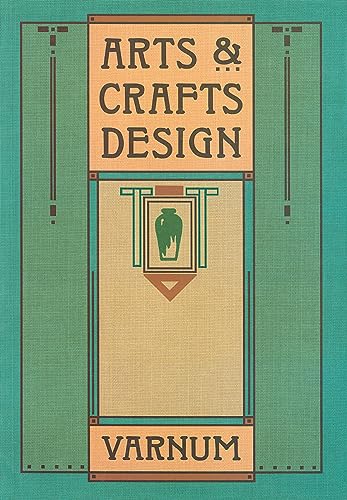

Arts & crafts design : a selected reprint of Industrial arts design / written by William H. Varnum ; foreword by Timothy L. Hansen. txt
Salt Lake City : Gibbs-Smith Publisher, 1995Edición: 1st reprint edDescripción: 248 p. : ill. ; 25 cmTipo de contenido:- text
- unmediaded
- volume
- 0879056991 (pbk.)
- 9780879056995
- Arts and crafts design
- 20 745.4
- NK1510 V3 1995
| Imagen de cubierta | Tipo de ítem | Biblioteca actual | Biblioteca de origen | Colección | Ubicación en estantería | Signatura topográfica | Materiales especificados | Info Vol | URL | Copia número | Estado | Notas | Fecha de vencimiento | Código de barras | Reserva de ítems | Prioridad de la cola de reserva de ejemplar | Reservas para cursos | |
|---|---|---|---|---|---|---|---|---|---|---|---|---|---|---|---|---|---|---|
| Libro | CARIBET Biblioteca Arquitectura Colección General CARIBET | General NK1510 V3 1995 (Navegar estantería(Abre debajo)) | 1 | Disponible | 91000000061465 |
Descripciones mejoradas de Syndetics:
Originally published in 1916 when the Arts & Crafts movement was in its heyday, this is a virtual textbook of materials, color, techniques, and designs. Arts & Crafts Design is a practical guide to the creation of high-quality, high-style furnishings through the industrial arts.
"In this relativistic age in which de gustilrie non disputandum est (it is undisputed that each person has their own sense of taste), it is refreshing to look back to the early twentieth century when at least a few people were certain that there are universal rules for good art and also that they had themselves mastered these precepts and could pass them on to a society that loved commonly held values. William H. Varnum was one of those people. He offers here a textbook that will, if followed, allow students to 'directly apply well-recognized principles of design to specific materials and problems.' No situation esthetics here. In fact, he followed these principles in designing the logos representing his tools and ratio system on the cover of his book.
"The publisher of this new edition has added a useful foreword and substitued the title Arts and Crafts Design for the original (1916) Industrial Arts Design, an appropriate modification since the term "industrial" suggests factory production whereas Varnum referred to objects that today we call "Craftsman"--Rookwood pottery, Stickley furniture, Jarvie candlesticks, etc. A delightful touch is that Varnum included pictures of these objects alongside the principles by which he believed they were designed. Varnum's book offers an enlightening, if somewhat technical, insight into thinking about design before World War I. There is no doubt that the Arts and Crafts period during which the principles of simple beauty married so neatly with function can be better understood and appreciated today through Varnum's perceptions."
Robert Winter
Originally published: Industrial arts design. Peoria, Ill., Manual Arts Press, 1916.
"Peregrine Smith book"--T.p. verso.
Includes index.
Divisions of industrial arts design
The primary mass and its proportions
Horizontal major divisions of the primary mass
Vertical major divisions of the primary mass
appendages and the rules governing them
Enrichment of the contours or outlines Designs in wood
Enrichment of the contours or outlines designs in clay
Enrichment of the contours or outlines designs in base and precious metals
Surface enrichment of small primary masses in wood
Surface enrichment of small primary masses in wood. (continued)
Surface enrichment with minor subdivisions of large primary masses in wood
Surface enrichment of clay.
Surface enrichment of precious metals. Small flat planes
Surface enrichment of large primary masses in base and precious metals
Color: hue, value, and chroma; stains
Color and its relation to industrial arts design. Large surfaces of wood; wall and ceiling areas
Color and its relation to industrial arts design. Small surfaces in clay and metal
Complete summary of rules
Appendix
(a) A complete course of study for the applied arts in the base and precious metals. Relation of the rules to the problems
(b) A complete course of study for the applied arts in pottery. Relation of the rules to problems
Index
Extracto provisto por Syndetics
Notas de autor provistas por Syndetics
William Harrison Varnum was an Assistant Professor of Drawing and Design at the University of Wisconsin in Madison when he wrote this book in 1916. The text was intended to be used for industrial arts courses in high school, colleges and universities, but has since transcended time and purpose.