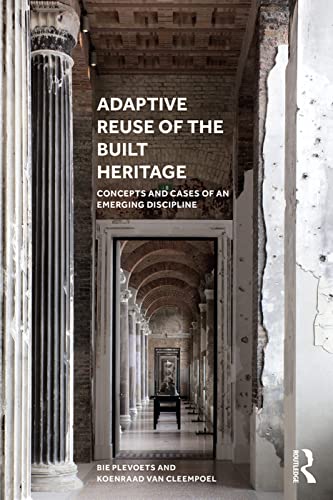

Adaptive reuse of the built heritage : concepts and cases of an emerging discipline / Bie Plevoets and Koenraad Van Cleempoel. txt
Editor: New York : Routledge, 2019Descripción: xix, 236 p. : ill.; photo.; plans; col.; 24 cmTipo de contenido:- text
- unmediated
- volume
- 9781138062757
- 9781138062764
- Buildings -- Remodeling for other use
- Architecture
- rchitectural Conservation and Building Conservation
- Architectural History
- Interior design
- Sustainable architecture
- Theory of Architecture
- Environment and Sustainability Conservation
- Environmental Studies
- Museum and Heritage Studies
- Heritage Management & Conservation
- 720.28/6 23
- TH3401 P59 2019
| Imagen de cubierta | Tipo de ítem | Biblioteca actual | Biblioteca de origen | Colección | Ubicación en estantería | Signatura topográfica | Materiales especificados | Info Vol | URL | Copia número | Estado | Notas | Fecha de vencimiento | Código de barras | Reserva de ítems | Prioridad de la cola de reserva de ejemplar | Reservas para cursos | |
|---|---|---|---|---|---|---|---|---|---|---|---|---|---|---|---|---|---|---|
| Libro | CARIBET Biblioteca Arquitectura Colección General CARIBET | General TH3401 P59 2019 (Navegar estantería(Abre debajo)) | 1 | Disponible | 91000000062125 |
Descripciones mejoradas de Syndetics:
Adaptive reuse - the process of repairing and restoring existing buildings for new or continued use - is becoming an essential part of architectural practice. As mounting demographic, economic, and ecological challenges limit opportunities for new construction, architects increasingly focus on transforming and adapting existing buildings.
This book introduces adaptive reuse as a new discipline. It provides students and professionals with the understanding and the tools they need to develop innovative and creative approaches, helping them to rethink and redesign existing buildings - a skill which is becoming more and more important. Part I outlines the history of adaptive reuse and explains the concepts and methods that lie behind new design processes and contemporary practice. Part II consists of a wide range of case studies, representing different time periods and strategies for intervention. Iconic adaptive reuse projects such as the Caixa Forum in Madrid and the Rijksmuseum in Amsterdam are discussed alongside less famous and spontaneous transformations such as the Kunsthaus Tacheles in Berlin, in addition to projects from Italy, Spain, Croatia, Belgium, Poland, and the USA.
Featuring over 100 high-quality color illustrations, Adaptive Reuse of the Built Heritage is essential reading for students and professionals in architecture, interior design, heritage conservation, and urban planning.
Includes bibliographical references and index.
Historical background -- Intervention strategies -- Adaptive reuse for urban regeneration -- Diocletian Palace, Split -- Attocha Station, Madrid -- Neues Museum, Berlin -- Former Prison, Hasselt -- St Joseph church, Ghent.
Adaptive reuse - the process of repairing and restoring existing buildings for new or continued use - is becoming an essential part of architectural practice. As mounting demographic, economic, and ecological challenges limit opportunities for new construction, architects increasingly focus on transforming and adapting existing buildings. This book introduces adaptive reuse as a new discipline. It provides students and professionals with the understanding and the tools they need to develop innovative and creative approaches, helping them to rethink and redesign existing buildings - a skill which is becoming more and more important. Part I outlines the history of adaptive reuse and explains the concepts and methods that lie behind new design processes and contemporary practice. Part II consists of a wide range of case studies, representing different time periods and strategies for intervention. Iconic adaptive reuse projects such as the Caixa Forum in Madrid and the Rijksmuseum in Amsterdam are discussed alongside less famous and spontaneous transformations such as the Kunsthaus Tacheles in Berlin, in addition to projects from Italy, Spain, Croatia, Belgium, Poland, and the USA. Featuring over 100 high-quality color illustrations, Adaptive Reuse of the Built Heritage is essential reading for students and professionals in architecture, interior design, heritage conservation, and urban planning.
Reseñas proporcionadas por Syndetics
CHOICE Review
Preservation, which this book's title renders as heritage, is a growing field within architecture and urban studies, and it has an expanding body of specialized disciplines and practices. Preservation encompasses two broad activities, each with its particular role and practices. One seeks to protect and display old, valued buildings and the existing areas that offer enjoyment now and in the future. The other, which is the focus here, makes modifications to old buildings and areas to equip them to serve new uses. Less strict standards obtain for what can qualify than for what is done, and these efforts are normally part of an economic or a revitalization program. The book's first half offers a useful historical review of preservation and of current procedures and standards prevalent in Britain and Continental Europe but also compatible with procedures and standards in the US. In the second half of the book the two authors (both, Hasselt Univ., Belgium) present 20 case studies, only one of them in the US (the Park Avenue Armory project, in New York). The footnotes and bibliographic references are ample, the index is adequate, but the extensive graphic material, much of it in color, often appears dark and muddy. Summing Up: Recommended. With reservations. Graduate students, researchers, faculty, professionals. --Carroll W. Westfall, emeritus, University of Notre DameNotas de autor provistas por Syndetics
Bie Plevoets holds a PhD in architecture and works on theory of adaptive reuse in the research group Trace - Adaptive Reuse and Heritage in the Faculty of Architecture and Arts at Hasselt University, Belgium. She teaches courses on adaptive reuse at BA and MA levels.
Koenraad Van Cleempoel is Professor of Art History in the Faculty of Architecture and Arts at Hasselt University, Belgium, where he is also a member of the research group Trace. He was previously holder of the Pieter Paul Rubens Chair at the University of California, Berkeley, USA.