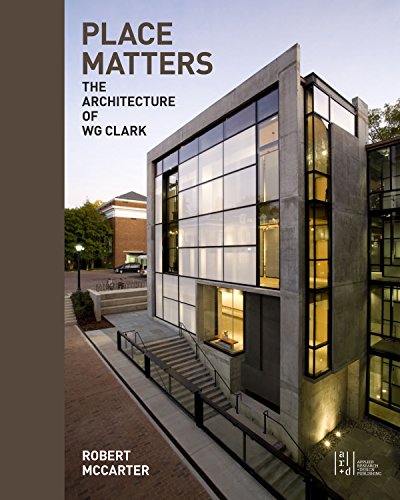

Place matters : the architecture of WG Clark. / Robert McCarter. txt
[Novato, CA] : Oro Editions , 2019Edición: 1st editionDescripción: 255 p. ill. ;col. ;plans. ;photo. ; 26 cmTipo de contenido:- text
- unmediaded
- volume
- 9781940743424
- 1940743427
- 23 720.92
- NA737.C49 M33 2019
| Imagen de cubierta | Tipo de ítem | Biblioteca actual | Biblioteca de origen | Colección | Ubicación en estantería | Signatura topográfica | Materiales especificados | Info Vol | URL | Copia número | Estado | Notas | Fecha de vencimiento | Código de barras | Reserva de ítems | Prioridad de la cola de reserva de ejemplar | Reservas para cursos | |
|---|---|---|---|---|---|---|---|---|---|---|---|---|---|---|---|---|---|---|
| Libro | CARIBET Biblioteca Arquitectura Colección General CARIBET | General NA737.C49 M33 2019 (Navegar estantería(Abre debajo)) | 1 | Disponible | 91000000061911 |
Descripciones mejoradas de Syndetics:
The architecture of WG Clark is inextricably grounded in its place, the Atlantic coastal states of the American South. Over the course of his 40-year career as a modern architect practicing in historic contexts, Clark has constructed a small but significant body of work of unparalleled high quality and experiential richness. Clark's remarkably resolved spatial compositions are formally restrained and contextually appropriate, and while relatively few in number, have nevertheless exerted an outsize influence on architects around the world. Clark's regional grounding, slow and measured pace of design, and modest publicity has provided him with the time-in-place necessary for thinking and making at the very highest level. Like the relatively few works of Louis Kahn and Carlo Scarpa, the works of WG Clark have attained canonical status, and his redefinition of architectural design as being grounded in the history of the discipline, as well as in the particularities of its place, has proved to be of ever-increasing relevance to contemporary practice.
Include Bibliography
Place Matters --
A practice of Making Places --
Middleton Inn, Dorchester County, South Carolina (1977-1985) --
New Orleans Museum of Art, New Orleans, Louisiana (1983) (unrealized) --
Reid House, Johns Island, South Carolina (1985-1987) --
Arizona History Museum, Competition, Phoenix, Arizona (1986) (unrealized) --
Charleston Bus Stop, Charleston, South Carolina (1987-1992) --
South Carolina Aquarium, Competition First Prize, Charleston, South Carolina (1987-2000) --
Croffead House, James Island, South Carolina (1986-1989) --
Lucy Daniels Foundation and Preschool, Cary, North Carolina (1990-1992) --
Menefee Mountain House, Zirconia, North Carolina (1990-1993) --
Clark House, Charlottesville, Virginia (1994-1996) --
8 Bedon's Alley, Charleston, South Carolina (1994-1999) --
Telluride House, Telluride, Colorado (2000-2001) (unrealized) --
Beckerdite/Scholley House, James City County, Virginia (2001-2005) --
National Association of Realtors Headquarters, Competition, Washington, DC (2002) (unrealized) --
South Eastern Center for Contemporary Art Habitat of Humanity, Competition, First Prize, (2003) (unrealized) --
Palisade Glacier Mountain Hut, Competition, (2003) (unrealized) --
Hillman House, Schuyler, Virginia (2003-2005) --
Sheldon Retreat, Wadmalaw Island, South Carolina (2004) (unrealized)--
Clemson Architecture Center in Charleston, Competition, First Prize, (2004-2005) (unrealized) --
Cameron Lane House Addition, Charlottesville, Virginia (2005-2006) --
Les Yeux des Monde Art Gallery, Albemarle County, Virginia (2007-2009) --
Mepkin Abbey, Entrance Gates and Sign, Guest House and Chapel, Berkeley County, South Carolina, (2005-2009, 2009-2013) --
Campbell Hall East Addition, University of Virginia, Charlottesville, Virginia (2004-2008) --
Thinking and Making --
The architecture of WG Clark is inextricably grounded in its place, the Atlantic coastal states of the American South. Over the course of his 40-year career as a modern architect practicing in historic contexts, Clark has constructed a small but significant body of work of unparalleled high quality and experiential richness. Clark's remarkably resolved spatial compositions are formally restrained and contextually appropriate, and while relatively few in number, have nevertheless exerted an outsize influence on architects around the world. Clark's regional grounding, slow and measured pace of design, and modest publicity has provided him with the time-in-place necessary for thinking and making at the very highest level. Like the relatively few works of Louis Kahn and Carlo Scarpa, the works of WG Clark have attained canonical status, and his redefinition of architectural design as being grounded in the history of the discipline, as well as in the particularities of its place, has proved to be of ever-increasing relevance to contemporary practice.