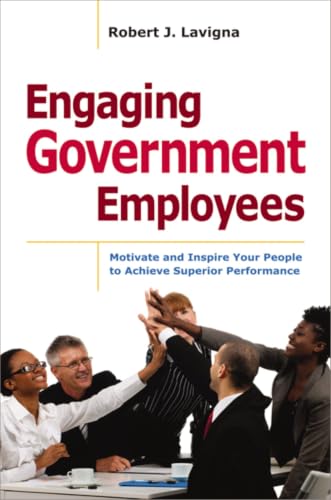
Imagen de portada de Amazon
Imagen de Amazon.com
Imagen de cubierta Syndetics
Portada de Syndetics
Imagen de OpenLibrary

Engaging government employees : motivate and inspire your people to achieve superior performance / Bob Lavigna.

Por: Editor: New York : American Management Association, ©2013Descripción: 276 pages ; 24 cmTipo de contenido:
  • text
Tipo de medio:
  • unmediated
Tipo de soporte:
  • volume
ISBN:
  • 9780814432792
Tema(s): Clasificación LoC:
  • JK765 .L38 2013
Valoración
    Valoración media: 0.0 (0 votos)
Existencias
Imagen de cubierta Tipo de ítem Biblioteca actual Biblioteca de origen Colección Ubicación en estantería Signatura topográfica Materiales especificados Info Vol URL Copia número Estado Notas Fecha de vencimiento Código de barras Reserva de ítems Prioridad de la cola de reserva de ejemplar Reservas para cursos
Libro Biblioteca Encarnación Valdés Colección General bev 352.66 L411e (Navegar estantería(Abre debajo)) Disponible 80000002638354
Total de reservas: 0

Descripciones mejoradas de Syndetics:


With over three decades of experience in public sector HR, Bob Lavigna gives managers the tools they need to leverage the talents of government's most important resource: its people.

You know firsthand that your government workers are not underworked, overpaid, or mindless clones just carrying out the morally compromised work that politicians forced through the pipeline. Besides having to daily overcome the persona of being a government employee, your hard-working employees face enormous pressures and challenges every day and are asked to solve some of our country's toughest problems, including unemployment, security, poverty, and education.

To be able to return to their desks daily with the passion and commitment required to accomplish these overwhelming duties will require a manager who knows how to leverage talent, improve performance, and inspire passion within these true servants.

In Engaging Government Employees, you will learn:

Why a highly engaged staff is 20 percent more productive How to get employees to deliver "discretionary effort" How to assess the level of engagement Why free pizza and Coke every Friday is not a viable strategy

Engaging Government Employees rejects the typical one-size-fits-all approach to motivation. Drawing on a wealth of empirical evidence, this indispensable resource shows how America's largest employer can apply the science of engagement to get team members passionate about the agency's mission and committed to its success.

Includes index.

Tabla de contenidos provista por Syndetics

  • 1 The Power of Employee Engagement and What This Book Is About(p. 1)
  • 2 So What Is Employee Engagement, Exactly?(p. 9)
  • 3 Why Engagement Matters: The Business Case for Improving Engagement(p. 23)
  • 4 The Special Case of Public Service and How This Affects Engagement and Efforts to Improve It(p. 45)
  • 5 How Managers Can Respond to the Differences Between the Public and Private Sectors and Improve Engagement(p. 79)
  • 6 Measuring Employee Engagement(p. 103)
  • 7 A Process Model for Measuring and Improving Employee Engagement(p. 113)
  • 8 Steps 1 and 2: Planning and Conducting the Employee-Engagement Survey(p. 119)
  • 9 Step 3: Reporting and Analyzing Survey Results: So What Do All These Numbers Mean?(p. 141)
  • 10 Step 4: Taking Action to Improve Employee Engagement(p. 157)
  • 11 Step 5: Sustaining Higher Levels of Engagement(p. 177)
  • 12 What Public-Sector Organizations Have Actually Done to Improve Engagement(p. 185)
  • 13 The Role of Human Resources(p. 229)
  • 14 Getting Started on the Journey to Improved Employee Engagement(p. 237)
  • Appendix 1 Action Plan Evaluation Worksheet(p. 241)
  • Appendix 2 Sample Communication Plan(p. 249)
  • Notes(p. 251)
  • Index(p. 269)

Extracto provisto por Syndetics

From Chapter 1 The Power of Employee Engagement and What This Book Is About    There are many other books about employee engagement, and some are excellent. But this book departs from the others in three ways. First, I focus on the science of employee engagement--that is, what the research clearly proves about the power of engagement to improve individual and organizational performance. Instead of relying on my insights "culled from my many years of experience" or "my work with many different types of organizations," I emphasize what the engagement research has proven empirically and how these results apply to government organizations. Sure, I have experience with engagement, and I will cite some of these experiences as examples, but I don't trust purely anecdotal experiences and don't believe they necessarily apply to the situations or challenges other managers face. I don't rely exclusively on my personal experiences to make the case for why government leaders, managers, frontline supervisors, and employees should focus on engagement. Instead, I rely on the research and empirical evidence. Second, my focus is government. There are other fine works on the science of engagement, but they don't emphasize the public sector. In Chapter 4, I highlight the unique challenges government faces, the fundamental differences between the public and private sectors, and the implications of these differences for managers--and for employee engagement. I argue that, in some respects, these differences make it harder to manage in the public sector. As a result, public-sector leaders, managers, and frontline supervisors must approach engagement differently than their private-sector counterparts. In addition to the hostile environment the government operates in today, other key factors that distinguish the public sector from the private sector include political leadership that changes frequently; hard-to-measure goals and impacts; complicated, rule-bound, and sometimes irrational decision making; multiple external stakeholders with power and influence; an older, more educated, and more white-collar workforce; strong civil-service rules and employee protections; heavy union influence; limited financial tools to influence and reward employee behavior; public visibility of government actions; and, more positively, a workforce that is intrinsically motivated toward public service. I believe that government leaders and managers need to understand these differences and their implications for employee engagement. This argument is a key focus of this book. The third way in which this book departs from many other works on engagement is that I don't present a one-size-fits-all approach to improving engagement. There are many engagement models and approaches that their designers maintain can be adopted just about anywhere. In contrast, I don't see how any single employee-engagement model can apply to all organizations and situations, particularly in government. Just in the United States, there are more than 85,000 government jurisdictions and agencies, and each has its own mission, strategy, values, and culture. Instead, I believe that every organization needs to measure its own level of employee engagement, analyze the results to identify specific areas to improve, set priorities for action, and then act on the data. While there are some broad principles that apply generally to engagement (which I'll discuss), there is no single solution that will automatically improve engagement across all organizations. I do present a model in Chapter 7, but it is an engagement process model--that is, a model that a public-sector organization can adapt and adopt to assess its level of employee engagement. The organization needs to then act on these results to improve engagement. The model is intended to help each agency generate the data it needs to draw conclusions about what its employee-engagement issues are and how to deal with them to improve engagement, but it does not prescribe generic solutions. In Chapter 12, I describe what some government agencies have done to improve engagement, but I present these actions as examples, not prescriptions. From the start, it is important to understand that there is no silver bullet to achieve high levels of employee engagement. Instead, what's needed is silver buckshot--an integrated series of actions, specific to each government jurisdiction or agency, to measure and then improve engagement. Here's a quote that I think sums up the power of employee engagement. According to Jim Goodnight, CEO of SAS, a leading business software company that is also a perennial member of Fortune magazine's annual "100 Best Companies to Work For," "My chief assets drive out the gate every day. My job is to make sure they come back." 9 Goodnight's statement is just as applicable (or maybe even more applicable) to government. And improving engagement is one clearly documented way to make sure that when the chief assets of government leave at the end of the day, they do plan to return tomorrow.    Excerpted from ENGAGING GOVERNMENT EMPLOYEES by Robert J. Lavigna. Copyright (c) 2013 by Robert J. Lavigna. Published by AMACOM Books, a division of American Management Association, New York, NY. Used with permission. All rights reserved. http://www.amacombooks.org.   Excerpted from Engaging Government Employees: Motivate and Inspire Your People to Achieve Superior Performance by Robert J. Lavigna All rights reserved by the original copyright owners. Excerpts are provided for display purposes only and may not be reproduced, reprinted or distributed without the written permission of the publisher.

Notas de autor provistas por Syndetics

ROBERT J. LAVIGNA has more than 30 years of experience leading public sector human capital management organizations, including positions with the state of Wisconsin, Partnership for Public Service, the U.S. Government Accountability Office, and the University of Wisconsin."
Compartir
logopucpr-y-vive

Contáctanos

¡Queremos saber de ti!

Tel. 787.841.2000 Ext. 1801

bibliotecavaldes@pucpr.edu

⁣Búscanos en las redes

© 2026 Desarrollado por Ignite Online • All Rights Reserved • Powered by Koha.