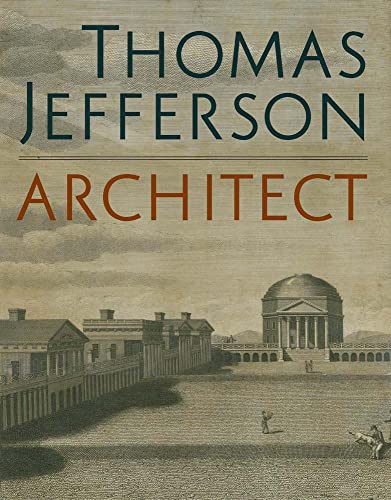

Thomas Jefferson, architect : palladian models, democratic principles, and the conflict of ideals. / [edited by] Lloyd DeWitt, with Corey Piper. txt
Editor: New Haven, CT : Yale University Press, 2019Descripción: vii, 200 p. ill. ;col. ;photo. ;maps. ;plans. ; 28 cmTipo de contenido:- text
- unmediaded
- volume
- 9780300246209
- 030024620X
- 720.92 23
- NA737.J4 D49 2019
| Imagen de cubierta | Tipo de ítem | Biblioteca actual | Biblioteca de origen | Colección | Ubicación en estantería | Signatura topográfica | Materiales especificados | Info Vol | URL | Copia número | Estado | Notas | Fecha de vencimiento | Código de barras | Reserva de ítems | Prioridad de la cola de reserva de ejemplar | Reservas para cursos | |
|---|---|---|---|---|---|---|---|---|---|---|---|---|---|---|---|---|---|---|
| Libro | CARIBET Biblioteca Arquitectura Colección General CARIBET | General NA737.J4 D49 2019 (Navegar estantería(Abre debajo)) | 1 | Disponible | 91000000061887 |
Descripciones mejoradas de Syndetics:
A compelling reassessment of Thomas Jefferson's architecture that scrutinizes the complex, and sometimes contradictory, meanings of his iconic work
Renowned as a politician and statesman, Thomas Jefferson (1743-1826) was also one of the premier architects of the early United States. Adept at reworking Renaissance--particularly Palladian--and Enlightenment ideals to the needs of the new republic, Jefferson completed visionary building projects such as his two homes, Monticello and Poplar Forest; the Capitol building in Richmond; and the University of Virginia campus. Featuring a wealth of archival images, including models, paintings, drawings, and prints, this volume presents compelling essays that engage broad themes of history, ethics, philosophy, classicism, neoclassicism, and social sciences while investigating various aspects of Jefferson's works, design principles, and complex character.
In addition to a thorough introduction to Jefferson's career as an architect, the book provides insight into his sources of inspiration and a nuanced take on the contradictions between his ideas about liberty and his embrace of slavery, most poignantly reflected in his plan for the academical village at the University of Virginia, which was carefully designed to keep enslaved workers both invisible and accessible. Thomas Jefferson, Architect offers fresh perspectives on Jefferson's architectural legacy, which has shaped the political and social landscape of the nation and influenced countless American architects since his time.
Published in association with the Chrysler Museum of Art
Exhibition Schedule:
Chrysler Museum of Art, Norfolk
(October 19, 2019-January 19, 2020)
Include index
Foreword / Armando Varricchio --
Introduction / Erik H. Neil --
Thomas Jefferson, the making of an architect / Howard Burns --
The Palladians / Guido Beltramini --
Jefferson and England / Richard Guy Wilson --
What he saw: Thomas Jefferson's grand tour / Lloyd DeWitt --
Books, buildings, and the spaces of democracy: Jefferson's library from Paris to Washington / Barry Bergdoll --
Race, reason, and the architecture of Jefferson's Virginia statehouse / Mabel O. Wilson --
The architecture of democracy in a landscape of slavery: design and construction at Jefferson's university / Louis P. Nelson --
Plates --
Renowned as a politician and statesman, Thomas Jefferson (1743-1826) was also one of the premier architects of the early United States. Adept at reworking Renaissance-particularly Palladian-and Enlightenment ideals to the needs of the new republic, Jefferson completed visionary building projects such as his two homes, Monticello and Poplar Forest; the Capitol building in Richmond; and the University of Virginia campus. Featuring a wealth of archival images, including models, paintings, drawings, and prints, this volume presents compelling essays that engage broad themes of history, ethics, philosophy, classicism, neoclassicism, and social sciences while investigating various aspects of Jefferson's works, design principles, and complex character. In addition to a thorough introduction to Jefferson's career as an architect, the book provides insight into his sources of inspiration and a nuanced take on the contradictions between his ideas about liberty and his embrace of slavery, most poignantly reflected in his plan for the academical village at the University of Virginia, which was carefully designed to keep enslaved workers both invisible and accessible. Thomas Jefferson, Architect offers fresh perspectives on Jefferson's architectural legacy, which has shaped the political and social landscape of the nation and influenced countless American architects since his time.
Reseñas proporcionadas por Syndetics
Library Journal Review
As a student at the College of William and Mary, Thomas Jefferson (1743--1826) exhibited an innate attraction to architecture and the work of the last great Renaissance architect, Andrea Palladio. He likely owned Giacomo Leoni's translation of Palladio's Four Books (1715--20), as well as James Gibbs's 1732 rule book. Both inspired the self-taught designer to distill European sources into his signature integration of Palladio and Greco-Roman architecture. This handsome volume accompanies an exhibition at Virginia's Chrysler Museum of Art and assembles a distinguished group of seven historians who take a fresh look at Jefferson's architectural legacy, from early ideas for Monticello through his architectural exposure to European ideals during his ambassadorship to France. With essential new scholarship, this volume nicely augments Hugh Howard's Thomas Jefferson: Architect. Noteworthy are lacerating essays by architectural historians Mabel O. Wilson on the Virginia capital's use of slave labor for its construction, and Louis P. Nelson on the paradox of the University of Virginia's "academical village" with its purported holistic educational environment alongside marginal accommodations for the sizable enslaved population on campus. A concluding section of full-color plates provides further examples of the material culture that surrounded this highly influential amateur architect. VERDICT Essential for academic and design libraries.--Paul Glassman, Yeshiva Univ. Libs., New YorkCHOICE Review
Produced for an exhibition at the Chrysler Museum (Norfolk, VA), this volume comprises, in addition to 49 color plates, seven essays by distinguished architectural historians (DeWitt among them), and together the essays provide an outstanding survey of Jefferson's work. One of the book's themes is how the architecture of Jefferson's time depended on slave labor. Using new research, the contributors forthrightly confront Jefferson and slavery. Does Jefferson's use of slaves as workers negate his architectural successes? The volume includes an examination of the Roman architectural forms and styles Jefferson used--and the classical sources he saw while traveling in England, France, northern Italy, Holland, and Germany--and of Jefferson's interest in Palladianism. Mabel Wilson contributes an essay on the Virginia Statehouse, which she considers as a national symbol within its social, economic, cultural, and political context, and Louis Nelson looks at the construction of the University of Virginia ("Jefferson's university"), which he sees in relationship to slavery. Comprehensive notes substitute for a formal bibliography. In addition to color plates, the book includes black-and-white and color pictures, vintage photographs, scale models, diagrams, and architectural drawings. This comprehensive survey, with its discussion of Jefferson and slavery, offers many insights on Jefferson's architecture and its historical context. Summing Up: Recommended. All readers. --William L. Whitwell, formerly, Hollins CollegeNotas de autor provistas por Syndetics
Lloyd DeWitt is the chief curator and Irene Leache Curator of European Art. Corey Piper is Brock Curator of American Art, both at the Chrysler Museum of Art.
Guido Beltramini is director of the Centro Internazionale di Studi Architettura Andrea Palladio and the Palladio Museum. Barry Bergdoll is Meyer Schapiro Professor of Art History at Columbia University. Howard Burns is president of the Scientific Committee of the Centro Internazionale di Studi Architettura Andrea Palladio. Erik H. Neil is director of the Chrysler Museum of Art . Louis P. Nelson serves as professor of architectural history and vice provost for academic outreach at the University of Virginia. Mabel O. Wilson is professor of architectural design and history/theory at Columbia University and senior fellow with the Columbia University Institute for Research in African American Studies. Richard Guy Wilson serves as Commonwealth Professor, Architectural History at the University of Virginia School of Architecture.