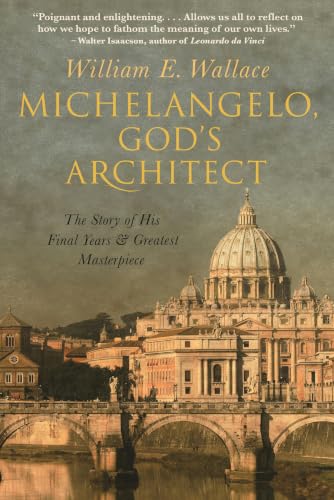
Imagen de portada de Amazon
Imagen de Amazon.com
Imagen de cubierta Syndetics
Portada de Syndetics
Imagen de OpenLibrary

Michelangelo, God's architect : the story of his final years and greatest masterpiece. / William E. Wallace. txt

Por: Editor: Princeton, NJ : Princeton University Press, 2019Descripción: 277 p. ill.; photo.; col. 24 cmTipo de contenido:
  • text
Tipo de medio:
  • unmediaded
Tipo de soporte:
  • volume
ISBN:
  • 9780691195490
  • 0691195498
Tema(s): Clasificación CDD:
  • 23 709.2
Clasificación LoC:
  • N6923.B9 W355 2019
Contenidos:
Contents: Preface IX -- Introduction 1 -- Chapter 1 Moses 7 -- Chapter 2 Friends At Seventy Matter More 28 -- Chapter 3 Along Lived Pope 56 -- Chapter 4 Architect of St. Peter’s 75 -- Chapter 5 A New Pope: Julius III 112 -- Chapter 6 Rome 1555 154 -- Chapter 7 Architect of Rome 184 -- Chapter 8 God’s Architect 215 -- Epilogue 239 -- Notes 243 -- Works Cited 261 -- Index 271 -- Photo Credits 279 --
Resumen: As he entered his seventies, the great Italian Renaissance artist Michelangelo despaired that his productive years were past. Anguished by the death of friends and discouraged by the loss of commissions to younger artists, this supreme painter and sculptor began carving his own tomb. It was at this unlikely moment that fate intervened to task Michelangelo with the most ambitious and daunting project of his long creative life. 'Michelangelo, God's Architect' is the first book to tell the full story of Michelangelo's final two decades, when the peerless artist refashioned himself into the master architect of St. Peter's Basilica and other major buildings. When the Pope handed Michelangelo control of the St. Peter's project in 1546, it was a study in architectural mismanagement, plagued by flawed design and faulty engineering. Assessing the situation with his uncompromising eye and razor-sharp intellect, Michelangelo overcame the furious resistance of Church officials to persuade the Pope that it was time to start over. In this richly illustrated book, leading Michelangelo expert William Wallace sheds new light on this least familiar part of Michelangelo's biography, revealing a creative genius who was also a skilled engineer and enterprising businessman. The challenge of building St. Peter's deepened Michelangelo's faith, Wallace shows. Fighting the intrigues of Church politics and his own declining health, Michelangelo became convinced that he was destined to build the largest and most magnificent church ever conceived. And he was determined to live long enough that no other architect could alter his design --
Valoración
    Valoración media: 0.0 (0 votos)
Existencias
Imagen de cubierta Tipo de ítem Biblioteca actual Biblioteca de origen Colección Ubicación en estantería Signatura topográfica Materiales especificados Info Vol URL Copia número Estado Notas Fecha de vencimiento Código de barras Reserva de ítems Prioridad de la cola de reserva de ejemplar Reservas para cursos
Libro Col. General CARIBET CARIBET Biblioteca Arquitectura Colección General CARIBET General N6923.B9 W355 2019 (Navegar estantería(Abre debajo)) 1 Disponible 91000000061853
Total de reservas: 0

Descripciones mejoradas de Syndetics:

The untold story of Michelangelo's final decades--and his transformation into one of the greatest architects of the Italian Renaissance

As he entered his seventies, the great Italian Renaissance artist Michelangelo despaired that his productive years were past. Anguished by the death of friends and discouraged by the loss of commissions to younger artists, this supreme painter and sculptor began carving his own tomb. It was at this unlikely moment that fate intervened to task Michelangelo with the most ambitious and daunting project of his long creative life.

Michelangelo, God's Architect is the first book to tell the full story of Michelangelo's final two decades, when the peerless artist refashioned himself into the master architect of St. Peter's Basilica and other major buildings. When the Pope handed Michelangelo control of the St. Peter's project in 1546, it was a study in architectural mismanagement, plagued by flawed design and faulty engineering. Assessing the situation with his uncompromising eye and razor-sharp intellect, Michelangelo overcame the furious resistance of Church officials to persuade the Pope that it was time to start over.

In this richly illustrated book, leading Michelangelo expert William Wallace sheds new light on this least familiar part of Michelangelo's biography, revealing a creative genius who was also a skilled engineer and enterprising businessman. The challenge of building St. Peter's deepened Michelangelo's faith, Wallace shows. Fighting the intrigues of Church politics and his own declining health, Michelangelo became convinced that he was destined to build the largest and most magnificent church ever conceived. And he was determined to live long enough that no other architect could alter his design.

Include index (271-277 p.)

Contents:
Preface IX --
Introduction 1 --
Chapter 1 Moses 7 --
Chapter 2 Friends At Seventy Matter More 28 --
Chapter 3 Along Lived Pope 56 --
Chapter 4 Architect of St. Peter’s 75 --
Chapter 5 A New Pope: Julius III 112 --
Chapter 6 Rome 1555 154 --
Chapter 7 Architect of Rome 184 --
Chapter 8 God’s Architect 215 --
Epilogue 239 --
Notes 243 --
Works Cited 261 --
Index 271 --
Photo Credits 279 --

As he entered his seventies, the great Italian Renaissance artist Michelangelo despaired that his productive years were past. Anguished by the death of friends and discouraged by the loss of commissions to younger artists, this supreme painter and sculptor began carving his own tomb. It was at this unlikely moment that fate intervened to task Michelangelo with the most ambitious and daunting project of his long creative life. 'Michelangelo, God's Architect' is the first book to tell the full story of Michelangelo's final two decades, when the peerless artist refashioned himself into the master architect of St. Peter's Basilica and other major buildings. When the Pope handed Michelangelo control of the St. Peter's project in 1546, it was a study in architectural mismanagement, plagued by flawed design and faulty engineering. Assessing the situation with his uncompromising eye and razor-sharp intellect, Michelangelo overcame the furious resistance of Church officials to persuade the Pope that it was time to start over. In this richly illustrated book, leading Michelangelo expert William Wallace sheds new light on this least familiar part of Michelangelo's biography, revealing a creative genius who was also a skilled engineer and enterprising businessman. The challenge of building St. Peter's deepened Michelangelo's faith, Wallace shows. Fighting the intrigues of Church politics and his own declining health, Michelangelo became convinced that he was destined to build the largest and most magnificent church ever conceived. And he was determined to live long enough that no other architect could alter his design --

Tabla de contenidos provista por Syndetics

  • Preface(p. ix)
  • Introduction(p. 1)
  • Chapter 1 Moses(p. 7)
  • Chapter 2 Friends at Seventy Matter More(p. 28)
  • Chapter 3 A Long-Lived Pope(p. 56)
  • Chapter 4 Architect of St. Peter's(p. 75)
  • Chapter 5 A New Pope: Julius III(p. 112)
  • Chapter 6 Rome 1555(p. 154)
  • Chapter 7 Architect of Rome(p. 184)
  • Chapter 8 God's Architect(p. 215)
  • Epilogue(p. 239)
  • Notes(p. 243)
  • Works Cited(p. 261)
  • Index(p. 271)
  • Photo Credits(p. 279)

Reseñas proporcionadas por Syndetics

Library Journal Review

Best known as a sculptor and painter, Michelangelo (1475--1564) spent his last years working on a half-dozen architectural commissions including as chief architect of St. Peter's Basilica in the Vatican. Following the work of other architects, 71-year-old Michelangelo received the St. Peter's commission from Pope Paul III, and worked on it for 17 years, serving under a total of five popes. Wallace (Barbara Murphy Bryant Distinguished Professor of Art History, Washington Univ., St. Louis; Discovering Michelangelo) presents a biographical treatment of Michelangelo's later works, as opposed to design histories such as Giulio Carlo Argan's Michelangelo or James S. Ackerman's The Architecture of Michelangelo. Based primarily on the artist's own letters, Wallace's study frequently ties together both sides of the correspondence. The resulting volume is a scholarly work written in a style accessible to general readers. By delving into his day-to-day life, the author presents Michelangelo as a creative genius but also as a businessman, engineer, and entrepreneur, as well as touchingly human. VERDICT This surprisingly engaging treatment of Michelangelo's later, but no less influential work, will appeal to readers seeking a more personal insight into the man.--Megan Farrell, Central Michigan Univ. Libs., Mount Pleasant

CHOICE Review

Wallace (Washington Univ., St. Louis) is a distinguished scholar of Michelangelo, and in this engaging book he focuses on the final two decades of Michelangelo's life. Though Michelangelo worked on disparate projects during this time, Wallace argues that the artist's most important accomplishment was the architectural work for St. Peter's Basilica in Rome. Wallace's knowledge of Michelangelo is immense, and he takes pains to craft a narrative that is readable rather than a study that is scholarly and dry. The effort pays off for the reader, who is introduced to myriad colorful characters who populated Michelangelo's world, from popes and aristocrats to the stonemasons and household servants Michelangelo interacted with on a daily basis. Widely referencing Michelangelo's art, poetry, and letters, the author documents and humanizes Michelangelo's activity in these later years. Wallace debunks the fictional image of a brooding, reclusive artist and presents a more convincing portrait of a dynamic master committed to artistic accomplishment in his old age (he died in 1654 at the age 89) while navigating a precarious world surrounded by both friends and foes. Including ample illustrations of Michelangelo's many works of art, this book reveals the active and inimitably creative life of the artist during his final years. Summing Up: Essential. Lower-division undergraduates through faculty; general readers. --A. Victor Coonin, Rhodes College

Notas de autor provistas por Syndetics

William E. Wallace is the Barbara Murphy Bryant Distinguished Professor of Art History at Washington University in St. Louis. His books include Discovering Michelangelo: The Art Lover's Guide to Understanding Michelangelo's Masterpieces ; Michelangelo: The Artist, the Man, and His Times; and Michelangelo at San Lorenzo .
Compartir
logopucpr-y-vive

Contáctanos

¡Queremos saber de ti!

Tel. 787.841.2000 Ext. 1801

bibliotecavaldes@pucpr.edu

⁣Búscanos en las redes

© 2026 Desarrollado por Ignite Online • All Rights Reserved • Powered by Koha.