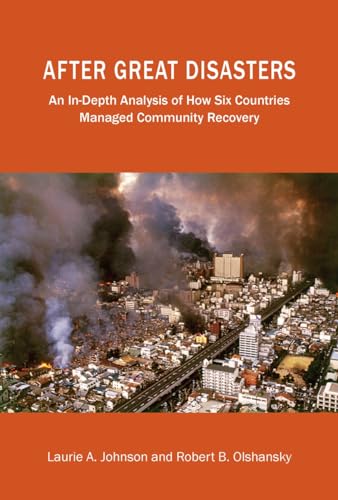

After Great Disasters : an in-depth analysis of how six countries managed community recovery. / Laurie A. Johnson and Robert B. Olshansky. txt
Editor: Cambridge, MA : Lincoln Institute of Land Policy, 2017Descripción: 380 p. ill. ; map ; plans ; 24 cmTipo de contenido:- text
- unmediaded
- volume
- 9781558443310
- 1558443312
- 23 363.34/8
- HD49 J654 2017
| Imagen de cubierta | Tipo de ítem | Biblioteca actual | Biblioteca de origen | Colección | Ubicación en estantería | Signatura topográfica | Materiales especificados | Info Vol | URL | Copia número | Estado | Notas | Fecha de vencimiento | Código de barras | Reserva de ítems | Prioridad de la cola de reserva de ejemplar | Reservas para cursos | |
|---|---|---|---|---|---|---|---|---|---|---|---|---|---|---|---|---|---|---|
| Libro | CARIBET Biblioteca Arquitectura Colección General CARIBET | General HD49 J654 2017 (Navegar estantería(Abre debajo)) | 1 | Disponible | 91000000061960 |
Descripciones mejoradas de Syndetics:
Great natural disasters are rare, but their aftermath can change the fortunes of a city or region forever. This book and its companion Policy Focus Report identify lessons from different parts of the world to help communities and government leaders better organize for recovery after future disasters. The authors consider the processes and outcomes of community recovery and reconstruction following major disasters in six countries: China, New Zealand, India, Indonesia, Japan, and the United States. If done well, reconstruction can help break the cycle of disaster-related impacts and losses, and improve the resilience of a city or region.
Includes bibliographical references and index.
Contents:
1 Introduction: evolving approaches to managing recovery from large scale disasters 1 --
2 China : top-down, fast paced reconstruction 17 --
3 New Zealand : centralizing governance and transforming cityscapes 55 --
4 Japan : national land use regulations drive recovery 107 --
5 India : state-managed recovery with NGO involvement 170 --
6 Indonesia : centrally managed, community driven approaches to reconstruction 209 --
7 United States : an evolving national level recovery policy 253 --
8 Conclusions and recommendations 313 --
References 333 --
Index 361 --
About the authors 381 --
About Lincoln Institute of land policy 383 --
"Considers community recovery and reconstruction following major natural disasters in six countries (China, New Zealand, India, Indonesia, Japan, United States). Identifies ways communities and governments can better organize for recovery after future disasters. Chapters discuss improving construction and design standards, renewing infrastructure, creating new land use arrangements, reinventing economies, and improving the resilience of cities and regions"--
Reseñas proporcionadas por Syndetics
CHOICE Review
Johnson (independent consultant) and Olshansky (Univ. of Illinois) analyze how six countries manage recovery from large disasters. The six case studies depict centralized approaches (China, New Zealand), partly decentralized management (Japan), and decentralized approaches with many organizations involved at multiple levels of government (Indian, Indonesia, US). The authors note the trade-offs among time, quality of work, and the level of public participation in recovery decisions. They summarize their own research in the six countries as well as the work of scholars across several academic disciplines. Each chapter is a narrative of the results from recovery efforts from recent major disasters. The final chapter offers conclusions and specific recommendations for improving recovery after major disasters. The scholarship is solid and the writing clear and precise. Pictures, mostly taken by the authors, illustrate the narratives. The book demonstrates that solid scholarship need not be pedantic or boring to all but specialists in a field. Administrators and everyone else involved with the recovery efforts from the 2017 Atlantic hurricanes would be wise to read this book. Summing Up: Recommended. Upper-division undergraduates through faculty. --Robert E. O'Connor, National Science FoundationNotas de autor provistas por Syndetics
Laurie A. Johnson, Ph.D., AICP, is an internationally recognized urban planner specializing in disaster recovery and catastrophe risk management. She has an extensive portfolio of disaster recovery expertise following earthquakes, landslides, floods, hurricanes, and man-made disasters across the United States and the world. In 2006, she was a lead author of the recovery plan for the City of New Orleans following Hurricane Katrina; she then co-authored the book Clear as Mud: Planning for the Rebuilding of New Orleans with Robert Olshansky.Robert B. Olshansky, Ph.D., FAICP, is professor and head of the department of Urban and Regional Planning, University of Illinois at Urbana-Champaign, where he has taught for more than 26 years. He has published extensively on post-disaster recovery planning, policy for earthquake risks, hillside planning and landslide policy, and environmental impact assessment. He co-authored Clear as Mud: Planning for the Rebuilding of New Orleans with Laurie Johnson, as well as the report Opportunity in Chaos: Rebuilding after teh 1994 Northridge and 1995 Kobe Earthquakes with Laurie Johnson and Ken Topping.