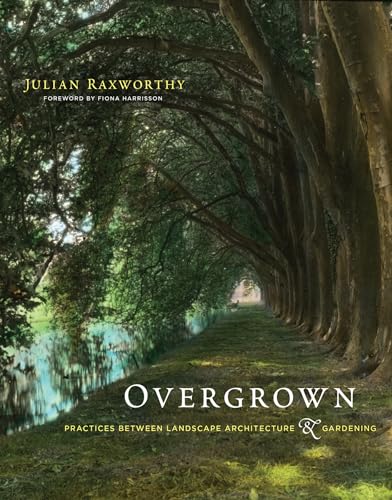

Overgrown practices between landscape architecture and gardening Julian Raxworthy, Foreword by Fiona Harrison txt
Editor: Cambridge, Massachusetts : The MIT Press, 2018Descripción: xvii, 374 pages : ill.; col. ; 24 cmTipo de contenido:- text
- unmediated
- volume
- 9780262038539
- 0262038536
- 23 712
- SB472 R37 2018
| Imagen de cubierta | Tipo de ítem | Biblioteca actual | Biblioteca de origen | Colección | Ubicación en estantería | Signatura topográfica | Materiales especificados | Info Vol | URL | Copia número | Estado | Notas | Fecha de vencimiento | Código de barras | Reserva de ítems | Prioridad de la cola de reserva de ejemplar | Reservas para cursos | |
|---|---|---|---|---|---|---|---|---|---|---|---|---|---|---|---|---|---|---|
| Libro | CARIBET Biblioteca Arquitectura Colección General CARIBET | General SB472 R37 2018 (Navegar estantería(Abre debajo)) | 1 | Disponible | 91000000061028 |
Descripciones mejoradas de Syndetics:
A call for landscape architects to leave the office and return to the garden. Addressing one of the most repressed subjects in landscape architecture, this book could only have been written by someone who is both an experienced gardener and a landscape architect. With Overgrown , Julian Raxworthy offers a watershed work in the tradition of Ian McHarg, Anne Whiston Spirn, Kevin Lynch, and J. B. Jackson.
As a discipline, landscape architecture has distanced itself from gardening, and landscape architects take pains to distinguish themselves from gardeners or landscapers. Landscape architects tend to imagine gardens from the office, representing plants with drawings or other simulations, whereas gardeners work in the dirt, in real time, planting, pruning, and maintaining. In Overgrown , Raxworthy calls for the integration of landscape architecture and gardening. Each has something to offer the other- Landscape architecture can design beautiful spaces, and gardening can enhance and deepen the beauty of garden environments over time. Growth, says Raxworthy, is the medium of garden development; landscape architects should leave the office and go into the garden in order to know growth in an organic, nonsimulated way.
Raxworthy proposes a new practice for working with plant material that he terms "the viridic" (after "the tectonic" in architecture), from the Latin word for green, with its associations of spring and growth. He builds his argument for the viridic through six generously illustrated case studies of gardens that range from "formal" to "informal" approaches-from a sixteenth-century French Renaissance water garden to a Scottish poet-scientist's "marginal" garden, barely differentiated from nature. Raxworthy argues that landscape architectural practice itself needs to be "gardened," brought back into the field. He offers a "Manifesto for the Viridic" that casts designers and plants as vegetal partners in a renewed practice of landscape gardening.
Includes bibliographical references (pages 335-264) and index.
Introduction -- The persistence of a line -- Architecture with plants -- Changing rooms -- A moving work of art -- Marginalia -- Wait and see -- Conclusion: a manifesto for the viridic.