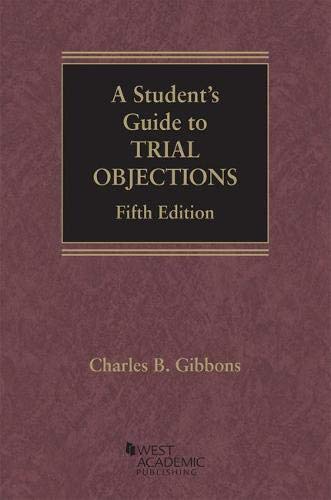

A student's guide to trial objections / Charles B. Gibbons, Buchanan Ingersoll & Rooney, Pittsburgh, Pennsylvania.
Editor: St. Paul, MN : West Academic Publishing, 2018Edición: Fifth editionDescripción: xiv, 661 pages ; 23 cmTipo de contenido:- text
- unmediated
- volume
- 9781642422863
- 164242286X
- 347.73/062 23
- KF 8935 .Z9 G46 2018
| Imagen de cubierta | Tipo de ítem | Biblioteca actual | Biblioteca de origen | Colección | Ubicación en estantería | Signatura topográfica | Materiales especificados | Info Vol | URL | Copia número | Estado | Notas | Fecha de vencimiento | Código de barras | Reserva de ítems | Prioridad de la cola de reserva de ejemplar | Reservas para cursos | |
|---|---|---|---|---|---|---|---|---|---|---|---|---|---|---|---|---|---|---|
| Libro | Biblioteca de Derecho Mons. Fremiot Torres Oliver Colección General biblioteca derecho | KF 8935 .Z9 G46 2018 (Navegar estantería(Abre debajo)) | Disponible | 70000000904784 |
Descripciones mejoradas de Syndetics:
This guide is a quick reference to various ways in which the courts have translated the text of the Federal Rules of Evidence. It is useful for students enrolled in trial practice courses and clinics and is also helpful as an adjunct reference for students taking basic and advanced evidence courses. The 2018 edition includes dozens of recent civil and criminal cases from all of the federal circuits and includes the recent amendments to the Federal Rules of Evidence with respect to Ancient Documents and Self-Authenticating Evidence effective December 1, 2017.
Includes bibliographical references.
Argumentative -- Asked and answered -- Assuming facts not in evidence -- Authentication of physical evidence -- Authentication : voice-telephone conversations, tape recordings -- Best evidence rule -- Beyond the scope -- Chain of custody -- Character witness : hypothetical question assuming guilt -- Closing argument -- Compound question -- Continuing objection -- Crimes, wrongs or other acts -- Cumulative -- Curative instructions -- Discovery rules : failure to comply (civil cases) -- Discovery rules : failure to comply (criminal cases) -- Evidence excluded by statute : Classified Information Procedures Act -- Evidence excluded by statute : Federal Highway Safety Act -- Evidence excluded by statute : federally authorized tax practitioners -- Evidence excluded by statute : National Transportation Safety Board ("NTSB") Reports -- Expert witness : assessing credibility prohibited -- Expert witness : competence to testify -- Expert witness : legal opinion -- Expert witness : requisite degree of certainty -- Expert witness : testimony based in part on hearsay -- conduit witness -- Expert witness : ultimate issue -- Habit/routine practice -- Hearsay : author's note confrontation -- criminal cases -- Hearsay : generally -- Hearsay : multiple hearsay -- Hearsay exemption : admission -- party's own statement -- Hearsay exemption : adoptive admission -- Hearsay exemption : admission by agent -- Hearsay exemption : admission by co-conspirator -- Hearsay exemption : admission -- persons authorized to speak -- Hearsay exemption : ancient documents -- Hearsay exemption : business records -- Hearsay exemption : dying declaration -- Hearsay exemption : excited utterance -- Hearsay exemption : forfeiture by wrongdoing -- Hearsay exemption : former testimony -- Hearsay exemption : learned treatise -- Hearsay exemption : market reports, commercial publications -- Hearsay exemption : personal or family history -- Hearsay exemption : present sense impression -- Hearsay exemption : prior consistent statement -- Hearsay exemption : public records and reports -- Hearsay exemption : recorded recollection -- Hearsay exemption : reputation concerning boundaries or general history -- Hearsay exemption : residual ("catchall") exception -- Hearsay exemption : statement against interest -- Hearsay exemption : statements for purposes of medical diagnosis or treatment -- Hearsay exemption : statements in documents affecting an interest in property -- Hearsay exemption : then existing mental, emotional condition (state of mind) -- Hearsay exemption : then existing physical condition -- Impeachment : bias, interest, motive -- Impeachment : credibility -- specific conduct -- Impeachment : prior convictions -- Insurance -- Judge's questions -- Judgement as a matter of law -- motion -- Judicial admissions -- Judicial notice -- Juror questioning -- Jury instructions -- Lay witness opinion -- Leading question -- Legal conclusion -- Limiting (cautionary) instructions -- Mistrial -- motion -- Models, maps, charts and other visual aids -- Motion to strike -- Narrative answer -- Non-responsive answer -- Offer of proof -- Opening the door : curative admissibility -- Opening statement -- Other sexual behavior -- Parole evidence rule -- Personal knowledge -- Photographs -- Polling the jury -- Polygraph -- Pretrial experiments -- Prior inconsistent statements -- Privilege : attorney-client -- Privilege : clergy -- Privilege : confidential informer -- Privilege : deliberative process -- Privilege : husband and wife -- Privilege : journalist -- Privilege : military and state secrets privilege -- Privilege : psychotherapist-patient -- Privilege : self-incrimination -- Refreshing present recollection -- Relevance -- Religious belief -- Reopening the case -- motion -- Repetition -- Rule of completeness (remainder of or related writings or recorded statements) -- Sequester witnesses -- motion -- Sequestration : violence of order -- Settlement : offers to compromise -- Speculation -- Subsequent remedial measures -- Summaries -- Unfair prejudice -- Vague and ambiguous question -- Voir dire of witness (as to admissibility of testimony or demonstrative evidence) -- Vouching.
"This guide is a quick reference to various ways in which the courts have translated the text of the Federal Rules of Evidence. It is useful for students enrolled in trial practice courses and clinics and is also helpful as an adjunct reference for students taking basic and advanced evidence courses. The 2018 edition includes dozens of recent civil and criminal cases from all of the federal circuits and includes the recent amendments to the Federal Rules of Evidence with respect to ancient documents and self-authenticating evidence effective December 1, 2017."--