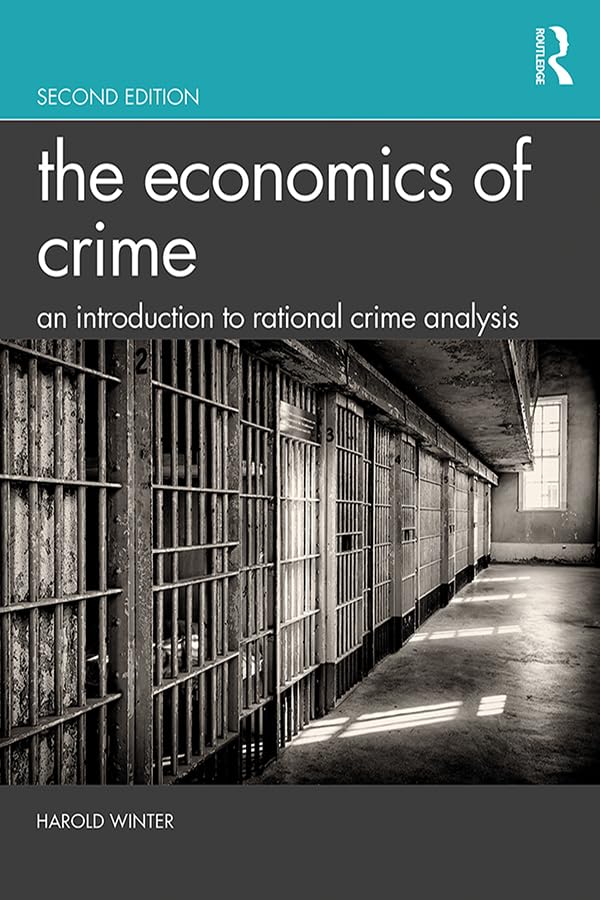

The economics of crime : an introduction to rational crime analysis / Harold Winter.
Editor: Abingdon, Oxon ; New York, NY : Routledge, ©2020Edición: Second editionDescripción: 136 pages ; 25 cmTipo de contenido:- text
- unmediated
- volume
- 9781138607521
- 9781138607538
- 364.2 23
- HV6030 .W56 2020
| Imagen de cubierta | Tipo de ítem | Biblioteca actual | Biblioteca de origen | Colección | Ubicación en estantería | Signatura topográfica | Materiales especificados | Info Vol | URL | Copia número | Estado | Notas | Fecha de vencimiento | Código de barras | Reserva de ítems | Prioridad de la cola de reserva de ejemplar | Reservas para cursos | |
|---|---|---|---|---|---|---|---|---|---|---|---|---|---|---|---|---|---|---|
| Libro | Biblioteca Encarnación Valdés Colección General bev | 364.2 W784e2 (Navegar estantería(Abre debajo)) | Disponible | 80000002638057 |
Descripciones mejoradas de Syndetics:
The Economics of Crimepresents a review of economic scholarly research in the ever-growing field of crime and punishment. Without using graphs or mathematical equations, Winter combines theory and empirical evidence relating to public policy concerns over a wide range of controversial topics such as the death penalty, racial bias in the criminal justice system, gun control, the war on drugs, fines versus imprisonment, policing tactics, and shaming punishments.
In addition to offering an updated and expanded coverage of these, and other topics, this second edition is more international in scope, with the inclusion of studies that use data from Italy, Australia, the U.K., Singapore, Brazil, and others. Also included is a brand-new chapter on the application of behavioral economics to crime and punishment, providing readers with a succinct introduction to this modern and increasingly important approach to economic issues.
By requiring no previous knowledge of economics, this book continues to be the perfect choice for students new to the study of economics and public policy, whether it is in the discipline of economics, political science, criminology, law, or any other field that is concerned with issues in crime and punishment. Furthermore, due to its accessibility, The Economics of Crimecan be enjoyed by anyone who follows current public policy debate over some of society's most contentious issues.
Includes bibliographical references and index.
"The Economics of Crime presents a review of economic scholarly research in the ever-growing field of crime and punishment. Without using graphs or mathematical equations, Winter combines theory and empirical evidence relating to public policy concerns over a wide range of controversial topics such as the death penalty, racial bias in the criminal justice system, gun control, the war on drugs, fines vs. imprisonment, policing tactics and shaming punishments. In addition to offering an updated and expanded coverage of these, and other, topics, this edition is more international in scope, with the inclusion of studies that use data from Italy, Australia, the U.K., Singapore, Brazil, and others. Also included is a brand new chapter on the application of behavioral economics to crime and punishment, providing readers with a succinct introduction to this modern and increasingly important approach to economic issues. By requiring no previous knowledge of economics, this book continues to be the perfect choice for students new to the study of economics and public policy, whether it is in the discipline of economics, political science, criminology, law, or any other field that is concerned with issues in crime and punishment. Furthermore, due to its accessibility, The Economics of Crime can be enjoyed by anyone who follows current public policy debate over some of society's most contentious issues"-- Provided by publisher.
Notas de autor provistas por Syndetics
Harold Winteris Professor of Economics at Ohio University. His previous books include The Economics of Excess: Addiction, Indulgence, and Social Policy (2011), Trade-Offs: An Introduction to Economic Reasoning and Social Issues (2013), and Issues in Law and Economics (2017).