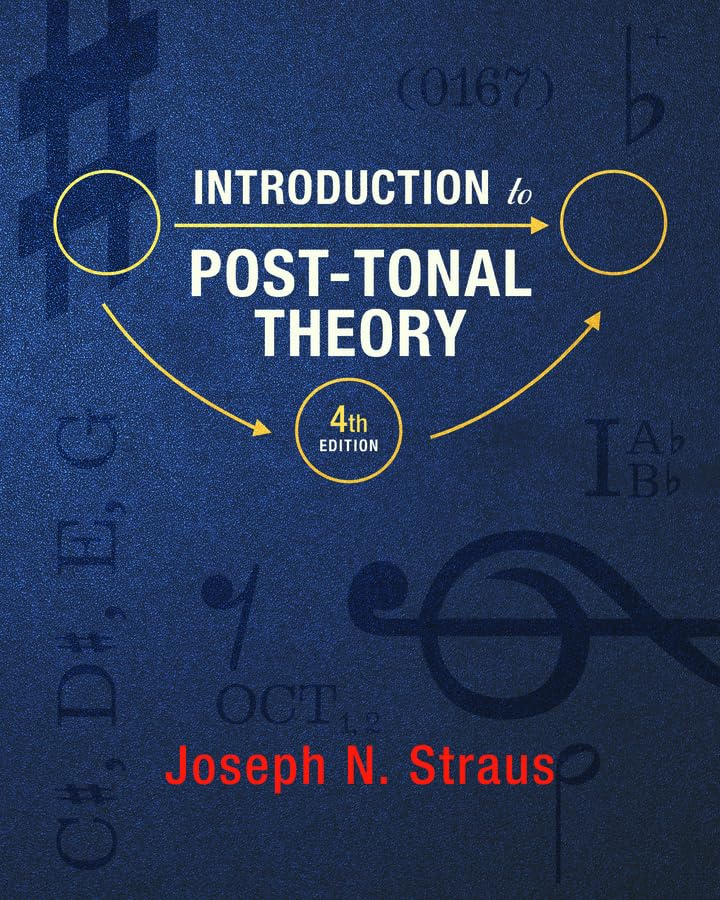
Imagen de portada de Amazon
Imagen de Amazon.com
Imagen de cubierta Syndetics
Portada de Syndetics
Imagen de OpenLibrary

Introduction to post-tonal theory / Joseph N. Straus.

Por: Editor: New York : W.W. Norton & Company, ©2016Edición: Fourth editionDescripción: xiv, 396 pages : illustrations, music ; 26 cmTipo de contenido:
  • text
Tipo de medio:
  • unmediated
Tipo de soporte:
  • volume
ISBN:
  • 9780393938838
Tema(s): Clasificación CDD:
  • 781.267
Clasificación LoC:
  • MT40 .S96 2016
Contenidos:
Basic concepts of pitch and interval -- Pitch-class sets -- Some additional properties and relationships -- Motive, voice leading, and harmony -- Centricity and referential pitch collections -- Basic concepts of twelve-tone music -- List of set classes.
Valoración
    Valoración media: 0.0 (0 votos)
Existencias
Imagen de cubierta Tipo de ítem Biblioteca actual Biblioteca de origen Colección Ubicación en estantería Signatura topográfica Materiales especificados Info Vol URL Copia número Estado Notas Fecha de vencimiento Código de barras Reserva de ítems Prioridad de la cola de reserva de ejemplar Reservas para cursos
Libro Biblioteca Encarnación Valdés Sala de Música S.M. 781.267 S9123i4 (Navegar estantería(Abre debajo)) Disponible 80000002635335
Total de reservas: 0

Descripciones mejoradas de Syndetics:

Now published by Norton, Introduction to Post-Tonal Theory has been thoroughly updated to reflect the latest developments in the field, with additional coverage of transformational theory and voice leading. The Fourth Edition helps students identify key theoretical points and guides them through the process of analysis, while also offering new recently composed musical examples-all at an exceptional value.

Includes bibliographical references (pages 376-377) and index.

Basic concepts of pitch and interval -- Pitch-class sets -- Some additional properties and relationships -- Motive, voice leading, and harmony -- Centricity and referential pitch collections -- Basic concepts of twelve-tone music -- List of set classes.

Extracto provisto por Syndetics

Compared to tonal theory, now in its fourth century of development, post-tonal theory is in its infancy. But in the past three decades, it has shown itself to be an infant of prodigious growth and surprising power. A broad consensus has emerged among music theorists regarding the basic musical elements of post-tonal music--pitch, interval, motive, harmony, collection--and this book reports that consensus to a general audience of musicians and students of music. Like books on scales, triads, and simple harmonic progressions in tonal music, this book introduces basic theoretical concepts for the post-tonal music of the twentieth and twenty-first centuries. Beyond basic concepts, the third edition of this book also contains information on many of the most recent developments in post-tonal theory, including expanded or new coverage of the following topics: Transformational networks and graphs Contour theory Composing-out Atonal voice leading Atonal pitch space Triadic post-tonality (including voice-leading parsimony) Inversional symmetry and inversional axes Interval cycles Diatonic, whole-tone, octatonic, and hexatonic collections As a result, this book is not only a primer of basic concepts but also an introduction to the current state of post-tonal theory, with its rich array of theoretical concepts and analytical tools. Although this book can make no pretense to comprehensiveness either, either chronologically or theoretically--there is just too much great music and fascinating theory out there--this third edition explores a much wider range of composers and musical styles than its predecessors. Although the "classical" prewar repertoire of music by Schoenberg, Stravinsky, Bart6k, Webern, and Berg still comprises the musical core, theoretical concepts are now also illustrated with music by Adams, Babbitt, Berio, Boulez, Britten, Cage, Carter, Cowell, Crawford, Crumb, Debussy, Feldman, Glass, Gubaidulina, Ives, Ligeti, Messiaen, Musgrave, Reich, Ruggles, Sessions, Shostakovich, Stockhausen, Varese, Wolpe, Wuorinen, and Zwilich. As with the previous editions of this book, I received invaluable advice from many friends and colleagues based on their teaching experience. I am grateful to Wayne Alpern, Jonathan Bernard, Claire Boge, Ricardo Bordini, Scott Brickman, Michael Buckler, Uri Burstein, James Carr, Patrick Fairfield, Michael Friedmann, Edward Gollin, Dave Headlam, Gary Karpinski, Rosemary Killam, Bruce Quaglia, Daniel Mathers, Carolyn Mullin, Catherine Nolan, Jay Rahn, Nancy Rogers, Steven Rosenhaus, Art Samplaski, Paul Sheehan, Stephen Slottow, David Smyth, Harvey Stokes, Dmitri Tymoczko, and Joyce Yip. My thanks go also to Chris Johnson and Laura Lawrie at Prentice Hall for their expert editorial work at every stage. Michael Berry provided additional editorial assistance. Closer to home, in matters both tangible and intangible, Sally Goldfarb has offered continuing guidance and support beyond my ability to describe or repay. Adam and Michael helped, too. Joseph N. Straus Graduate Center City University of New York Excerpted from Introduction to Post-Tonal Theory by Joseph Nathan Straus All rights reserved by the original copyright owners. Excerpts are provided for display purposes only and may not be reproduced, reprinted or distributed without the written permission of the publisher.
Compartir
logopucpr-y-vive

Contáctanos

¡Queremos saber de ti!

Tel. 787.841.2000 Ext. 1801

bibliotecavaldes@pucpr.edu

⁣Búscanos en las redes

© 2026 Desarrollado por Ignite Online • All Rights Reserved • Powered by Koha.